
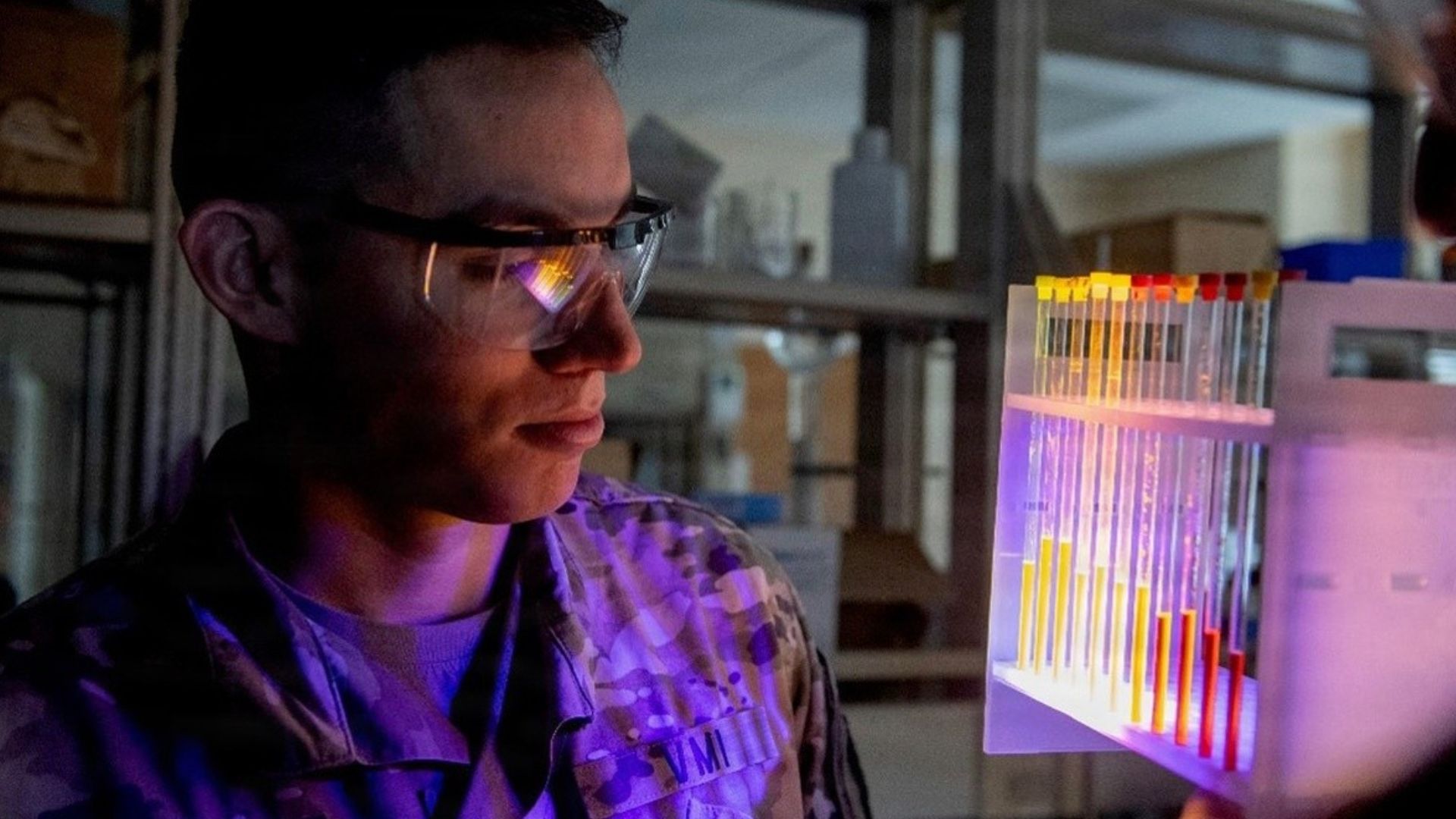
U.S. Army scientists are developing a new class of light-absorbing and light-emitting materials that could eventually support technologies ranging from highly sensitive chemical sensors to systems for producing fuel on-site. The research brings together scientists from the U.S. Army Combat Capabilities Development Command’s Army Research Laboratory, or ARL, the Virginia Military Institute and the U.S. Military Academy at West Point. Published in the American Chemical Society journal Inorganic Chemistry, the research focuses on iridium-based chromophores, materials whose ability to absorb and emit light can be engineered for specific applications. According to the Army Research Laboratory, the technology could eventually contribute to on-site fuel generation or provide early warning of chemical warfare agents. Designing molecules before making them Developing new materials has traditionally involved significant trial and error, with researchers synthesizing compounds and then testing their properties in the laboratory. The ARL-led team took a more predictive approach. Researchers combined computational modeling with precision synthetic chemistry to estimate how a molecule would behave before producing it. The strategy uses Hammett parameters to systematically tune the optical properties of iridium complexes through a process called orbital decoupling. This allowed the researchers to manipulate the materials’ light-absorbing and light-emitting behavior more predictably. “Our design strategy demonstrated that we could predictably engineer optical behavior,” ARL scientist Dr. Thomas Rohrabaugh said in the Army’s announcement. According to Rohrabaugh, the approach could offer a more systematic alternative to traditional trial-and-error methods and could potentially be applied across different classes of materials. Potential applications from sensors to solar fuels Chromophores are fundamental components in a wide range of technologies because of their interaction with light. The Army said advanced versions could have applications ranging from OLED displays and solar fuels to highly sensitive chemical sensors. For defense, one potential application could be detecting the presence of chemical warfare agents. Materials engineered to respond predictably to light could potentially form part of highly sensitive sensing technologies designed to provide earlier warning of hazardous substances. Another area highlighted by the Army is fuel generation. Rohrabaugh said the materials could play a role in technologies designed to generate fuel at the point of use, potentially reducing logistical demands in certain operational environments. The research itself remains focused on advancing the underlying science of transition-metal photophysics and the ability to design materials with specific optical behavior. From fellowship program to defense research network The project also grew out of a long-term collaboration between ARL, VMI, and West Point. The partnership was supported through the Military College Faculty Fellowship Research Program and the Davies Postdoctoral Research Fellowship program. VMI researchers contributed expertise in synthetic and computational chemistry, while ARL provided advanced photophysical analysis capabilities. The collaboration also involved ARL postdoctoral researcher Dr. Ryan Gaynor, who divided his time between teaching cadets at West Point and conducting materials analysis connected to the Army’s research. According to ARL, the partnership has since helped expand research capabilities at VMI, including the acquisition of a transient absorption spectrometer for advanced optical characterization. The Army now sees the collaboration as part of a broader defense research network involving institutions including the U.S. Air Force Academy, Air Force Research Laboratory and the U.S. Army Corps of Engineers’ Engineer Research and Development Center. While the immediate breakthrough is not a finished sensor or fuel-production system, It is a new methodology for designing materials whose interaction with light can be more precisely predicted and controlled. That could eventually give defense researchers a faster route to developing advanced materials for sensing, energy, and other next-generation technologies. Get the latest in engineering, tech, space & science - delivered daily to your inbox.Kaif Shaikh is a journalist and writer passionate about turning complex information into clear, impactful stories. His writing covers technology, sustainability, geopolitics, and occasionally fiction. A graduate in Journalism and Mass Communication, his work has appeared in the Times of India and beyond. After a near-fatal experience, Kaif began seeing both stories and silences differently. Outside work, he juggles far too many projects and passions, but always makes time to read, reflect, and hold onto the thread of wonder.
US Army turns to predictive chemistry for next-gen light absorbing materials
Full Article
Original Source
Read the full article at Interestingengineering →KhanList aggregates and links to publicly available news content. We do not host full articles from third-party sources. Always verify important information with original sources.