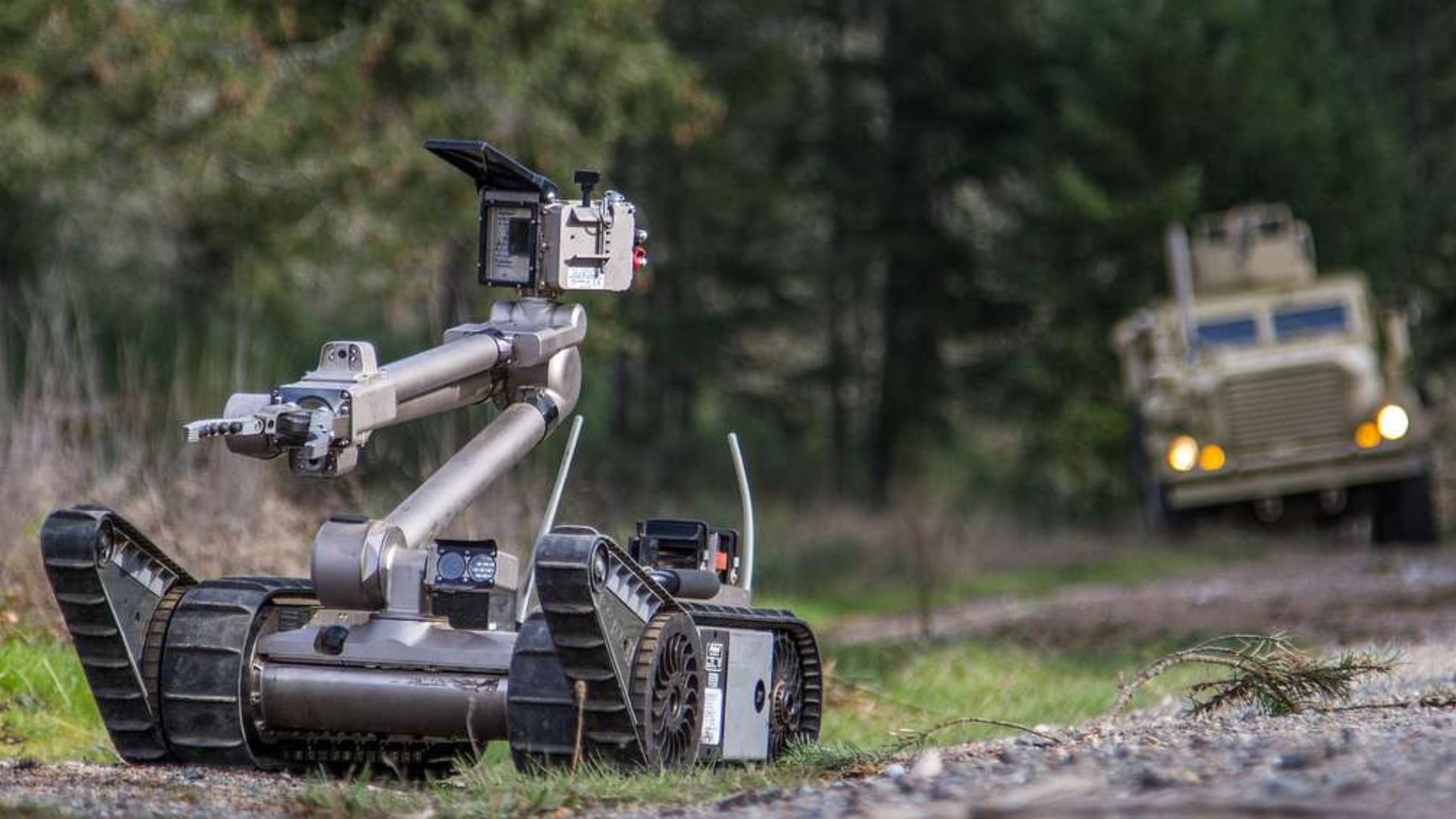
The U.S. Army is moving to put autonomous ground vehicles into one of the most dangerous parts of the battlefield, selecting six companies to develop production-ready prototypes for missions that currently require soldiers to drive into exposed areas. The Infantry Last Tactical Mile (ILTM) initiative focuses on the stretch between rear support areas and the forward line of own troops (FLOT), where getting ammunition, equipment and supplies forward, or bringing casualties back, can expose personnel to enemy fire. The six selected companies are Maren-Go, Overland AI, Forterra, Hendrick’s Motorsports, American Rheinmetall and HDT. Each is expected to provide four prototype vehicles for Army testing, according to Breaking Defense, citing an Army spokesperson. Rather than simply building another remotely controlled vehicle, the Army wants systems capable of beyond-line-of-sight autonomous operation. The vehicles are intended to conduct logistical resupply, casualty evacuation and network-extension missions, potentially allowing troops to perform critical battlefield tasks without putting additional drivers or medics directly in harm’s way. The “last tactical mile” The concept borrows from a familiar logistics problem. Moving supplies from a large rear-area distribution point to a forward unit can be relatively straightforward until the final few miles. Those roads and trails are often where vehicles become vulnerable to artillery, drones, mines, and small arms fire. That makes the ILTM concept less about replacing conventional trucks and more about removing humans from particularly hazardous portions of the supply chain. The Army says the selected systems will need to support manned close-combat formations while operating autonomously beyond the operator’s direct line of sight. The approach also reflects a quickly occurring shift in military robotics. Autonomy is increasingly being treated as a means of changing how existing vehicles are used rather than simply as a new type of weapon. Six companies, different approaches The Army has not publicly disclosed the vehicles that all six companies will submit, but some candidates are already known. According to Breaking Defense, American Rheinmetall is expected to provide its Mission Master SP-H, an unmanned tracked vehicle designed for autonomous logistics and other missions. Overland AI will provide its ULTRA platform, an autonomous off-road vehicle derived from Polaris’ RZR platform and equipped with Overland’s autonomy technology. Forterra has previously unveiled MESA, a logistics and casualty-evacuation vehicle based on the Polaris Ranger XD 1500. It combines Forterra’s AutoDrive autonomous driving system with its Vektor communications technology, which is designed to operate in low-bandwidth environments. The other three participants, Maren-Go, Hendrick’s Motorsports and HDT, have not publicly disclosed their intended ILTM vehicles. The variety is significant. Instead of committing immediately to a single vehicle architecture, the Army is effectively subjecting multiple approaches to the same test regime and allowing battlefield performance to determine which ones deserve further investment. From prototypes to soldiers The selections are not yet a production order for an autonomous Army fleet. The companies are expected to receive formal prototype agreements in the coming weeks, followed by technical demonstrations and evaluations. Each vendor is expected to deliver four vehicles, after which the Army will assess how the systems perform under operationally relevant conditions. The decisive stage is planned for early 2027, when an Army unit will conduct an Operational Assessment. Feedback from soldiers will then help determine which platforms should move toward production. That testing will be particularly important because autonomy in a controlled demonstration is very different from autonomy in a battlefield environment. A useful system must navigate difficult terrain, maintain communications, operate when satellite or other links are disrupted, and respond appropriately when its route or mission changes. The Army’s objective is therefore not simply to create a vehicle that can drive itself. It is looking for a system that can keep logistics moving and evacuate casualties when sending a human crew into the same area would be unnecessarily dangerous. If the ILTM program succeeds, autonomous ground vehicles could become another layer of the Army’s battlefield logistics network, taking on some of the most exposed jobs while allowing soldiers to concentrate on the missions that still require human judgment. Get the latest in engineering, tech, space & science - delivered daily to your inbox.Kaif Shaikh is a journalist and writer passionate about turning complex information into clear, impactful stories. His writing covers technology, sustainability, geopolitics, and occasionally fiction. A graduate in Journalism and Mass Communication, his work has appeared in the Times of India and beyond. After a near-fatal experience, Kaif began seeing both stories and silences differently. Outside work, he juggles far too many projects and passions, but always makes time to read, reflect, and hold onto the thread of wonder.
U.S. Army tests six autonomous UGVs for frontline resupply and casualty evacuation
Full Article
Original Source
Read the full article at Interestingengineering →KhanList aggregates and links to publicly available news content. We do not host full articles from third-party sources. Always verify important information with original sources.