
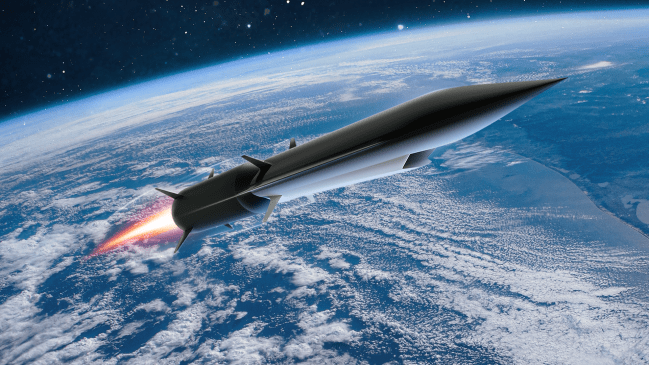
US aircraft engine supplier GE Aerospace has received a new contract from the Defense Innovation Unit (DIU) to advance development of a liquid-fueled hypersonic test platform under the Hypersonic and High-Cadence Airborne Testing Capabilities, or HyCAT, program. The project is aimed at making hypersonic flight testing faster and more repeatable, addressing one of the major bottlenecks in the development of weapons and other systems designed to operate at speeds above Mach 5. The GE Aerospace platform is intended as a test bed that can carry out flight demonstrations and generate data for future hypersonic systems. The latest contract builds on work that began in 2023, when GE Aerospace received initial funding for concept development and assembled the team that would work on the platform. Combined booster and cruiser Under the new phase, GE Aerospace will design and develop a combined booster and cruiser configuration. The two components will work together as an all-up-round, or AUR, test bed capable of supporting hypersonic flight testing. The architecture is intended to provide a flexible platform for testing hypersonic technologies without requiring every new system to be developed alongside a dedicated flight-test vehicle. This could help reduce the time and cost associated with collecting real-world data during development. The company describes the effort as part of a broader push to increase the pace of hypersonic testing. Steve Russell, vice president and general manager of Edison Works at GE Aerospace, said accelerating this type of testing is important for developing next-gen capabilities. The emphasis on a test platform is significant because hypersonic systems present particularly difficult testing requirements. Engineers need flight data on propulsion, aerodynamics, thermal management, guidance and other subsystems under conditions that are difficult to reproduce on the ground. From concept development to flight qualification The US company and its partners have already passed several development milestones since the program started. Initial concept development took place in 2023, followed by subsystem refinement and evaluation in 2024. In 2025, the project reached preliminary design review for the all-up-round configuration. The 2026 phase moves the program toward full integration of the AUR. It will also include the first qualification and component-level testing of key subsystems, providing an important transition from design work toward hardware validation. The approach fits the US military’s broader effort to increase the availability of hypersonic flight-test infrastructure. Programs such as HyCAT are intended to provide more frequent opportunities to test technologies in realistic flight conditions, potentially allowing developers to identify problems earlier and iterate more quickly.For GE Aerospace, the project also builds on its existing work in advanced propulsion and defense technologies. The company has an installed base of roughly 50,000 commercial and 30,000 military aircraft engines, although the HyCAT effort is focused specifically on developing a dedicated hypersonic testing capability.Get the latest in engineering, tech, space & science - delivered daily to your inbox.Bojan Stojkovski is a freelance journalist based in Skopje, North Macedonia, covering foreign policy and technology for more than a decade. His work has appeared in Foreign Policy, ZDNet, and Nature.
US aircraft engine supplier to build next-gen test bed for hypersonic systems
Full Article
Original Source
Read the full article at Interestingengineering →KhanList aggregates and links to publicly available news content. We do not host full articles from third-party sources. Always verify important information with original sources.