
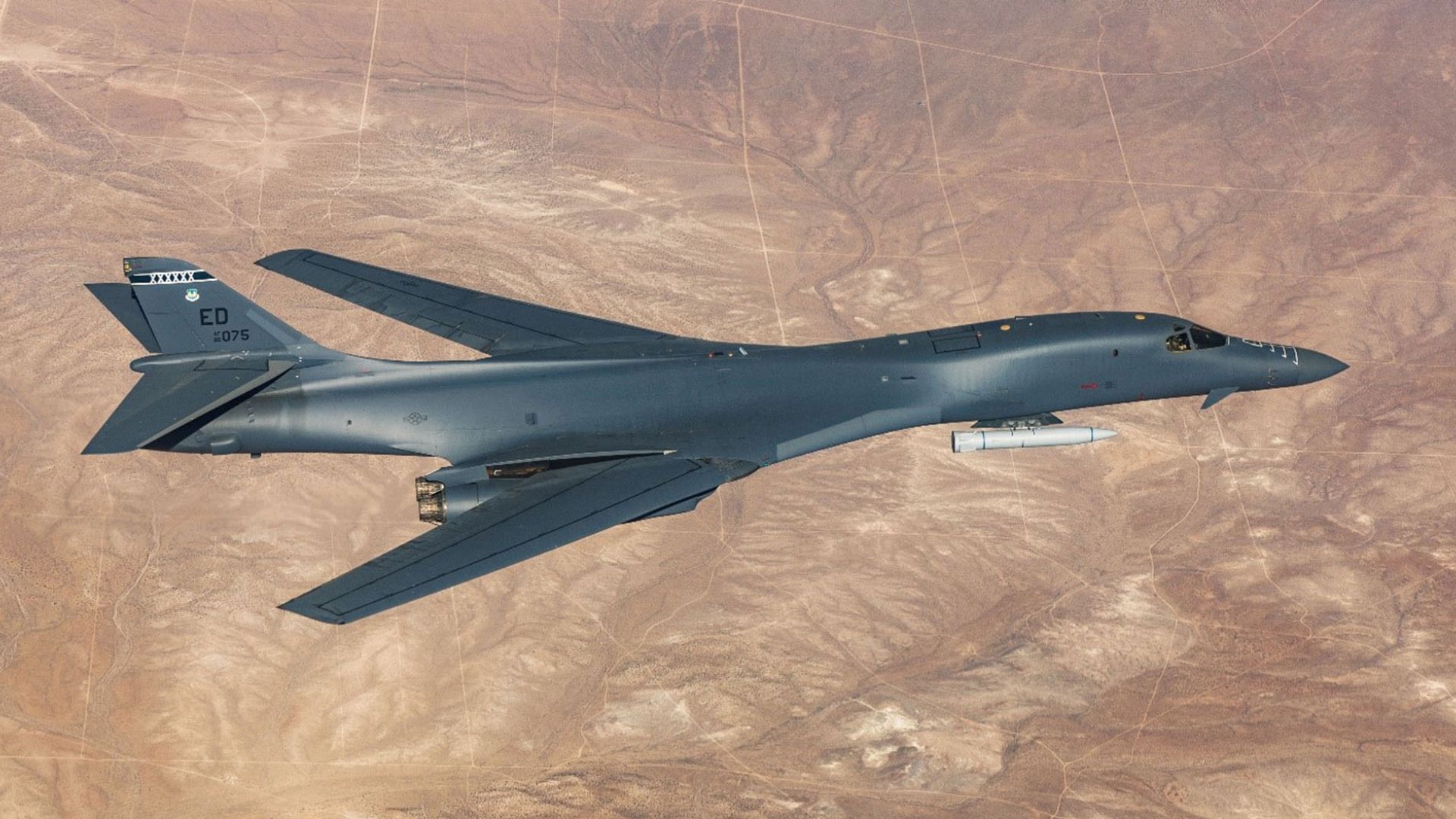
Key TakeawaysBoeing’s Load Adaptable Modular (LAM) pylon for the B-1B Lancer passed its critical design review on November 17, 2026, clearing the hardware and software for manufacturing and testing.The modular pylon bolts onto six dormant Cold War fuselage hardpoints, enabling the bomber to carry oversized hypersonic missiles and potentially double its overall payload capacity.Expanding external carriage allows the Air Force to use the B-1B as a hypersonic testbed and strike platform until the B-21 Raider fleet reaches full strength in the late 2030s. Boeing’s Load Adaptable Modular (LAM) external weapons pylon for the U.S. Air Force’s B-1B Lancer strategic bomber has cleared its critical design review, marking a key engineering milestone that moves the system from blueprint to hardware manufacturing and flight testing. The upgrade is designed to restore the heavy bomber’s external carriage capability, allowing it to haul oversized hypersonic missiles and significantly expand its conventional munitions load. While the B-1B already carries the largest internal payload of any bomber in the U.S. Air Force inventory, up to 75,000 pounds (34,019 kilograms) distributed across three internal weapons bays, those enclosed bays restrict the length and diameter of next-generation standoff weapons. By mounting new pylons beneath the fuselage, the Air Force aims to unlock extra carrying capacity without redesigning the bomber’s airframe. Repurposing dormant Cold War hardpoints In a Boeing announcement on November 17, 2026, following the completion of the May 2026 preliminary design review, the critical design review confirmed that the LAM pylon’s engineering architecture is complete and established a formal product baseline with the Air Force’s B-1 program office. “We are starting a new chapter in this journey,” said Lynsay Brannock, Boeing’s B-1 program manager. “This is the moment when we shift from designing the solution to preparing to produce and test it.” Rather than cutting into the bomber’s structure to install new mounting points, Boeing’s Oklahoma City engineering team, led by engineer Tristin Lam, after whom the pylon is named, designed the hardware to bolt onto six existing external hardpoints beneath the fuselage. Those attachment points were originally engineered during the Cold War to carry nuclear Air-Launched Cruise Missiles before being deactivated to comply with strategic arms-control treaties. By reactivating all six stations with modular pylons, the B-1B gains flexible external carriage tailored to different mission profiles. Boeing estimates the upgrade could effectively double the bomber’s total payload capacity, while earlier Air Force demonstrations at Edwards Air Force Base have tested the pylon concept with both conventional precision bombs and oversized hypersonic weapon shapes. Bridging the gap to the B-21 Raider For the U.S. Air Force, the LAM pylon serves two immediate operational purposes: expanding long-range strike volume and relieving pressure on its aging B-52 Stratofortress test fleet. Because several B-52 aircraft are tied up in long-term radar and engine modernization programs, the service has increasingly turned to the B-1B as an airborne testbed and future operational carrier for air-breathing and boost-glide hypersonic missiles that cannot fit inside internal bomb bays. With roughly 45 B-1B Lancers remaining in active service across Dyess Air Force Base in Texas and Ellsworth Air Force Base in South Dakota, the Air Force plans to keep the supersonic-capable bomber flying until at least 2037 as Northrop Grumman’s stealthy B-21 Raider gradually enters service. By giving commanders a modular way to hang heavy standoff munitions externally, Boeing and the Air Force aim to keep the Cold War-era bomber relevant in high-end contested airspace into the late 2030s and beyond.Get the latest in engineering, tech, space & science - delivered daily to your inbox.Kaif Shaikh is a journalist and writer passionate about turning complex information into clear, impactful stories. His writing covers technology, sustainability, geopolitics, and occasionally fiction. A graduate in Journalism and Mass Communication, his work has appeared in the Times of India and beyond. After a near-fatal experience, Kaif began seeing both stories and silences differently. Outside work, he juggles far too many projects and passions, but always makes time to read, reflect, and hold onto the thread of wonder.
US Air Force to turn Cold War B-1B bombers into a hypersonic missile carrier with Boeing
Full Article
Original Source
Read the full article at Interestingengineering →KhanList aggregates and links to publicly available news content. We do not host full articles from third-party sources. Always verify important information with original sources.