
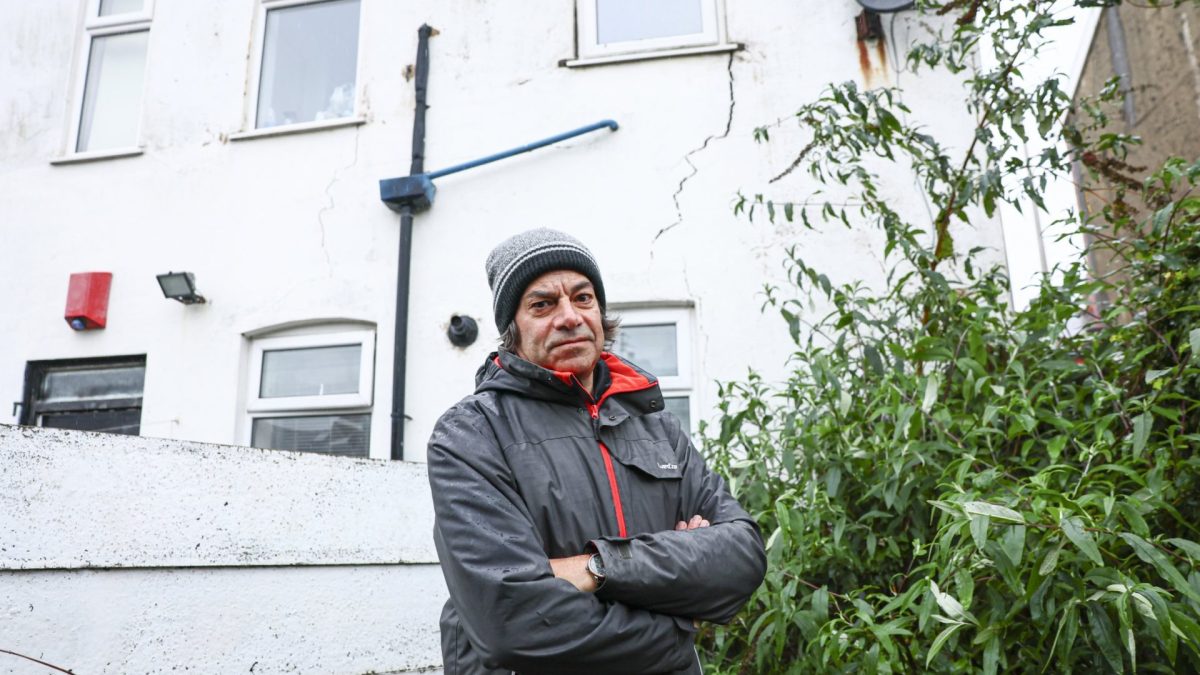
When Chris Goldhawk received a call from his tenant telling him a crack had appeared in the wall of his one-bedroom flat in Blackpool, he wasn’t particularly worried. He had owned the property since 2007 and had never encountered any problems with it. Now, 19 months later, he is frightened about what the growing fissure means for the property, and whether he can afford to fix it. The crack, which he says is around 3mm wide, has been attributed to suspected structural movement, in other words subsidence, which occurs when the ground beneath a building’s foundations moves downwards, potentially causing damage. Subsidence commonly appears in periods of dry weather when clay soil loses moisture and shrinks but sometimes it can be caused by leaking drains or nearby tree-roots. Fixing the cause can be as simple as removing trees, but in more severe cases, underpinning – strengthening or deepening – a house’s foundations is required, and that can cost tens of thousands of pounds and takes months. Shorts Not surprisingly, this summer’s record temperatures have only made the damage to Goldhawk’s flat worse. But he is not alone; thousands of other homeowners across the UK are totting up the damage to their houses. According to the Association of British Insurers (ABI), domestic subsidence-related insurance payouts reached a record high in 2025, rising by 10 per cent since 2024, which The British Geological Survey (BGS) linked to hotter, drier weather and shrinking clay soils, potentially placing more properties at risk. BGS projects that under a medium-emissions scenario, more than 1.8 million British properties (roughly five per cent) could be highly or extremely susceptible to clay shrink–swell by 2070. Under a high-emissions scenario, that figure could rise above 4.2 million (11 per cent of UK homes). This year, the ABI reported £72m in domestic subsidence payouts during the second quarter of the year, while the average claim reached a record £20,000 (more than £2,000 higher than in the same period in 2025). Bob Gibson, an independent subsidence consultant, structural engineer and building surveyor with 40 years of experience, says he has never seen the number of cases he is witnessing now. “This year has been the biggest surge I’ve ever known,” he says. “This is what happens when you get two heatwaves and droughts. Climate change is driving subsidence through the roof.” Gibson, the owner of Building & Structural Consultants Ltd (B&SC), says the number of people seeking advice has also increased significantly. He set up a Facebook group – UK Subsidence (clay shrinkage & trees) – last year to help homeowners understand subsidence and since June its membership has quadrupled from around 1,000 to 4,000. Goldhawk is worried about the worsening crack and how it’ll impact the living standard of his tenant (Photo: Paul Currie) It’s little wonder homeowners are worried: even a whisper of subsidence is often enough to put off any potential tenants or buyers. Goldhawk purchased the freehold to his flat almost 20 years ago for £69,000. Now, at 58, he relies on the income from his tenant, although that already leaves him £30 short each month. With retirement looming and the prospect of his tenant leaving, he is terrified that his flat could become inhabitable or unsellable. “I was told by my surveyor that we’re talking more than 10 years before the property could fall down but a huge storm could change that,” he says. “Luckily, I know my tenant but it’s stressful and I feel bad I can’t do anything. I feel helpless. I haven’t dealt with anything of this scale.” The value of the flat has already deteriorated (he predicts it’s worth around £60,000) and he’s worried about the future of the property. “Any profit has gone out the window, so I’m just stuck at the moment.” Most standard UK buildings insurance policies cover subsidence damage, subject to a policy’s excess, and may also pay for alternative accommodation if the property becomes uninhabitable. But such is the demand for claims, many insurance companies are having to deal with substantial backlogs. Sheffield homeowner, Peter*, 37, is in the process of making an insurance claim for the removal of two trees after a structural engineer identified clay soil shrinkage as the likely cause of subsidence at his Victorian semi-detached home. He bought the three-bedroom property in 2020, hoping it would be their long-term family home after previously owning a leasehold flat with his partner. In August this year, when they returned from a holiday with their children, aged four and two, they noticed a crack in the entrance hallway which was round 3mm wide and ran from above the door down towards their cellar. “It’s a Victorian house, so at first we thought it was more modern plaster cracking,” he says. “We did get an engineer to look at it, who confirmed it was subsidence due to clay soil shrinkage. It was a shock. I didn’t know the ins and outs of subsidence.” In 2025, subsidence insurance payouts reached a record high (Photo: Paul Currie) Their assessment cost £540 and the report said that the two trees, which Peter believes were planted around 80 years ago, were likely contributing to the movement of the home. They have been reassured that their subsidence case is “minor” but they’re yet to hear from their insurer about the work being carried out at their home. They’ve been waiting six weeks. “It’s a major point of anxiety,” he says. “There are horror stories of insurers taking one to two years to resolve cases. If we don’t get the trees removed before spring next year, it risks getting worse before summer.” They’re still hoping that the insurance covers it in time rather than having to foot the bill themselves. Over the past few weeks, he’s been ridden with anxiety around the what-ifs. He’s unsure whether the subsidence diagnosis would affect their ability to remortgage when their five-year fixed-rate deal ends in 2031, or whether they might be forced onto a more expensive variable rate. “If we were in a position where we wanted to sell the house, would we even be able to do that, or would we take a massive financial loss? It’s a huge stress.” “There’s been a coldness and lack of empathy from the loss adjusters, and it’s hard when this is our primary financial asset where our family lives,” he adds. “It feels like the system isn’t equipped to deal with this.” Gibson agrees that “insurance companies can’t cope in times like this. They don’t have the resources to deal with these cases. They’re sinking and drowning in subsidence claims at the moment”. He believes the UK needs to do more to help homeowners identify and address the problems to prevent such claims, and thinks we need a French model. Their government has introduced a pilot scheme to help eligible homeowners assess their property’s vulnerability to clay shrinkage and fund preventative work, rather than relying solely on insurance to pay for damage after it occurs. The first thing to do, according to Gibson, is check if your home is built on clay and what vegetation like trees are around. “Look at what is capable of growing its roots underneath the foundations as that can take moisture. Many people underestimate the distance that roots will go, we’re seeing them travelling deeper and further than we ever thought possible.” He believes properties in London and the south-east are particularly vulnerable because clay soils are prevalent in many areas and temperatures can be higher, but it can impact properties across the UK. For homeowners like Goldhawk and Peter, their immediate concern is getting answers, and understanding what they’ll be expected to pay. Over a year has passed since Goldhawk’s initial insurance claim and he’s yet to have an investigation completed on the property. “It seems the government needs to intervene and get more people to deal with this, we need more surveyors to get the work done. It’s a huge stress.” *name has been changed
‘Unsellable and unliveable’: The subsidence crisis engulfing British homeowners
Full Article
Original Source
Read the full article at Inews →KhanList aggregates and links to publicly available news content. We do not host full articles from third-party sources. Always verify important information with original sources.