
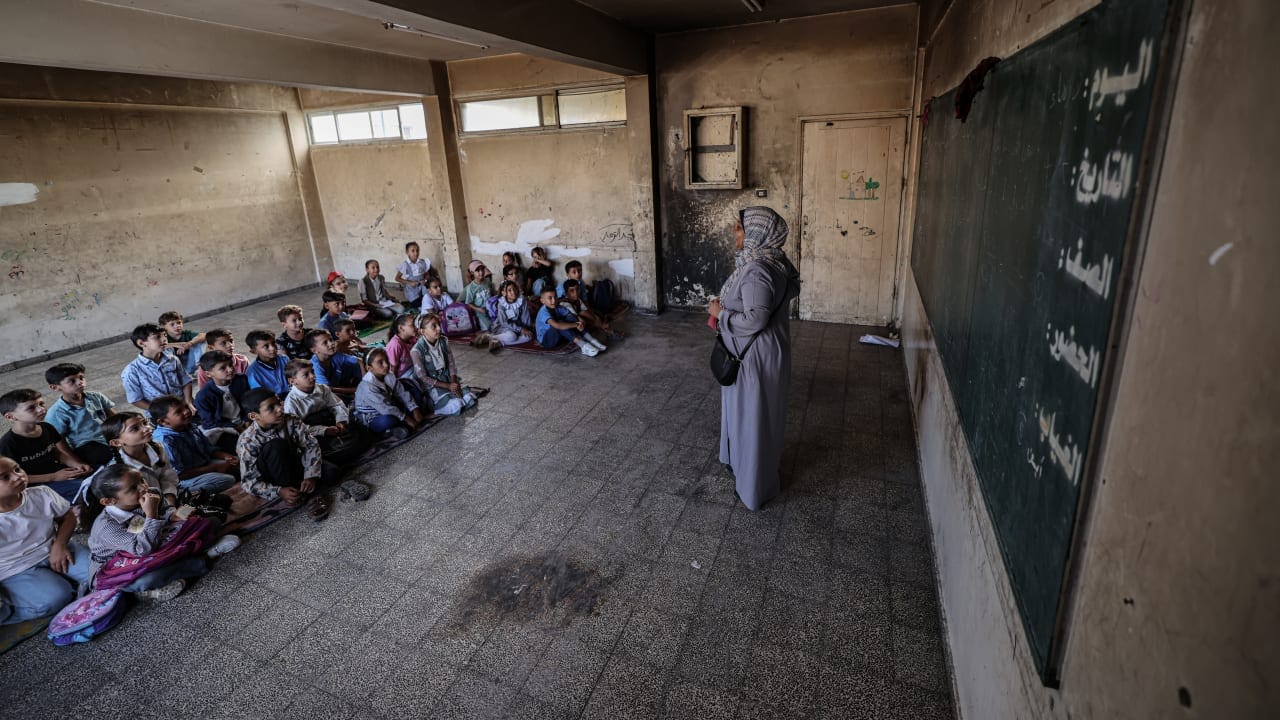
OCTOBER 23, 2026 17:13The antisemitic and pro-Hamas indoctrination of Gazan students has a “profound impact” that extends far beyond the classroom, a Gaza-based UNRWA teacher told The Jerusalem Post on Saturday, after school administrators threatened her with scissors for confronting extremist rhetoric being pushed onto young girls.Speaking to the Post anonymously due to the risks she faces, T. said she decided it was her responsibility to speak out after repeatedly witnessing a colleague attempt to blur the “boundaries between education and political and religious indoctrination within the school environment.”“I believe that remaining silent in the face of such practices means abandoning our moral and educational responsibilities,” she said, stressing that Palestinian students deserved an environment where they could study and dream of a future uncolored by conflict.“They have already experienced more than enough war, fear, and death,” T. said. “No one has the right to rob them of their childhood or predetermine that their future must be an extension of the conflict.”While T. told the Post that she did not consider her attempts to challenge the indoctrination to be anything special, she acknowledged that confronting radicalization had put her at risk. She said she became more aware of the danger recently, when a school administrator threatened her with scissors after she intervened in an attempt by another teacher to promote support for Hamas.Palestinian students walk through the corridors of Nuseirat Preparatory Boys School as they head to their classrooms on September 19, 2026 in Nuseirat Camp, central Gaza. (credit: Omar Ashtawy/Getty Images)School administrator threatened to cut teacher's tongue for mentioning Hamas“I had confronted several teachers on more than one occasion over their attempts to indoctrinate children with extremist ideas. During one of these incidents, I became involved in a heated argument with a female teacher who was promoting such views,” she recounted.“Shortly afterward, a school administrator confronted me, pushed me into a room, pulled a pair of scissors from his pocket, and threatened me, saying: ‘I’ll cut your tongue out if you ever mention Hamas again.’”T. said she decided not to file a formal complaint with UNRWA because she could not trust that the matter would be handled confidentially or that the organization could guarantee her safety, particularly given the extent of the radicalization she had witnessed within the agency.“Some people abroad imagine that UNRWA, because it is a United Nations agency, operates in Gaza the same way international institutions operate in Western countries, with an independent administration to which employees can turn for protection. But the reality I experienced was very different,” she said. “I also believe that UNRWA operates in an environment where it cannot simply ignore Hamas’s influence and control on the ground. In my view, employees who openly oppose Hamas may put themselves at risk and potentially create pressures affecting the agency’s operations.”Even as she explained that UNRWA had to navigate a complex political terrain to be able to operate in Gaza, and was not responsible for the creation of the culture in its facilities, T. argued that the UN agency has not done enough to confront it and has failed to enforce strict boundaries on teachers, allowing the problem to enter the classroom.T. stressed that not all UNRWA employees supported or were affiliated with Hamas, but argued that the agency lacked adequate structural safeguards to protect her and other whistleblowers.“If a school administrator could push me into a room, pull scissors from his pocket, and threaten to cut out my tongue because I spoke about Hamas, how could I feel confident that filing a complaint would not expose me to an even more serious threat? What guarantee would I have that next time they would not stop at threatening to cut out my tongue, but might actually kill me?” she asked. “For me, this was not simply a matter of administrative procedures or filing an official complaint. It was a matter of life and death. That is why I did not report the incident. Not because what happened was insignificant, and not because I accepted the threat, but because I did not trust the available system to protect my identity or my safety if I spoke out.”Hamas uses punishment beyond physical intimidationBeyond physical intimidation, T. said Hamas could use other means to punish her for speaking out, including accusations against her honor and threats against her family, to silence dissent.“There are dissenting voices, and there are people who reject these ideas. But most people are afraid for their families. Not everyone can bear the consequences of confronting an organization that holds political power, influence, and security authority,” T. said. “For this reason, I do not believe what happened to me was an isolated incident. In my view, it reflects a much broader problem within Gaza’s educational environment. I believe Hamas understood, from the time it came to power, the importance of education in shaping the minds of future generations.”Asked how Hamas-oriented education was affecting Palestinian children, T. said antisemitism and the romanticization of martyrdom were shaping their worldviews in psychologically damaging ways.She added that the schooling system's emphasis on memorization and repetition to answer exam questions failed to equip students with the critical-thinking skills that could help protect them from radicalization.“When an educational system built around memorization is combined with an ideological discourse that discourages dissent, the problem becomes even more dangerous,” she said. “A child who has never learned to ask questions, challenge assumptions, or examine information critically may become more vulnerable to extremist narratives.”Nevertheless, T. stressed that Palestinian students should not be defined by the conflict or viewed solely as potential fighters but as children who are also victims of war who have the ability to choose a different future if given the chance.“The children of Gaza have lived through years of war, fear, destruction, and the loss of loved ones. They need an education that gives them hope and helps them build their lives, not one that makes hatred and conflict permanent parts of their identity,” she shared. “I fear that continued extremist ideological indoctrination could produce generations who believe violence is the natural solution to disagreements, and that a person’s religious or national identity alone is enough to judge them…I want Palestinian children to dream of becoming doctors, engineers, teachers, or artists. I want them to know that their future does not have to be confined to a choice between war and death.“Reforming education is not simply about changing textbooks. It is an essential part of building a society that can live in peace and dignity, and give its children a genuine opportunity for a better future.”Follow us on Google
UNRWA teacher tells ‘Post’ she was threatened for challenging pro-Hamas rhetoric in Gaza schools
Full Article
Original Source
Read the full article at Jpost →KhanList aggregates and links to publicly available news content. We do not host full articles from third-party sources. Always verify important information with original sources.