
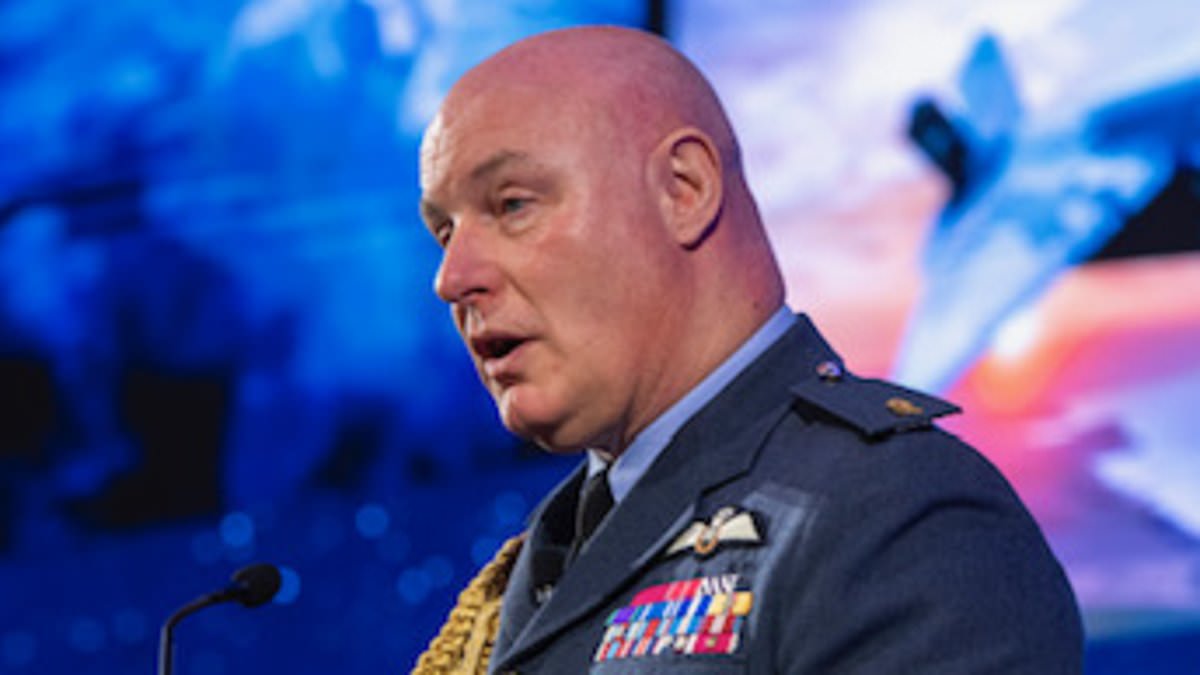
Russian aggression in space could wipe out our sat-nav and GPS systems, costing lives and causing billions of pounds of damage, the head of the RAF has warned.Air Chief Marshal Sir Harv Smyth today accused the Kremlin of 'provocative actions' that are 'dangerous' and raise serious questions about Russia's 'intent in space'.He told a London conference that space has become a ‘warfighting domain in its own right’ and it was critical the UK stepped up its operations there.At threat is the network of satellites that provide systems such as GPS and sat-nav, which are worth £1.4billion every day to the UK economy. These systems face ‘an unprecedented threat’ according to ACM Sir Harv.He said today: ‘We are seeing more and more irresponsible and provocative actions from our adversaries in flagrant disregard of the norms for responsible behaviour by spacefaring nations.‘In May of this year we tracked a series of unusual and significant manoeuvres by five Russian satellites moving to within rapid reach of two Finnish commercial satellites.‘The next month, it was confirmed that a Russian satellite constellation had caused disruptions to GPS signals across Europe, Greenland and Canada.‘Make no mistake the satellite services you may have taken for granted face an unprecedented threat. Sat-nav systems would fail, congestion on our roads would be severe and our emergency services would take longer to help those in need.‘Space can no longer be delayed, deferred or delegated. It must now be delivered. No one wants war in space. But we must respond to a rapidly changing environment in which threats to our critical space systems are growing every day.’ Air Chief Marshal Sir Harvey Smyth accused the Kremlin of 'provocative actions' that are 'dangerous' and raise serious questions about Russia's 'intent in space' A new RAF space squadron will be deployed to protect satellites like the Tyche reconnaissance satellite (pictured being launched by SpaceX's Falcon-9 rocket) used by the UK Armed Forces Opening the 2026 UK Space Conference in London, Sir Harv also confirmed the creation of a new RAF space squadron to defend satellites, the No III Space Effects Squadron.He also outlined plans for a fourth, fifth and sixth space squadron, reflecting the growing threat to UK security posed by conflict outside the earth’s orbit.He was speaking after the United States confirmed it has already positioned weapons in space to counter Chinese and Russian military activity.It is understood while the UK is hoping to position military assets in space by 2035, the emphasis of its capabilities will be upon electronic warfare measures, such as jammers to prevent attacks on UK satellites.The formation of No III Space Effects Squadron delivers on the UK's Control of Space Requirement – the need to maintain freedom to operate in space, and deny adversaries the same freedom.This was set out in the UK Space Strategy published earlier this month, and builds on the Strategic Defence Review, which made clear the ability to operate in, from and through space underpins the UK's security, prosperity and daily way of life.While taking action to protect critical space infrastructure, the government has made clear it remains committed to the peaceful and sustainable use of space.The UK has formally ruled out destructive anti-satellite missile testing and continues to work through the UN Committee on the Peaceful Uses of Outer Space to promote norms, rules and principles of responsible space behaviours.That commitment underpins the UK’s continuous work with allies and partners to strengthen collective defence in space, including an £880million investment between 2026-27 and 2029-30 in space-based intelligence, surveillance and reconnaissance and space control activities.In the case of the UK, global space and satellite services support 18 per cent of this country’s GDP, including the City of London. Worldwide, the space economy is estimated to be worth approaching £500billion.The new UK Space Strategy describes space as increasingly a ‘domain of competition’ where Britain’s adversaries are seeking to ‘disrupt, degrade and deny’ use of those satellites and other space-based services.In a veiled warning to Russia and China, the US said it is positioning military hardware there to guard against what it described as ‘hostile adversary action’.Those weapons already deployed to space are thought to include technology to jam enemy satellites, lasers for blinding enemy sensors and electronic warfare gadgetry.While China responded to the US’s announcement by warning of an ‘arms race’ in space, the US’s adversaries are understood to be gearing up for galactic warfare.China and Russia are understood to have tested weapons capable of destroying satellites. While in February this year it emerged that Russia was positioning its military satellites to intercept communications between Western satellites to access sensitive data.It also emerged yesterday how Russia has used its spy satellites to help Iran in its conflict with the United States.US analysis of orbital data reported by CNN found 14 Russian spacecraft passed over the Prince Sultan Airbase in Saudi Arabia in the days before the facility was targeted by Iran, resulting in 12 US casualties.The timing and sequencing of their movements gave Iran access to precise locations of US military hardware and troops.Any conflict in space would have lasting consequences with any debris from missiles left floating there, endangering non-military craft and satellites.Space will also be used to deploy defensive weapons systems such as interceptors that identify rocket launches on earth. This technology is at the forefront of President Donald Trump’s Golden Dome anti-missile system.
'Unprecedented threat' of Russian aggression in space 'could wipe out UK's sat-nav and GPS systems' and cost us £1.4billion a day, head of RAF warns
Full Article
Original Source
Read the full article at Dailymail →KhanList aggregates and links to publicly available news content. We do not host full articles from third-party sources. Always verify important information with original sources.