
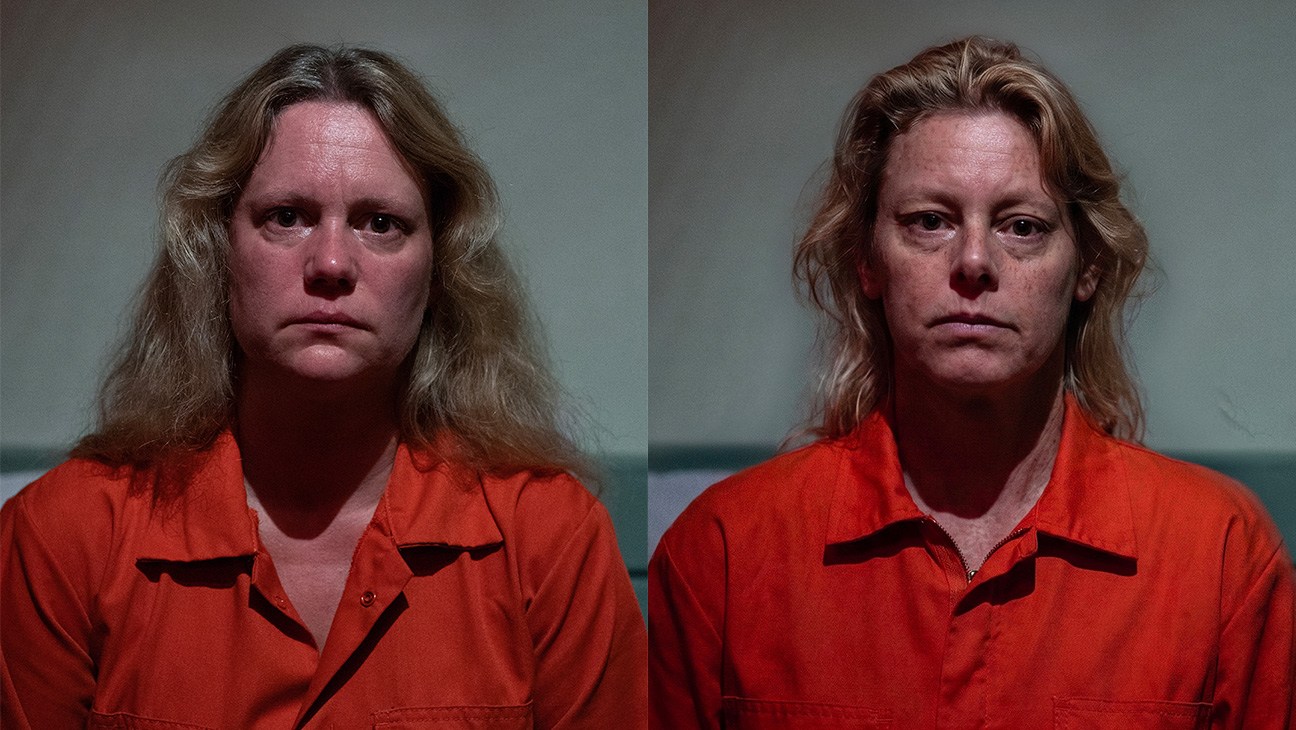
You’ve never see Aileen Wuornos like this. Or perhaps it is more accurate to say you’ve seen her exactly like this. Investigation Discovery’s new documentary series Unmasking a Monster: Aileen Wuornos utilized an AI-mask tool in post-production to make actress Morag Peacock look exactly like the infamous serial killer. The docuseries then did the same with nine other actors and their real-life counterparts. This specific deployment of AI is a first for the industry, the series’ executive producer Stephen Dost told The Hollywood Reporter. The vice president of content at Arrow Media had been “aware” of the digital mask tech, which he describes as “really advanced motion capture” — Dost just needed a use case. “We were asking ourselves, ‘If you could show someone as they were at the time, what kind of story would make sense for that?'” Dost recalled. “I just kept coming back again and again to Aileen Wuornos, and probably the reason for that is that if you’re going to show someone’s face, there’s got to be a reason. It can’t be for the sake of showing off tech.” “With [Wuornos], if you look at her face, you can see the the suffering that went behind it. You can see the abuse that she went went through,” he continued. “It’s a bit like the story of her life you can read on her face, and she went through hell.” There were other reasons. For starters, archival footage of Wuornos is “very limited,” Dost said. Plus, traditional TV reenactments are flawed, ID president Jason Sarlanis told THR. “Audiences want realism and access to the truth behind these stories. Reenactments have been part of this genre from the start, but they’ve also been an obstacle to believability,” Sarlanis said. “By augmenting our actors’ performances with digital prosthetics, we can bring viewers into these key moments with a new level of authenticity.” “In a traditional reenactment, you would actually try to avoid [the actor’s] face. You would try to be abstract,” Dost said. “But this was an opportunity to look right at her — uncomfortably — at the humanity that was there.” Dost just needed a human with a face. OK, it was a bit more than that. The docuseries needed a capable actress that, with 90 minutes of hair and makeup (and one prosthetic tooth), could kind of look like Wuornos. “Where the tech was at the time, we needed someone who had basically the same face shape,” Dost said. Peacock’s face worked for the assignment. It was her eyes that did the heavy lifting. “We would get through a take, and you could hear a pin drop at the end. We’re not seeing any of the VFX — it felt like we were in the room with Aileen Wuornos,” Dost said. Peacock played it as if her own face would make the finished product. “I’m going for as close to her as possible, and then the the technology bit kind of left my head after that. I was like, ‘This is the job that I’m supposed to do. I’ll do mine to the best of my ability, and then after that, it’s over to them. Hopefully, they get what they want, and everyone’s happy,” she told THR. “So, I knew about it — it was probably there in the back of my mind, but it was more about…matching her mannerisms, her quirks, the way she expressed with her eyes and things like that.” Peacock says she was “pleasantly surprised” by the trailer, which is the first time she saw footage from the final cut. “I can definitely recognize myself underneath it,” Peacock said. Her family did too. Aileen Wuornos: The Selling of a Serial Killer, Aileen Wuornos, 1992. Strand Releasing/Courtesy Everett Collection. AI is Hollywood’s hottest-button issue this side of Paramount/Warner Bros., the latter of which owns Investigation Discovery. At first, Peacock had reservations about accepting the Wuornos gig — and not because of the whole serial killer thing. “Probably much like most people, as soon as you see ‘AI,’ you kind of go, ‘Hold on,’ you know? So it was really important that myself, my agent, we discussed it, and we got to grips with what it was that was being asked of me, and what was going to be the end result,” Peacock said. “I’m not redundant in any way, I haven’t been cloned. There isn’t an AI persona that’s being created — nothing like that’s happening,” she continued. “Once I’ve kind of got to, ‘Well, yeah, it’s basically kind of like CGI…and it’s still me.’ Then, yeah, I was comfortable with that.” One thing AI was definitely not was a shortcut. “Anyone who tells you that using AI speeds things up is wrong,” Dost said. “It slows things down by a lot — especially if you’re going to do it the right way.” It took three years to “ethically” use AI to make Unmasking a Monster, Dost said. He shared his ethical roadmap with us: Getting consent from the real people (homicide investigators, defense attorney, private investigator, Wuornos’ friend), as well as from the actors playing them. Not using the tech in cases where we could not get consent, like Mike Joyner, who died after giving his interview, or Tyria Moore, Aileen’s ex-girlfriend, who did not participate in the documentary. Ensuring authenticity throughout our scenes. Everything in the scenes comes directly from the transcripts, police records, and memories of our interview subjects. Nothing is invented for dramatic purposes. Being transparent about the process and the technology used. With interviews like these and behind-the-scenes videos to come, we want to be as transparent with our audience as we can about the process we used to visualize these new stories. Sarlanis said ID takes the “responsibility of every creative choice we make in crafting these complex stories very seriously.” “We knew that these tools, if used improperly, could and should warrant pushback. That’s why we took just as much time and care into developing the guidelines for how we would use the tech as we did in developing the capabilities of what the tech could do,” he continued. “Our focus was always on using these tools to empower the creativity of our filmmakers and in doing so we believe we’ve unlocked a way for the audience to experience this story in a uniquely authentic way.” (L to R) Sarah Paulson as Aileen Wuornos, Jessie Lee as Shelby in episode 406 of Monster: The Lizzie Borden Story. Courtesy of Netflix Dost and Peacock are not the only duo tackling Wuornos this month. About two weeks prior, Ryan Murphy’s Monster: The Lizzie Borden Story premiered on Netflix. Though Borden (played by Ella Beatty) is the star of the show, Wuornos (Sarah Paulson) is a substantial recurring character. The timing is “totally coincidental,” Dost said, but ultimately “a good thing.” Buzz about Monster can only help pique interest in Unmasking a Monster, and the two series don’t really play the same game. “Although they do scenes that are directly pulled from transcripts, they also imagine her as a Lizzie Borden admirer, which obviously she wasn’t,” Dost said. “Probably if she knew anything about the real Lizzie Borden, [Wuornos] would have hated Lizzie Borden. But it’s fiction, so that’s OK.” Between Paulson and Oscar winner Charlize Theron (for portraying Wuornos in 2003 film Monster), Peacock is in good company — even if she didn’t previously know who Paulson is. (She’s since Googled her). “Everything Sarah Paulson does is amazing, and no, luckily Morag was not aware at the time that she would be up against Sarah Paulson,” Dost said, “because who would want that as a challenge?” Unmasking a Monster: Aileen Wuornos premieres tonight on ID and HBO Max.
‘Unmasking a Monster’: Star, EP, and ID President on Using AI Masks to Perfect Their Aileen Wuornos Look
Full Article
Original Source
Read the full article at Hollywoodreporter →KhanList aggregates and links to publicly available news content. We do not host full articles from third-party sources. Always verify important information with original sources.