
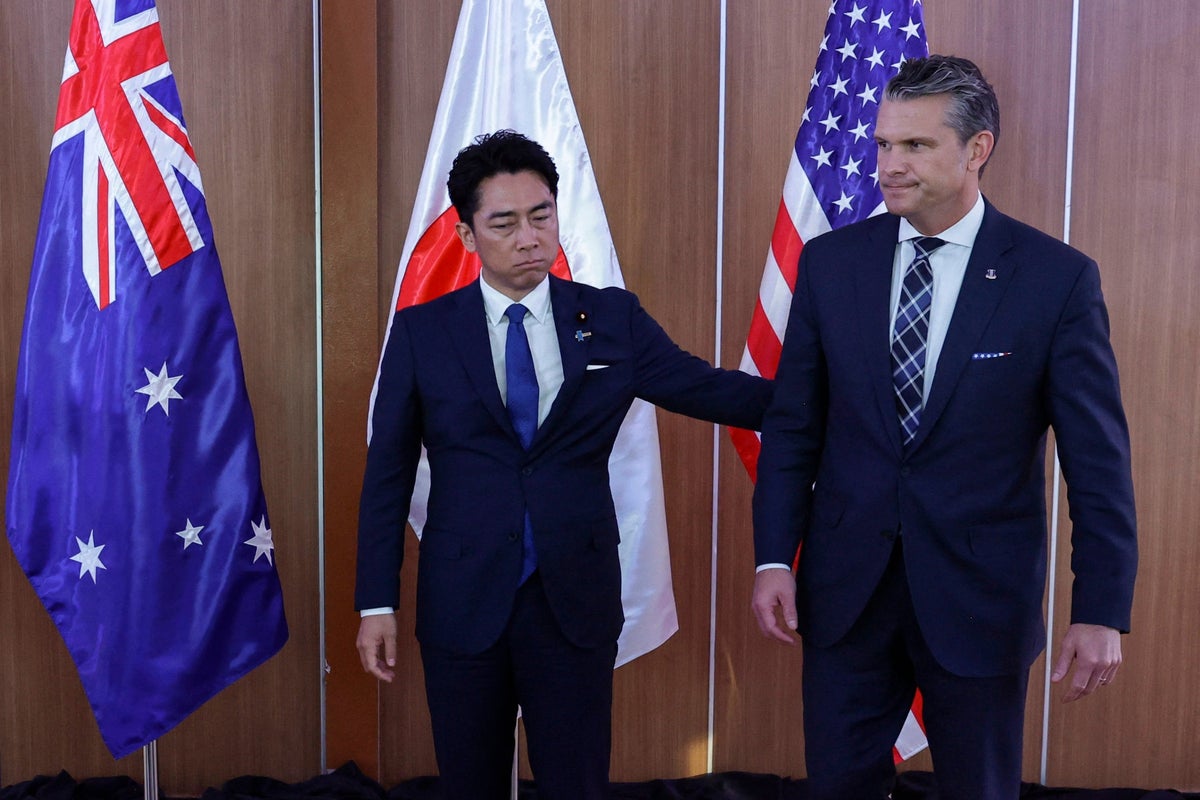
The United States and Japan have agreed to establish a production facility in Japan to jointly manufacture advanced medium-range air-to-air missiles, according to the Japanese defense chief.The decision marks the latest step by the two allies to bolster security capabilities amid heightened concerns over China's growing military assertiveness across Asia.Japanese Defense Minister Shinjiro Koizumi announced the agreement during a news conference Wednesday evening in Cebu, a province in the central Philippines. His remarks followed a bilateral meeting with U.S. Defense Secretary Pete Hegseth on the sidelines of an annual gathering of Southeast Asian defense chiefs and their major Asian and Western counterparts.During a session on Thursday, Koizumi highlighted increased Chinese naval presence near southwestern Japan, noting that three Chinese destroyers alongside a coast guard vessel recently passed through the Osumi Strait south of Kyushu into the Pacific Ocean. He stated that it was the first time his ministry had recorded such a fleet configuration.Koizumi pointed to the transit as "an example illustrating the challenging security environment in the region," adding that Tokyo will maintain close surveillance of Chinese naval operations while continuing to accelerate its own military buildup in southwestern Japan.(AP)The annual meetings aim to prevent major conflict and deepen regional cooperation, though the U.S., China, and their respective allies frequently exchange criticisms during the proceedings.The joint manufacturing effort, titled "Operation Supercharge," will establish a final assembly and inspection plant in Japan for the Advanced Medium-Range Air-to-Air Missile, or AMRAAM. Koizumi emphasized that these missiles are essential for F-35 stealth fighters, which are operated by both the U.S. and Japanese militaries.Recounting his meeting with Hegseth, Koizumi said he "shared a sense of crisis … regarding the increasingly severe regional situation and we agreed to strengthen the deterrence and response capabilities of the Japan-U.S. alliance with greater speed and intensity than ever before."He added: "We reaffirmed the importance of a free and open international order based on the rule of law, which rejects any attempts to unilaterally alter the status quo through the use of force, coercion or other means."In a separate meeting with ASEAN defense ministers led by Philippine Defense Secretary Gilberto Teodoro Jr., Hegseth offered renewed assurances regarding Washington's commitment to regional stability. Philippine Defense Secretary Gilberto Teodoro Jr. shakes hands with Hegseth (AP)Without calling out Beijing by name, Hegseth outlined the U.S. approach."The approach we’re taking, we describe as strong, quiet and clear," Hegseth told the defense chiefs, adding it is "Strong enough to deter coercion and aggression, quiet enough to avoid needless escalation or public theatrics to let our actions speak for themselves."He emphasized that the position is "clear enough that our friends, our partners and potential adversaries understand precisely where the United States stands and that we will defend our interests and the interests of our allies and partners."Hegseth reassured the Philippines, Washington’s oldest treaty partner in Asia, that the Trump administration will maintain robust deterrence against Beijing’s actions in the South China Sea, a critical trade waterway claimed almost entirely by China.Australian Defense Minister Richard Marles pledged that Australian forces, alongside allies like the U.S., would continue upholding international law despite Chinese actions in disputed waters. Referring to an incident last year where a Chinese J-16 jet released flares near an Australian P-8 Poseidon surveillance plane, Marles said: "That doesn’t deter us from doing what we need to do and that’s essentially asserting the rules-based order here in the end of the Pacific."He added: "Freedom of navigation on the high seas is profoundly important for Australia."Territorial claims in the South China Sea remain contested among the Philippines, Vietnam, Malaysia, Brunei, and Taiwan, with frequent standoffs involving Chinese and Philippine coast guard and naval vessels. Washington maintains that it is bound by treaty to defend the Philippines if Filipino forces, ships, or aircraft come under armed attack. Separately, Tokyo and Beijing remain locked in a maritime dispute over Japanese-controlled islands in the East China Sea.
United States and Japan forge missile production alliance to counter China's power
Full Article
Original Source
Read the full article at Independent →KhanList aggregates and links to publicly available news content. We do not host full articles from third-party sources. Always verify important information with original sources.