
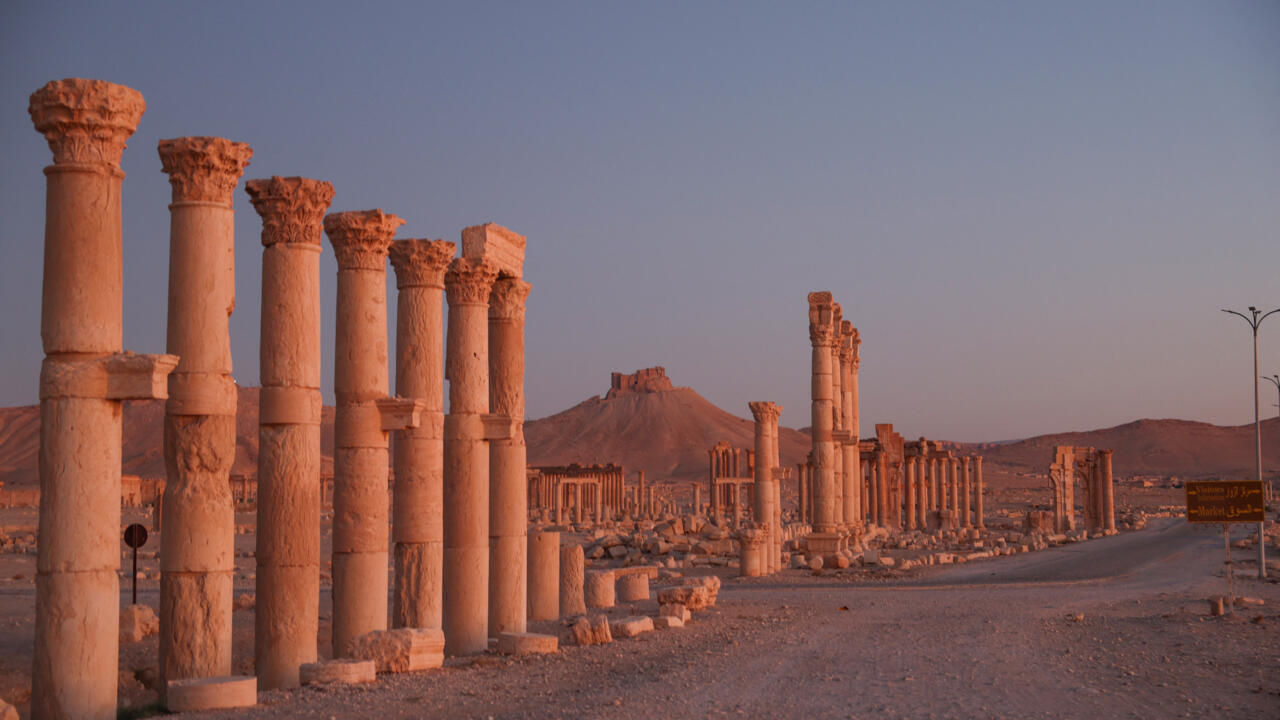
Eight decades after its creation, the United Nations' cultural arm is fighting harder than ever to protect global heritage in a world where conflict is on the rise, and the erasure of identity has become a weapon. For the United Nations Educational, Scientific and Cultural Organisation (Unesco), preserving cultural heritage helps to ensure that histories and identities are not erased in conflicts such as those currently being waged in Palestine, Sudan and Yemen. "Cultures do not necessarily exist within national borders. There have always been exchanges, interactions and mutual influences across the globe. Culture must not be used for political ends," says Krista Pikkat, director of Unesco's Culture and Emergencies Unit. The deliberate destruction of cultural heritage, due to its symbolic, religious and historical value, has become increasingly common over recent decades, starting with the wars of the 1990s in the former Yugoslavia. Researcher Helen Walasek, author of Bosnia and the Destruction of Cultural Heritage, speaking in 2019, said: "[We must not] view destruction in isolation, as a phenomenon curiously distinct from other atrocities. On the contrary, destruction was an inextricable part of ethnic cleansing during the Bosnian War and constituted one of the main objectives of those waging the conflict." Culture versus climate: how global heating endangers Unesco heritage sites 'Erasing all traces' Recent years are littered with examples of deliberate cultural destruction. Afghanistan's Buddhas of Bamiyan, carved in the 6th century, were blown up by the Taliban in 2001. In 2003, the National Museum of Iraq in Baghdad was looted during the US invasion and the fall of Saddam Hussein. In 2012, extremist Islamist groups including al-Qaeda in the Islamic Maghreb destroyed 14 of the 16 Unesco World Heritage-listed Sufi saint mausoleums in Timbuktu, Mali. Irina Bokova, then director-general of Unesco, told Le Monde at the time: "When everything else is destroyed, it is culture that gives a people the strength to rebuild themselves. Those who attacked the mausoleums of Timbuktu... know exactly where to strike: at the very heart of people's identities. Beyond strategy and geopolitics, we are witnessing the deliberate destruction of a shared heritage dating back a thousand years." In 2015, Islamic State jihadists attacked the ancient city of Palmyra in Syria, while in Ukraine, hundreds of cultural heritage sites have been targeted by Russia since the full-scale invasion in February 2022. Since 2023, the Gaza Strip has seen its heritage methodically erased by the Israeli army. Today more than 70 percent of its historical and cultural sites have been destroyed or damaged – including the Great Al-Omari Mosque in Gaza, which has in its time been an Egyptian temple, a Byzantine church, a 7th-century mosque, a Crusader cathedral and then a mosque once more. A person walks at the ruins of al-Omari mosque, which was destroyed in the Israeli military offensive, in Gaza City on 18 October 2024. © Dawoud Abu Alkas / Reuters In Lebanon, Israeli strikes have hit the area surrounding the Roman ruins at Baalbek, as well as Roman ruins at Tyre, an ancient Phoenician city which also preserves significant remains of medieval buildings dating from the Crusades. Unesco placed 34 cultural sites threatened by Israeli bombing under "temporary enhanced protection" in November 2024. Since February, Iran’s heritage too has been under attack – including the legendary Golestan Palace, which suffered significant damage from shockwaves and debris during US and Israeli airstrikes in March. Unesco raises alarm over heritage sites as bombing in Iran intensifies "Our culture, the heritage we carry, but also our customs and traditions, are truly at the heart of who we are," says Unesco's Pikkat. "We are indeed seeing targeted attacks because of the cultural significance of heritage, no doubt intended to intimidate a community, weaken social ties or, perhaps even erase all traces of communities' presence on their land and in the history of that land. In a way, it is also an attack on cultural diversity. They strike at the very heart of who we are, at the heart of our identity." Enshrined in international law In the aftermath of the Second World War, British Prime Minister Clement Attlee said: “Since wars begin in the minds of men, it is in the minds of men that the defences of peace must be constructed." This declaration was enshrined in the preamble to the Unesco Constitution, which came into force on 4 November 1946. "Throughout human history, cultural heritage has been destroyed in times of war," says Pikkat. "This is also, to some extent, why Unesco adopted the Hague Convention for the Protection of Cultural Property in the Event of Armed Conflict in 1954." Under the auspices of the UN organisation, this was followed in 1972 by the World Heritage Convention. The Second Protocol to the Hague Convention (1999) – described as the "operational arm of the Convention" – was then adopted following atrocities committed against cultural property during the armed conflicts of the 1980s and '90s. Although not ratified by the US or Israel, it stipulates that any aggressor may be prosecuted before international courts for war crimes. The convention also says that parties must incorporate the recommendations into their national legislation, and must instil in their armed forces a spirit of respect for the cultures and cultural property of all peoples. UN cultural agency Unesco selects Egypt's El-Enany as new director-general The UN also has procedures in place to prevent destruction caused by conflicts. Protected sites are marked by signs or flags, and Unesco provides belligerents with the geographical coordinates of protected sites from the outset of a conflict. “It is therefore truly a matter of national responsibility," says Pikkat. "By incorporating the provisions of the conventions into their legislation, states take on the responsibility of implementing concrete measures to protect their heritage, organising training and, in the event of a breach of these laws, prosecuting those responsible before national and international courts." To date, no state has ever been brought to trial for the destruction and looting of heritage, despite accountability for attacks on heritage being part of the mandate of the International Criminal Court. "The obstacle is jurisdictional competence and political will," Bijan Rouhani, a researcher with the Endangered Archaeology in the Middle East and North Africa project, told the BBC last October. Fleeing Iraqis walk past the heavily damaged al-Nuri mosque in the city of Mosul in northern Iraq, 4 July 2017. The mosque, famous for its 12th-century leaning minaret, was destroyed by Islamic State and has been a focal point of Unesco's restoration efforts since 2020. © AP - Felipe Dana Today, the protection of cultural heritage is increasingly regarded as a human right, and preserving humanity’s heritage also means helping to rebuild a community torn apart by war. "In Mosul, for example, we saw that to rehabilitate a city, it was not enough simply to restore buildings, mosques, churches or historic houses," says Pikkat. "We also had to restore the spirit. Buildings without the communities that have a connection to that heritage are empty cities." This article has been adapted from the original version in French by Anne Bernas.
Unesco at 80: 'Attacks on culture strike at the very heart of who we are'
Full Article
Original Source
Read the full article at Rfi →KhanList aggregates and links to publicly available news content. We do not host full articles from third-party sources. Always verify important information with original sources.