
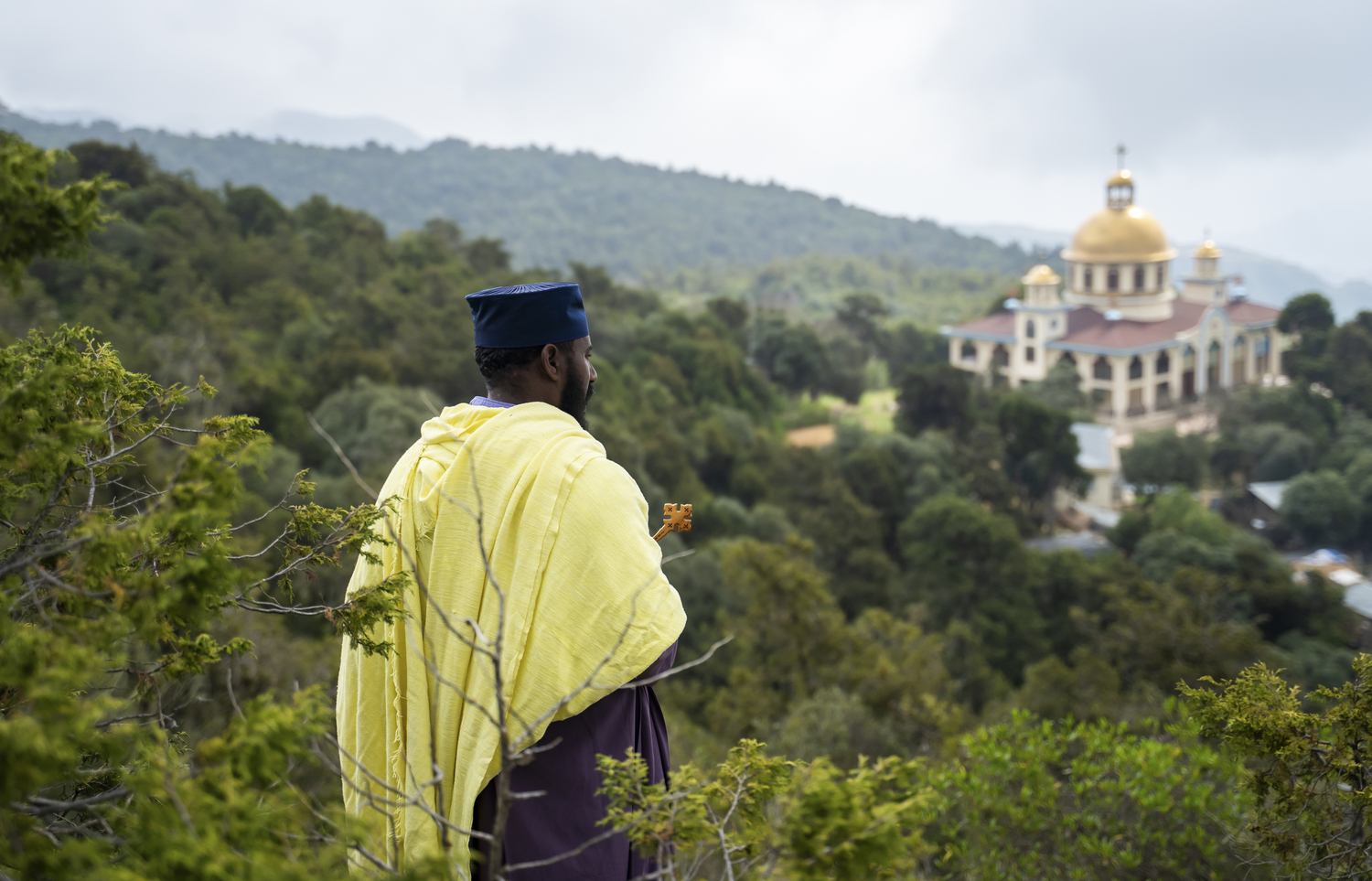
The United Nations Environment Programme named Ethiopia’s Desa’a forest restoration initiative a World Restoration Flagship, recognizing efforts to restore a degraded Afromontane ecosystem in the Tigray region.The project has restored more than 23,000 hectares (57,000 acres) of degraded land, prevented an estimated 500,000 metric tons of soil erosion and increased soil water infiltration in restored areas.Despite progress, years of armed conflict have disrupted restoration work and devastated local communities. Renewed fighting reported in September 2026 could further threaten the project’s long-term goals. On Oct. 29, 2026, the United Nations Environment Programme (UNEP) recognized the Desa’a project, an initiative to restore Ethiopia’s forests in the Great Rift Valley, as a World Restoration Flagship during the U.N. Biodiversity Conference (CBD COP17) in Yerevan, Armenia. “It is to inspire others to take action and revive nature,” Doreen Lynn Robinson, deputy director of the Ecosystems Division at UNEP, told Mongabay by phone. “Restoration, when it’s done well, brings stakeholders together because they’re working together to find solutions to common problems. We believe that by giving recognition to our flagships, they also receive some support. They’ll get technical support, monitoring support, and communication and advocacy support,” she continued. The initiative, officially called the “Restoring Desa’a landscape: Bringing the Great Rift Valley Back to Life,” is based in the Tigray region of northeastern Ethiopia, in what is known as the Afromontane forests. The Afromontane ecosystem extends across Africa, from the Arabian Peninsula south along the Rift Valley to the Drakensberg Mountains in the east, and consists of dryland forests located at elevations above 1,500 meters (4,900 feet). It is home to the endangered Ethiopian wolf (canis simensis), gelada monkey (theropithecus gelada) and giant lobelia (lobelia rhynchopetalum). This forest is also important for carbon storage, but it is on the verge of disappearing. At the beginning of the project in 2016, an estimated 74% of Ethiopia’s Desa’a Forest had “already disappeared.” Today, an estimated 70% of the remaining forest is considered degraded. Forest cover degradation can affect cloud formation and rainfall, potentially leading to more frequent droughts and food insecurity. Tigrayans working the land in the area under restoration near Desa’a’s forest. Image courtesy of © UNEP/Sosina Mengistu. “The community has been living around the forest for a long time, and people have mostly depended on agricultural practices to survive,” Yemane Gebru, project manager of the initiative, told Mongabay by phone. “We have been here for more than 1,000 years, according to the stories passed down to us. The population keeps increasing, and with it, the need for more food and more agricultural land. As a result, the area has been cultivated beyond its capacity, and the land is now severely degraded.” As a result of forest degradation, the fertile topsoil is eroding, making the land increasingly less fertile. This has a harmful impact on communities that depend on the forest for their water and energy supplies, as well as for grazing their livestock. Agriculture is not the only driver of land degradation. The use of wood as a source of energy also contributes, as do the armed conflicts that have ravaged the region. ‘It is in our interest to preserve the area’ The NGO WeForest launched a forest restoration project to address these issues. “It was very difficult for us to work with the communities when we started because they depend on the forest for their livelihoods. So, when you arrive and tell them to stop cutting trees and remove their livestock from the forest, it is quite a challenge,” recalled Aklilu Negussie Mekuria, WeForest’s country director for Ethiopia, who has worked on the project since its inception, in a phone interview with Mongabay. But after months of consultations and discussions, the NGO says it succeeded in working with local communities. “We mobilize a lot of community members. Sometimes we even mobilize thousands of people for planting and conservation activities. Today, the initiative is led by the communities. We listen to them, and they guide us. There is so much knowledge within the community, so we are also learning. Every year, we discover something new. And as they see us staying, working with them and making improvements in the forest cover, they are now trusting us,” Mekuria explained. Gebru, the project manager, is himself from Mekelle, the regional capital, located 45 kilometers (28 miles) from Desa’a Forest. According to his estimates, nearly 56% of the region’s population lives below the poverty line, surviving on less than $2 a day. Giving up the use of the forest, therefore, also meant giving up a source of income, a problem the project seeks to address. “The project has three main components: Reclaiming degraded land, expanding the forest by increasing vegetation cover, and improving livelihoods. These activities create job opportunities for the community. For example, one of our livelihood programs is beekeeping. The vegetation and weather in Desa’a are suitable for honey production, and Tigray honey is very expensive. Because beekeeping requires less labor and less land than agriculture, it is a win,” Gebru said. “It is in our interest to preserve the area. Desa’a is not just a place where people live; it is also home to church forests, some of the oldest Christian sites in the world,” he continued. A beekeeping activity set up by We Forest to provide communities with additional income and enable them to rely less on the forest and agriculture for their livelihoods. Image courtesy of © UNEP/Sosina Mengistu. According to WeForest, the initiative has brought more than 23,000 hectares (56,800 acres) of degraded land under restoration, helping prevent 500,000 metric tons of soil from being lost to erosion and enabling the collection of 1.9 million cubic meters of rainwater each year, equivalent to 760 Olympic-sized swimming pools. “We are also conducting water research with Mekelle University, the main university in the region. We discovered how landscape restoration; tree planting and forest conservation have improved soil infiltration rates. We found that the soil infiltration rate has increased by 26% since 2019. It is really impressive. By comparison, areas that remain degraded and have not undergone restoration have seen soil infiltration rates decrease by 40%,” Mekuria said. Two years of conflict impacted restoration These results are particularly impressive given that the region has been affected by armed conflict since 2020. “It took us longer than expected to get to this point. We were asking communities to plant trees and carry out activities, but at the same time, we were afraid to do so because of airstrikes or drone attacks,” Mekuria explained. In November 2020, following a dispute between the federal government in Addis Ababa and the Tigray regional government about the decision to postpone elections, the national army launched an armed offensive against Tigrayan forces, which had taken control of the military headquarters in Mekelle, Tigray’s regional capital. The origins of the conflict are disputed. The conflict escalated into a civil war, which lasted two years and ended with the establishment of a fragile peace under the 2022 Pretoria peace deal. After two years of conflict, the toll was severe: Nearly half of Tigray’s 5.7 million people faced a severe food crisis, and one in three children under 5 suffered from malnutrition. “I was out in the field a lot at that time, so I saw what was happening. It was difficult for farmers to work under those conditions, so we found solutions. We worked in small groups, frequently changing locations,” Mekuria said. “Most markets were no longer functioning, except for small open markets. There was no internet or telephone service, and there were constant fuel shortages. So, to get around, we sometimes used bicycles or donkeys, and we managed.” Today, WeForest continues its research and hopes eventually to sell carbon credits generated by its conservation activities. “The estimates for this particular initiative and its ambition suggest a potential carbon capture of 6 million metric tons of CO₂ equivalent over 50 years. It could be a tangible benefit for the planet and the communities,” Robinson with UNEP said. However, with armed conflict returning to the region in late September 2026, the work of the NGO and local communities could once again be threatened. Banner image: A member of the Tigrayan community looking at a traditional forest church, a major center of Christianity in the world located in Desa’a forest in the Ethiopian Afromontane region, an iconic and endangered area of biodiversity in East Africa. Image courtesy of © UNEP/Sosina Mengistu. Citation: Abiem, I., Arellano, G., Kenfack, D., & Chapman, H. (2020). Afromontane forest diversity and the role of grassland-forest transition in tree species distribution. Diversity, 12(1), 30. doi: 10.3390/d12010030 Feedback: Use this form to send a message to the author of this post. If you want to post a public comment, you can do that at the bottom of the page. Credits Topics
UN recognizes ongoing restoration work inside Ethiopia’s Desa’a forest amid conflict
Full Article
Original Source
Read the full article at News →KhanList aggregates and links to publicly available news content. We do not host full articles from third-party sources. Always verify important information with original sources.