
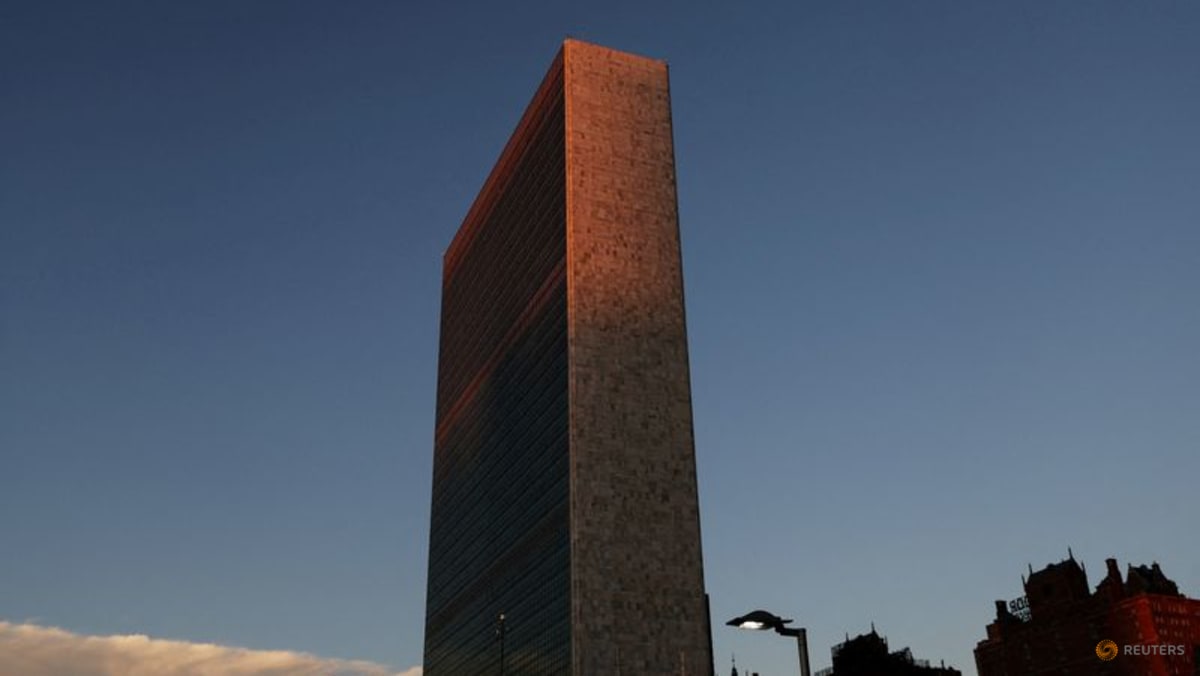
World Nearly 130 heads of state and government are expected in New York for the UN General Assembly’s High-level Week, as multiple global issues test the UN’s ability to find common ground. FILE PHOTO: The United Nations building is seen at sunrise during the 77th Session of the United Nations General Assembly at the U.N. Headquarters in New York City, U.S., September 21, 2022. REUTERS/Shannon Stapleton/File Photo New: You can now listen to articles. This audio is generated by an AI tool. NEW YORK: World leaders are gathering for the United Nations General Assembly this week, as the global body confronts wars, deepening geopolitical divisions, the rapid rise of artificial intelligence and the growing impact of climate change.Nearly 130 heads of state and government will attend the High-level Week in New York, with the General Debate running from Tuesday (Sep 22) to Sep 28.The 15-member UN Security Council may also hold high-level meetings on Ukraine, AI and the Middle East, including talks with Arab leaders, diplomats said. IRAN IN THE SPOTLIGHTThe Middle East is expected to be a major focus of discussions, as the Iran war continues to fuel regional instability. Recent Houthi gains have threatened shipping through the Bab el-Mandeb Strait, a key alternative route for some Gulf energy exports, potentially pushing prices higher. Iranian President Masoud Pezeshkian is scheduled to address the assembly on Wednesday, as peace talks remain stalled and the US and Iran continue to exchange strikes.His presence in New York would create an unusual diplomatic moment: The Iranian leader would be setting foot on US soil while the two countries remain at war. But the General Assembly could provide an opportunity for progress on some political issues surrounding Iran, according to Maya Ungar, a senior policy adviser at London-based monitoring group Conflict Armament Research. “Last year, when Gaza was the main topic, (there was) an important meeting between a number of Arab states and President Trump, which was part of the discussions that led to the US's announcement of a 20-point peace plan for Gaza,” said Ungar.“So, some of these meetings and conversations can lead to concrete action after the week itself. And I think Iran is probably the most likely topic where that could be the case.” ONGOING CHALLENGES IN GAZA AND UKRAINEThe focus on Iran comes as diplomatic efforts over Gaza face their own challenges. The UN Security Council endorsed US President Donald Trump’s 20-point peace plan to end the Gaza conflict in November last year, but efforts to secure further progress in the embattled enclave appear to have stalled.Ungar says that with so much urgency surrounding Iran, Gaza risks slipping further into the background at this year’s assembly.Ukraine will also be on the agenda, with Ukrainian President Volodymyr Zelenskyy and Russian Foreign Minister Sergei Lavrov both due to address the gathering.Diplomats said Zelenskyy is expected to use the forum to bolster Ukraine’s position ahead of another difficult winter.Efforts by the Security Council to end the conflict have been hampered by Russia’s veto power as one of its five permanent members.But where major powers are unable to find common ground, Ungar says there might be opportunities for so-called “middle powers” to exert some influence.India, which has maintained ties with both Russia and Ukraine, is among the countries that could potentially play such a role.“Middle powers play an incredibly important role in negotiation processes between great powers,” said Ungar.“And India would not be the first to try for Russia and Ukraine. You've had China, you've had Brazil, you've had others who have used the UN and speeches here as a platform to launch initiatives towards a conclusion of conflict." CAN THE WORLD AGREE ON AI?Apart from geopolitical conflicts, AI could provide another test of the UN’s ability to build global consensus.UN member states adopted the Global Digital Compact in 2024, establishing a framework for international digital cooperation, including on AI governance.“This is really making the UN ready for the 21st century, ready for emerging technologies, artificial intelligence, and the digital world,” said Waheguru Pal Singh Sidhu, clinical professor at New York University’s Centre for Global Affairs.In July, Geneva hosted the first UN Global Dialogue on AI governance, bringing together governments and other stakeholders to discuss issues including AI safety, accountability and human oversight.UN Secretary-General Antonio Guterres has said that AI will be a major topic, calling for countries pushing its frontiers to set up “common guardrails in order to avoid this race to the bottom that could lead one day to a gigantic disaster at the global level”. But reaching an agreement among the world’s leading AI powers remains difficult.Trump on Sep 14 dismissed AI risks as a hoax, while saying China would benefit from the doubt cast on its development.Murdoch University professor of human rights Simon Adams says the stakes could become particularly high as AI adoption accelerates. “This is a huge issue,” he said.“We're now facing the prospect of literal killer robots, mechanisms making targeting decisions for drones, potentially autonomous weapons that could be killing human beings,” he added.“These are issues crying out for international multilateral leadership, and the UN is really the only body with the convening power to make a real difference.” CLIMATE ACTIONWhile the future of AI is impossible to ignore, so is the reality of climate change.South Korea, Japan and parts of Europe saw record-breaking temperatures in August, while deadly floods wreaked havoc in Nepal and parts of China. World leaders will have an opportunity to press the issue at a special climate summit, but divisions among governments could make meaningful action difficult.“What we've seen in the General Assembly is the US taking a position that denies or opposes climate change references in General Assembly resolutions,” said Mariea Sekijima, an analyst in UN advocacy and research with the International Crisis Group.“You can see the US is not seeing the UN as a venue to talk about this issue.”
UN General Assembly: Wars, geopolitical divides, AI and climate change test global cooperation
Full Article
Original Source
Read the full article at Channelnewsasia →KhanList aggregates and links to publicly available news content. We do not host full articles from third-party sources. Always verify important information with original sources.