
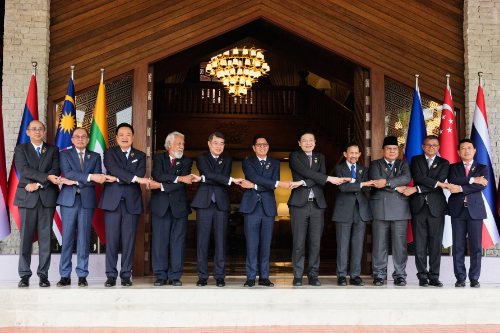
Country representatives pictured during the 49th ASEAN summit in Manila on November 15, 2026 (Photo: Aaron Favila/AFP) UN Secretary-General Antonio Guterres expressed support Monday for fresh diplomatic efforts to engage with Myanmar’s post-coup military government, but said that “violence needs to stop”. Guterres made the remarks in Manila, where leaders from the Association of Southeast Asian Nations (ASEAN) agreed Sunday to pursue a “calibrated engagement” with the war-torn country. Myanmar has been excluded from high-level ASEAN meetings since a military junta seized power in a coup in 2021, but the regional bloc is seeking a path towards normalising diplomatic relations. “We have never opposed the idea that it is always necessary to engage with whoever is involved in a conflict,” Guterres told a press conference on the sidelines of the ASEAN summit. While “engagement is not appeasement”, Guterres said the “intolerable violations of human rights in Myanmar” must end. “Violence needs to stop, humanitarian access needs to be granted, and all those arbitrarily detained must be immediately released,” Guterres said. “And these are the conditions that could allow for what everybody should will [to happen], which is that Myanmar will find a way to move… to a true democratic situation.” Thailand has been leading efforts to normalise relations with Myanmar since coup leader Min Aung Hlaing installed himself as president this year following elections dismissed by monitors as a charade. Bangkok has called for a “calibrated engagement” in an effort to implement ASEAN’s long-languishing five-point plan to end the war between the military and a coalition of pro-democracy resistance fighters and ethnic minority armed groups. ASEAN leaders adopted that language on Sunday in calling for the pursuit of “a calibrated engagement with Myanmar through a phased and progress-based approach”, according to the joint statement. Guterres’s remarks came as the UN’s International Court of Justice prepares to rule on whether Myanmar committed genocide against its marginalised Muslim Rohingya minority. A decade of reporting at a cost In 2025, we marked the 10th anniversary of Myanmar Now. In Myanmar’s history, journalists are often the first targets during political repression. We founded this outlet during a brief window of stability, starting with a small team in a modest office in downtown Yangon. Our goal was simple: to report on injustices that had been silenced for decades. In many countries, justice is sought through courts and police. In Myanmar, these institutions have historically been instruments of oppression. From the start, we committed to reporting without discrimination—regardless of ethnicity, religion, or citizenship. We believe our work should be accurate, deeply sourced, and strong enough to serve as a historical record. We also believe journalism should be a force for positive change, and that our primary readers should be the people of Myanmar. That belief came at a cost. Members of our team and others associated with Myanmar Now have endured long legal battles, physical assaults, arrests, and torture. Despite these hardships, Myanmar Now continues to report the news—thanks to the resilience of our team, the courage of our sources, and the trust of our readers. Please subscribe to support a free press in Myanmar.
UN chief backs engagement with Myanmar but ‘violence needs to stop’
Full Article
Original Source
Read the full article at Myanmar-now →KhanList aggregates and links to publicly available news content. We do not host full articles from third-party sources. Always verify important information with original sources.