
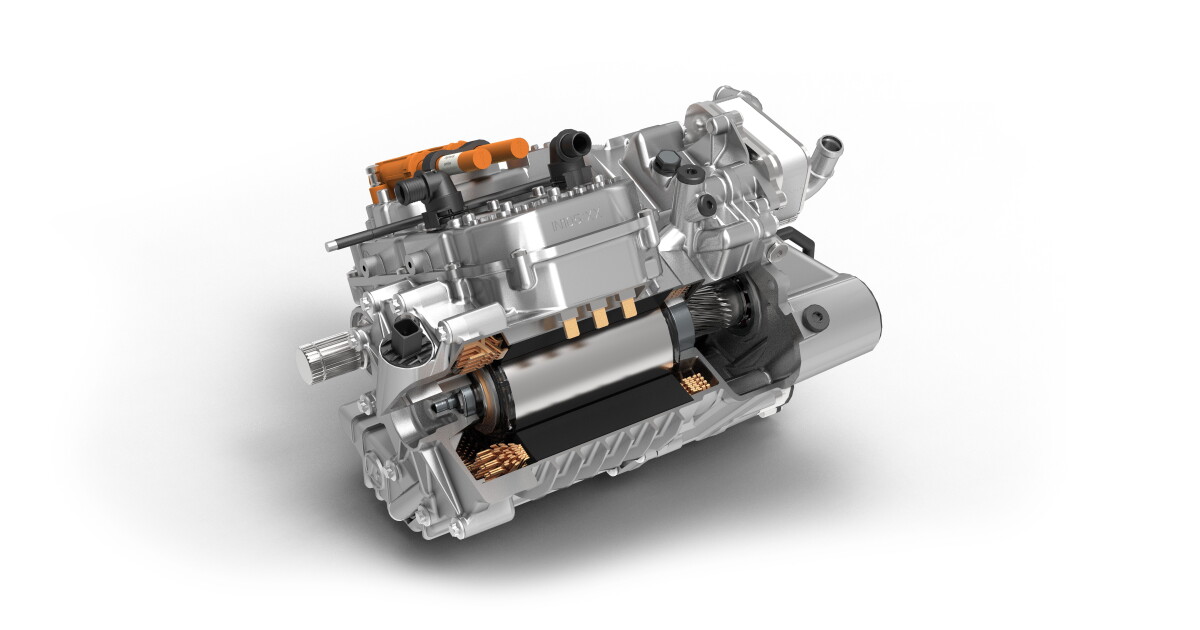
My tired old gas car idles a bit unevenly at around 800 rpm, hits the speed limit at 3,000 rpm, and bangs up against its redline at a desperately gasping 6,500 rpm.Even screaming Italian ICE supercars like a Ferrari 296 GTB top out around 8,500 rpm before their pistons beg for mercy. Most electric vehicles (EV) cruise somewhere between 2,000 and 9,000rpm. F1 cars redline at 15,000rpm.So, when the German engineering giant ZF strolls in the room and casually drops a car motor on the table that spins all the way to 30,000 rpm, the auto world takes a lot of notice.In case you need persuading, think of the motor rotating 500 times each second. That’s a spin every two milliseconds.Even if you’re not a mechanical mastermind this new unit sounds, err, fast. It even whizzes round five times faster than the laptop hard drive that I’m currently writing on (and hopefully saving on). The only thing I can find that spins that fast is a high-end food mixer.Apart from, wait for it, the latest hyper EVs from China, including the U9 Xtreme, which was crowned the world’s fastest production car a few days ago.So, back to this little 30k unit from ZF. It has just been quietly unveiled without concept-car theatrics or pyrotechnics. The 'High Revolution Drive' uses its dizzying rotational speed to shrink a complete electric axle drive by nearly 25% in both size and weight and, even more importantly, cutting its rare-earth magnet mass in half.Most car fans have heard of ZF, without really know what it is. The German engineering specialist was founded in 1915 as Zahnradfabrik, literally "gear factory," to build precision transmissions for Count Ferdinand von Zeppelin’s airships.ZF has spent more than a century creating crucial mechanical bits for global automakers – from BMW and Mercedes-Benz to Ford and Stellantis. It turns over €39 billion (US$42 billion) a year across 29 countries as one of the most influential behind-the-scenes powerbrokers in mobility. So when ZF changes direction, the rest of the auto industry takes notes.In this case, the numbers sound huge but the physics of its High Revolution Drive are simple. Power in any motor is just torque or twisting force multiplied by speed. Conventional EV motors top out around 18,000 rpm, so engineers build large, heavy rotors packed with expensive rare-earth magnets to generate enough muscle. Spin a rotor nearly twice as fast, however, and you need far less twisting force for the same horsepower. Spinning at a super-fast 30,000 rpm means the new unit can power a normal electric vehicle while still cutting size, weight and rare-earth magnetsZF But when ZF showed off the new small motor integrated with an inverter and gearbox there was little drama. It delivered a modest 268 hp (200 kW). Unlike ultra-high spinning EV units from top Chinese vehicles at the moment, the High Resolution Drive is targeting everyday passenger cars with average motor power and simple 400- and 800-volt architectures.ZF leans on its century-old core specialty to turn the super-spin into usable power. A two-stage helical spur-gear transmission with aggressive 18:1 reduction ratio gears that delivers a hefty 2,581 lb.ft (3,500 Nm) of torque at the wheels.Strategically, the timing is interesting. China currently controls 90% of global rare-earth refining and magnet manufacturing, giving Beijing huge leverage over western EV supply chains.Until now, automakers looking to break free have tried developing complex magnet-free designs. ZF itself previously pioneered a compact magnet-free motor using an inductive exciter inside the rotor shaft, while rivals like Mahle have chased wireless rotor-coil motors and General Motors has backed iron-nitride magnet startups.By halving magnet mass rather than eliminating magnets altogether, the new ZF motor is charting a pragmatic middle course. The 50% cut in magnets reduces dependency on China, without sacrificing range or punch.That puts ZF in an intriguing competition against its high-speed Chinese rivals.We’ve reported on Xiaomi’s 27,200-rpm HyperEngine V8s, a 570-hp (425-kW) monster built for halo performance sedans like the Xiaomi SU7. ZF’s breakthrough is bringing extreme rpm down to ordinary, affordable family crossovers and sedans rather than six-figure track toys. It’s targeting production within four years.As Western automakers hunt for ways to make EVs lighter, cheaper and less reliant on Beijing, ZF has shown that sometimes the smartest way forward is simply to spin faster.Source: ZF
Ultra-fast 30,000-rpm motor can make your future EV lighter and cheaper
Full Article
Original Source
Read the full article at Newatlas →KhanList aggregates and links to publicly available news content. We do not host full articles from third-party sources. Always verify important information with original sources.