
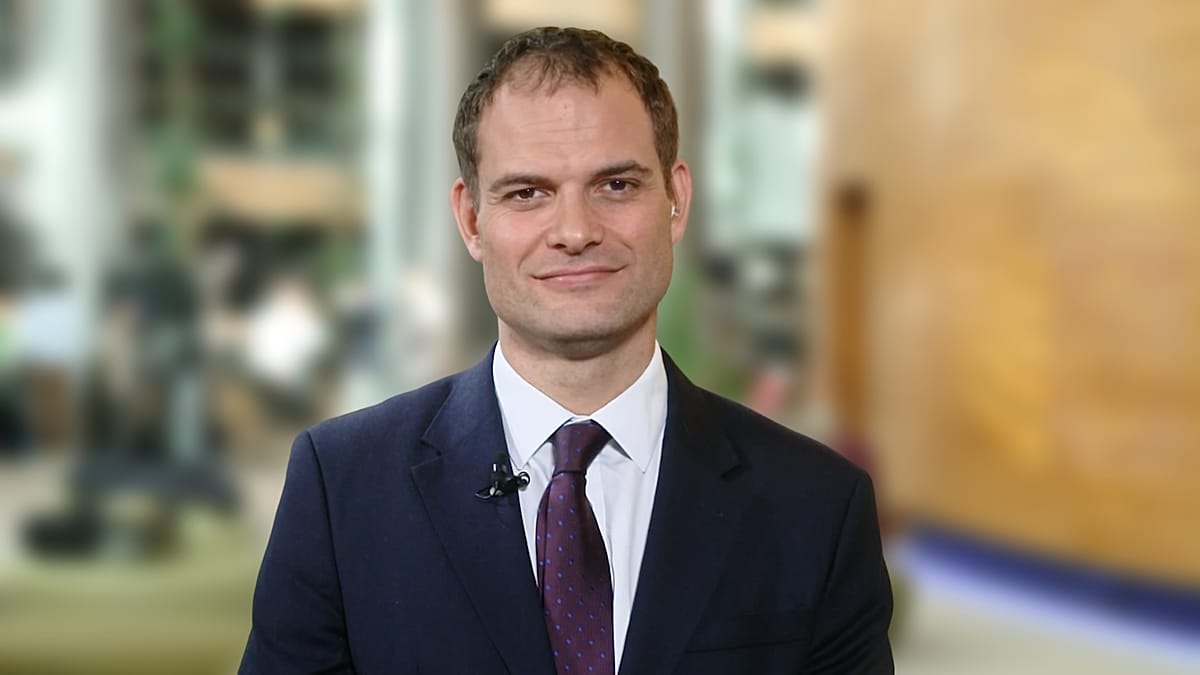
Europe risks weakening its industries if the UK is shut off from European supply chains as a result of the EU’s "Made in Europe" policy, the UK’s minister for European relations, Hamish Falconer, has told Euronews. ADVERTISEMENT ADVERTISEMENT Speaking from Strasbourg on Wednesday, where he held talks with EU counterparts including Trade Commissioner Maroš Šefčovic, Falconer said that maintaining open supply chains was “strongly in the EU and UK’s interests”. “I think it is vital that we don't do things to make European industry weaker,” Falconer said. “It would not be in either of our interests to see new barriers arising in our economic relations.” The EU wants to shield its domestic industries from unfair foreign competition by introducing a preference for European manufacturers in public contracts. The proposed rules, part of the European Commission’s Industrial Accelerator Act (IAA), are widely seen as a response to China’s increasingly assertive trade policies and state subsidised competition. But opinions are divided over what qualifies as “European”, and whether non-EU companies can be treated on an equal footing with their EU counterparts. The Burnham government has made the UK’s inclusion in the scheme a key priority in talks with Brussels. “The industries that have lobbied me with the most enthusiasm are European industries,” Falconer explained, adding that there’s a “clear sense” that the European industrial base is shared with the UK, which is the bloc’s second largest export market and largest destination for new EU-manufactures vehicles. “If we were to fracture that industrial base, that would simply mean a weaker Europe, both in the UK and in the EU,” he added. Last week, UK Prime Minister Andy Burnham raised his concerns over the scheme directly with European Commission President Ursula von der Leyen during the UN General Assembly in New York, saying ahead of that meeting: “we are not your enemies”. While France has pushed for a stricter approach, the German government is considered more open to a model that would extend rules of origin to EU trading partners, provided they offer European companies equivalent access in return. Burnham is due to meet Chancellor Friedrich Merz for talks in Berlin on Thursday. EU sources say that talks on the UK’s inclusion in the scheme have accelerated since Burnham took office in July, but that it remains to be seen if progress towards a deal can be achieved ahead of an upcoming EU-UK summit expected to take place before the end of the year. Asked if the UK would be willing to make concessions in order to gain access to the scheme, Facloner said that "talking about concessions is quite the right place to start", pointing out that this is a "shared European industrial base". ‘Shared desire’ for closer ties Minister Falconer also hailed a “shared desire” to bring the UK “back closer” to the European Union, days after Burnham opened the door to the country eventually rejoining the bloc. He said he shared Burnham’s view that “the current relationship that we have is not good enough”. “We are eternal neighbours, we have real shared interests and we're looking at this relationship with a real range of determination and ambition,” he explained. Falconer also said that Burnham would detail some of the options for the future relationship that he floated last week “around the time” of the EU-UK summit, widely expected to take place in Brussels before the end of the year. The summit was originally scheduled for July but abruptly called off in June when former Prime Minister Keir Starmer announced his resignation, torpedoing plans for both sides to close a range of deals, including on agri-food trade, electricity markets and youth exchanges. Minister Falconer said he was hopeful that the Burnham-led government would move “further and faster” on the reset, saying he was aiming for “the most ambitious possible package” to be agreed at the summit. Yet Burnham’s recent remarks have changed the stakes of the ongoing talks, with attention now turning to a potentially much closer relationship in the long term. Recent polling suggests a majority of UK voters could support rejoining the EU if the question was out to a referendum. A survey by the Messina Group (TMG) last week suggested that almost half of all voters support the move. However, opening the door to rejoining is seen as a delicate political move, with most of Burnham’s ministers – including Falconer – representing constituencies which supported Brexit in the 2016 referendum.
UK’s exclusion from ‘Made in EU’ scheme would ‘weaken’ Europe, minister warns
Full Article
Original Source
Read the full article at Euronews →KhanList aggregates and links to publicly available news content. We do not host full articles from third-party sources. Always verify important information with original sources.