
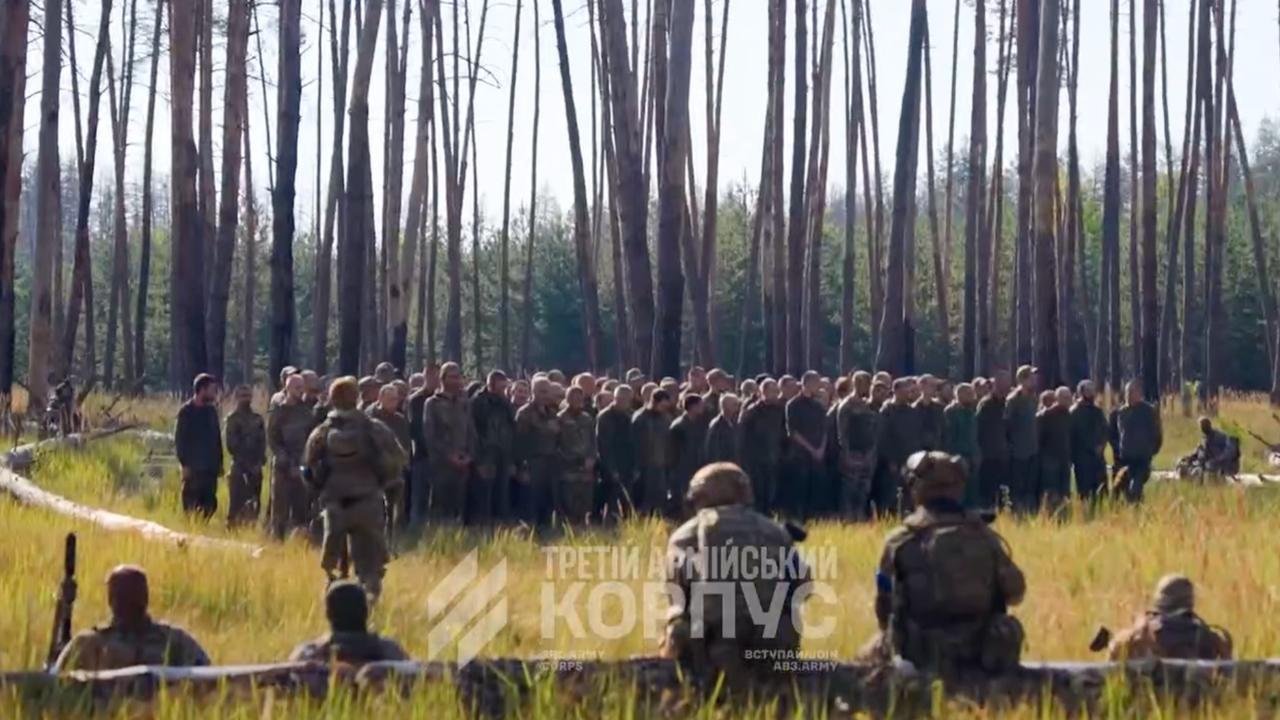
Every day, the Ukraine Battlefield update newsletter offers a clear look at how the war is unfolding on the ground. Subscribe for free here to get the full text delivered to your inbox. The Ukrainian offensive continues on the northern flank of the Sloviansk-Kramatorsk sector of the front. Russia has begun targeting data centres in Ukrainian cities. Ukrainian drones struck a factory producing missile guidance systems. It is no longer discussed as often, but Ukraine’s medium-range campaign is continuing successfully. Maps of the day – a map of sites struck in Kyiv; Ukrainian successes around Lyman and Sloviansk. Videos of the day – a swarm of Russian drones approaches Kyiv; a Ukrainian drone carrying a flag flew over the occupied town of Hola Prystan; the Ukrainian army used drones to deliver food to residents of occupied Oleshky in Kherson region. The Ukrainian offensive continues on the northern flank of the Sloviansk-Kramatorsk sector of the front. “The situation on the Lyman axis remains difficult. According to reports from the ground, the enemy is trying to push Russian forces beyond the Zherebets River, along which meeting engagements are continuing. Ukrainian forces are active in the Yampil area and on the approaches to Lyman. Heavy fighting is under way to stabilise the line and individual positions,” the Russian Z-channel Two Majors wrote on Monday (28 September) morning. Last week, the Ukrainian army asked OSINT experts not to help Russia by publishing their analyses. We therefore currently have information mainly from Russian accounts and from what official Ukrainian sources selectively release to the public. By coincidence, several reports concerning this particular battlefield emerged on Monday morning. Ukrainian president Volodymyr Zelensky was the first to announce, without further details, on Sunday afternoon that there were “important results from our units taking part in Operation Vivaldi on the Lyman axis”. On Monday morning, the 3rd Army Corps, which is conducting Operation Vivaldi, released details. “The opponent was misled and slept through the real strike,” corps commander Andriy Biletsky said. The 3rd Army Corps liberated the villages of Nove, Ridkodub, and Katerynivka, and “restored control” over Karpivka and Novomykhailivka. It should be noted that two different timelines intersect at this point. While Two Majors and other Russian accounts refer to current events, the report by Biletsky’s corps only acknowledges events that took place at the beginning of the summer. The Ukrainian command has only now admitted them and described them as the third phase of Operation Vivaldi. It also reported the capture of 250 Russians. The Ukrainians also released previously unknown footage from the operation, showing an outdated BTR-60 armoured vehicle loaded with explosives and remotely sent to destroy a fortified Russian position, which it succeeded in doing. During Operation Vivaldi, Ukraine’s 3rd Army Corps converted Soviet-era BTR-60 armored personnel carriers into a massive unmanned explosive vehicles, using them to breach some of the Russian fortified positions during the offensive. https://t.co/1dKZ6TtE3H pic.twitter.com/9SR9FbrZjx— Special Kherson Cat 🐈🇺🇦 (@bayraktar_1love) September 28, 2026 The Ukrainians managed to convince the Russians that their target was the village of Shandryholove, to which they sent their reserves for counterattacks. However, the Ukrainians struck in the village of Nove, further east. This is where the footage of the BTR-60 attack was recorded. French analyst Clément Molin said that Biletsky was referring in this case to events from May and June. According to him, the battlefield map looked like this at the time: Ukraine 🇺🇦 just announced the 3rd part of "Vivaldi" operation, liberating multiple villages back in May and June-> This confirms the main push was done in Nove direction-> Russia didn't retreat in a good order (250 prisoners, more dead) https://t.co/WuemIHSSBC pic.twitter.com/orfn5wm1g6— Clément Molin (@clement_molin) September 28, 2026 Today, the situation is even worse for the Russians. The Russian military channel Military Informant published two maps which still show the now non-existent salient north of Lyman, but the area without a Russian presence around the city has expanded. “The Ukrainian army is advancing and pushing the Russian Armed Forces away from the city and surrounding villages. Russian forces, in turn, are trying to bring the situation under control and are conducting counterattacks. It is not difficult to see that the loss of these positions significantly complicates the entire operation towards Sloviansk,” Military Informant wrote. Importantly, the improvement has not only occurred near Lyman, but also partly east of Sloviansk. “On the Sloviansk axis, Ukrainian forces carried out local counterattacks and pushed Russian forces out of positions east of Mykolaivka, as well as from the areas of Rai-Oleksandrivka and Velykyi Lis. However, the enemy advanced west of Fedorivka Druha towards the Siverskyi Donets-Donbas Canal,” the Ukrainian account Petrenko said. Rybar also confirmed Ukrainian attacks on the approaches to Sloviansk last week: Finnish analysts from Black Bird Group recorded the same development. On their map, one Ukrainian advance runs from Sloviansk directly towards Rai-Oleksandrivka, while the other is slightly further north. Mykolaivka is in the centre, Sloviansk to its left and Lyman above it. Russia has begun targeting data centres in Ukrainian cities. “Today, in Kyiv alone, Russian jet-powered drones ‘destroyed’ two kindergartens and two schools, an ordinary residential building, a car repair shop, several warehouses and telecommunications facilities,” Zelensky wrote on Sunday evening. The following map shows some of these sites. Weekend Ukraine map thread for Sunday 27th September 2026Russian strikes targeting specifically civilian areas continue to increase, leaving many dead. The map below shows some (but not all) of the recent strikes upon Kyiv, which has been pounded this week. Cities will be left… pic.twitter.com/SW2mrzWdwn— Ukraine Control Map (@UAControlMap) September 27, 2026 The last category in Zelensky’s list of “targets” – telecommunications facilities – is worth noting. More specifically, these are data centres, which Russian drones have begun attacking in an attempt to cause internet coverage outages. They reportedly struck, among other sites, the headquarters of the major telecommunications operator Kyivstar. The Russian Z-channel Veteran’s Notes wrote that nine centres had been struck over the previous week. The Russian Telegram channel Rybar, which consistently refers to Ukraine as “so-called”, assessed the results as “visible”, but said no “digital collapse” had occurred. According to Rybar, some services were disrupted, but destroying several servers was insufficient to cause more serious damage. Moreover, digital infrastructure is decentralised and therefore more resilient. Nevertheless, the Russians expect the new campaign to deliver longer-term results. “In addition to causing economic damage, it allows us to identify the opponent’s weakest points,” Rybar wrote. It expects that this will eventually make it possible to maximise the damage. Ukrainian drones struck a factory producing missile guidance systems. This happened overnight from Friday to Saturday, when at least five production halls at the Azov Optical-Mechanical Plant in Rostov region were damaged. Satellite imagery also confirms the strikes. Satellite images from the Sept 26 strike on the Azov Optical-Mechanical Plant in Russia’s Rostov region show hits on 5 workshops across 6 buildings, foundry 022 burning, optics 008 hit twice, assembly 009 at least 3 times, galvanic 010 once, machining 024 twice with a roof… https://t.co/Zm6XEbdFl3 pic.twitter.com/lVLFPWjbY7— WarTranslated (@wartranslated) September 27, 2026 The location of the factory is marked on a map published by the Ukrainian general staff. The Ukrainian army said that it produces optical and electronic systems for guiding artillery, missiles and anti-tank weapons. ⚡️⚡️ Azov Optical and Mechanical Plant hitDuring the night of 26th September 2026, units of the Defence Forces of Ukraine struck production facilities at the Azov Optical and Mechanical Plant in Azov, Rostov region, russian federation.A fire was reported in the foundry… pic.twitter.com/Aat2G1W3Z9— Генеральний штаб ЗСУ (@GeneralStaffUA) September 26, 2026 The attack was complex. Ukrainian website Militarnyi reported that it involved, among other weapons, Neptune missiles originally designed as anti-ship missiles. The same source wrote that Russia manufactures at the factory components for Kh-31P anti-radiation missiles, R-74 short-range and R-37M long-range air-to-air missiles, Kh-101, Kh-35U and Kh-59/Kh-69 cruise missiles, Oreshnik intermediate-range ballistic missiles, as well as guided glide bombs. It is no longer discussed as often, but Ukraine’s medium-range campaign is continuing successfully. For the third consecutive month, Ukrainian drones have destroyed more than 600 trucks at distances of 35 to 300 km from the front, despite Russian countermeasures. The chart below, by Clément Molin, indicates that 640 Russian logistics vehicles have been destroyed so far in September. When the campaign began with an effort to isolate Crimea, the Hornet drone was the most frequently mentioned. But even then, medium-range strikes were carried out by several types of drone. Military correspondent Francis Farrell wrote for the Kyiv Independent about one of them, named Zozulya. “Its old-fashioned silhouette and simple piston engine driving a wooden propeller evoke the first fighters of the world wars. But without a pilot, and controlled from a command room anywhere in Ukraine via satellite coverage, this aircraft also represents the cutting edge of modern drone warfare,” the author wrote about the unmanned aircraft, a photograph of which was already shown by the Ukrainian army in April. It does indeed show an almost primitive-looking weapon, on which nothing, apart from the panel receiving a Starlink satellite signal, evokes the 21st century: Unlike Molin, the analytical account Playfra said that the number of so-called middle strikes had fallen slightly, but that they remained effective because the Russians “still cannot jam Starlink, which is essential if they want to stop Ukrainian medium-range strikes”. The same source said that the smaller amount of video evidence was due to the Ukrainians no longer publishing it. This does not mean, however, that conclusive footage is not public. Some of it is also published by Russian sources, such as the Russian Telegram channel Military Informant in the images below: Videos of the day A swarm of Russian drones near Kyiv. Judging by the sound, these are older versions powered by a piston engine and a pusher propeller. A drone carrying a Ukrainian flag flew over the occupied town of Hola Prystan in Kherson region, which had a population of 13,000 before the war. The town lies just 13 km south-west of the better-known Oleshky. According to Ukrainian sources, the humanitarian crisis in Oleshky itself is deepening. Several thousand residents still live in the town and have very limited access to food. The Ukrainian army attempted to improve their situation using drones. 🔴 BREAKING: Ukraine delivered about 4 tons of food to temporarily occupied Oleshky in the Kherson region using drones.The aid was delivered to 100 locations for residents, despite Russian forces reportedly shooting down aid drones and confiscating food. pic.twitter.com/TmGtZ9r3Bl— UNITED24 Media (@United24media) September 27, 2026 What are the losses No update on Monday. By Tuesday (22 September), Russia had demonstrably lost 24,138 pieces of heavy equipment (24,098 on Monday [14 September]). Of these, 19,105 (19,065) were destroyed by Ukrainians, 1,000 (1,000) were damaged, 1,194 (1,194) were abandoned by their crews, and 2,839 (2,839) were captured by the Ukrainian army. This includes 4,448 (4,447) tanks, of which 3,353 (3,352) were destroyed in combat. Ukraine lost 12,175 (12,143) pieces of equipment, of which 9,579 (9,551) were destroyed, 702 (698) were damaged, 695 (695) were abandoned and 1,199 (1,199) were captured. This includes 1,464 (1,462) tanks, of which 1,125 (1,120) were destroyed in combat. Note: Neither side regularly reports its own deaths or destroyed equipment. Ukraine publishes daily figures for Russian casualties and destroyed equipment, which cannot be independently verified. This overview uses data from the Oryx project, which has compiled a list of equipment losses documented exclusively by photographs since the beginning of the war.
Ukrainians captured 250 Russian soldiers during Operation Vivaldi (Ukraine Battlefield update, Day 1,677)
Full Article
Original Source
Read the full article at Euobserver →KhanList aggregates and links to publicly available news content. We do not host full articles from third-party sources. Always verify important information with original sources.