
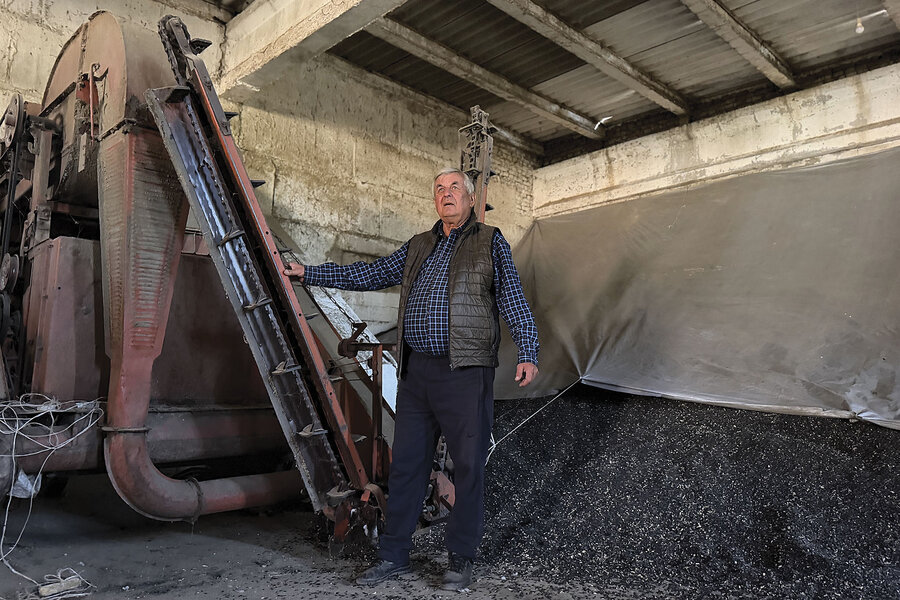
Baranove, Ukraine | Nov. 01, 2026, 5:05 a.m. ET | 5 min read Farmer Volodymyr Varbanets huffs as he heaves open a heavy warehouse door, setting pigeons aflutter in the rafters. Shafts of sunlight mingle with the earthy scent of winter wheat, barley, and sunflower husks – the latest harvest, gathered by an aging but agile crew in Odesa.The plentiful bounty was yielded by the land’s nutrient-rich black soil, which earned Ukraine its reputation as the breadbasket of the world. The output would typically make any farmer feel rich – and reassure global markets that depend on Ukrainian grain.But at this juncture of the war, such bounty is a burden. “There is no way to export this grain,” says Mr. Varbanets. Nor can farmers hold onto their crops indefinitely. In peacetime, Odesa’s Black Sea ports would have provided the natural gateway to overseas buyers. But repeated Russian missile and drone attacks have battered this vital trade route, destroying terminals, setting warehouses ablaze, and sinking commercial vessels.Cargo handling at the region’s three main ports – Odesa, Chornomorsk, and Pivdenny – plunged more than fifteenfold after July 22, according to Ukraine’s infrastructure minister. Since Russia’s full-scale invasion, nearly 300 civilian vessels and more than a thousand port infrastructure facilities have been damaged, according to Ukrainian government figures published in September. Dominique SoguelThe port of Odesa awaits more grain for storage in its silos and shipment from its terminals, Oct. 3. “Russia has been hitting the port the whole time during these 4.5 years,” says Dmytro Barinov, president of Ukrport, the Ukrainian Ports Association, in Odesa. “But they changed their tactics this July. They started not only shelling the port infrastructure or vessels that are in the port. They started hunting down vessels incoming or outgoing from the port.”“For farmers, it’s a disaster,” he says.“Navigation should be free”Agriculture is the backbone of Ukraine’s export economy, accounting for 56% of exports in 2025, worth $22.6 billion. Wheat, corn, sunflower oil, soybeans, and rapeseed are among the country’s key agricultural exports. Turkey, Egypt, and Italy are the biggest buyers of Ukrainian grain. Ukraine is expecting another bumper harvest, with around 84 million tons of grain and oilseed forecast for 2026-27 season. Russia’s territorial gains and attacks on silos and warehouses have slashed storage capacity to 59 million tons, according to the Food and Agriculture Organization of the United Nations. Ukraine could face an 11-million-ton storage shortfall by November.On Oct. 3, a Russian strike on a cargo ship killed one sailor and wounded three others, according to the Ukrainian Sea Ports Authority. Two days later, Moscow claimed to have hit fuel storage facilities at Chornomorsk and two cargo vessels. Fires blazed at industrial and port installations, sending towering plumes of black smoke over families lunching by the seaside and children playing in the sand.Beyond Ukrainian shores, a Turkish-owned ship carrying corn from the Danube port of Izmail to Italy was struck and sank in Romanian waters on Oct. 5, killing two sailors. The following day a drone struck a Marshall Islands-flagged vessel carrying rapeseed oil, killing one crew member and injuring others. Another drone attack on Oct. 13 sank a cargo ship off Bulgaria.“I hope these incidents will convince those at the highest level, presidents, to push Russia to stop,” says Mr. Barinov. “Navigation should be free.”It was briefly early in the war. Under a grain deal brokered by the United Nations and Turkey in July 2022, ships were guaranteed safe passage through a designated Black Sea corridor. Russia withdrew from the deal a year later and Ukraine subsequently established its own maritime corridor, which requires military coordination to navigate narrow windows of safety and includes no international guarantees. Dominique SoguelSmoke rises after Russian strikes set warehouses on fire in the port city of Odesa, endangering the region’s grain production, Oct. 4. Maritime traffic has ground to nearly a complete halt since the intensification of Russian attacks. The result is that farmers who would normally bring their cargo to traders at the Black Sea ports of Odesa must now find buyers further afield. Hauling their harvest to alternative ports means additional fuel, labor, and transport costs, further squeezing already thin profit margins. Diesel prices in Ukraine have surged nearly 80% year-on-year, almost entirely due to the Iran war, and fertilizer costs are also on the rise. “People are anxious,” says Mr. Varbanets, who heads the 4,200-strong Odesa Region Farmers Association. “We try to help each other. ... For example, I will borrow seeds from you today, tomorrow I will give you fertilizer. The biggest concern at the moment is how to pay for the work of the workers and leased farmland.”Farmers are also just exhausted. Military conscription, he says, has pulled younger men away from agriculture. Those who remain are typically of retirement age and putting in longer hours to compensate for the workload of absent colleagues. “People work 24/7,” he says. “We understand our duty.”Taxes, he adds, are another shared concern. “Because there is a war and we need to feed the army, the government is very harsh on taxes,” he says. “And nobody has the money to pay.” Those who can, take out loans. But many cannot.Crying, and dancingFor Viktor Kozhukharenko, who farms 15,000 hectares (37,000 acres), the arithmetic is unforgiving. Transporting a ton of grain once cost him $33 each, rerouting it through the Danube now costs $70. His trucks can spend five or six days unloading instead of two. “Everyone will benefit from Ukrainian grain, but not a Ukrainian farmer,” he says at his office in Odesa. Dominique SoguelFarmer Viktor Kozhukharenko, at his office in Odesa on Oct. 2, says he had to put off plans to expand his operation because of increased transport and logistical costs. He considers the current crisis worse than the chaos following Russia’s full-scale invasion. Back then, farmers had already sold most of their previous harvest and covered key expenses before the ports closed. This time, the attacks struck during harvest, when farmers desperately needed cash to finance the next growing season.Having built his farm from just 46 hectares in 1992, Kozhukharenko has shelved expansion plans to focus on survival. He fears a delayed agricultural collapse as farmers scale back planting. “Most of the players on the market, including the government, fail to realize the seriousness of the situation that we are facing now.”He is equally pessimistic about international help. “While half the world is crying, the other half is dancing,” he says, invoking a Ukrainian proverb. Competing grain exporters, he argues, are “opening Champagne and celebrating” higher prices, while poorer countries dependent on Ukrainian grain lack the political clout to demand a solution. Deepen your worldviewwith Monitor Highlights.Politics with respectGet political stories with respectful analysis.There‘s a world of new ideas in everyBooks newsletter.There‘s more to life, enrich yours withCulture & Learning weekly.Follow humanity‘s discoveries withScience & Nature stories in your inbox.Gain a spiritual perspectivefrom the stories in your inbox.Want to understand the deeper impact of critical events? Learn the Monitor‘s insight.Already a subscriber? Log in to hide ads. “Without the sea, we have nothing,” says Mr. Kozhukharenko.Oleksandr Naselenko supported reporting for this story. ALREADY A SUBSCRIBER? LoginReal news can be honest, hopeful, credible, constructive.The Christian Science Monitor was founded in 1908 to lift the standard of journalism and uplift humanity. We aim to “speak the truth in love.” Our goal is not to tell you what to think, but to give you the essential knowledge and understanding to come to your own intelligent conclusions. Join us in this mission by subscribing.
Ukraine’s farmers dig in as Russia turns its sights back on grain shipments
Full Article
Original Source
Read the full article at Csmonitor →KhanList aggregates and links to publicly available news content. We do not host full articles from third-party sources. Always verify important information with original sources.