
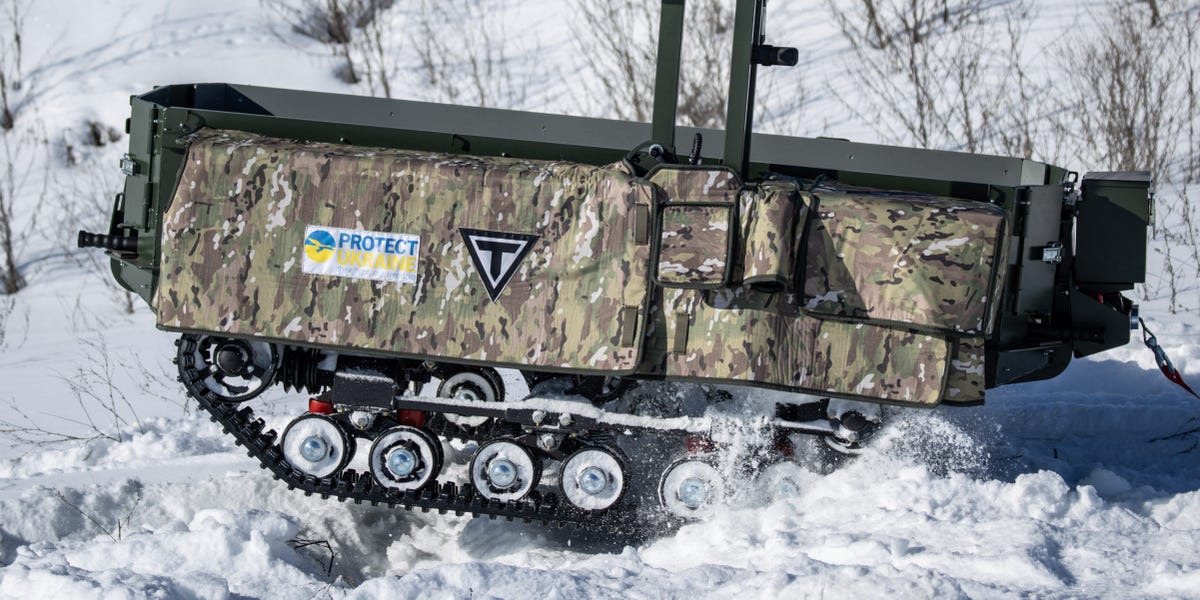
Ukraine has put thousands of new war robots into the fight. Fall and winter will test how they handle mud and snow. Ukraine's ground robot fleet has grown since last winter. Chris McGrath/Getty Images Ukraine's ground robot fleet has swelled, but new tests lie ahead, specifically the thick autumn mud and the winter cold and snow that can make battlefield movement more difficult and stress certain systems.Over the last year, the country's military and industry have prioritized fielding an army of robots to attack, gather intelligence, carry gear, and evacuate the wounded. The purpose is to replace as many human soldiers as possible in the war's most dangerous sectors.The fleet has expanded significantly and advanced technologically since last winter. Now it faces seasonal tests."These ground robotic systems are constantly being improved," Oleksandr Yabchanka, head of robotic systems for Ukraine's Da Vinci Wolves Battalion, told Business Insider. "Their operational range and off-road mobility are increasing.""Now that autumn has arrived, we will be able to assess how much they have evolved compared to last autumn," he said. "After all, operating in the summer on dry ground is one thing, but in the autumn — when the ground turns to mud and movement becomes significantly more difficult — it is quite another." Mud and other autumn and winter conditions make it harder for robots to travel. John Moore/Getty Images In March, Ukraine's defense ministry said that since the beginning of the year, more than 20,000 ground robotic systems had been contracted, which it said was almost twice as many as in all of 2025. It said their use was "rapidly expanding.""There are more of them now," Yabchanka, also a cofounder of the nonprofit Defence Robotics UA, said. "Throughout 2026, many units have begun employing UGVs.""This usage has already become widespread," he said, sharing that "ground-based robotic systems are becoming an integral part of combat operations for most units deployed along the line of contact."Autumn and winter have long been a difficult test for Ukraine's military equipment. First, the ground turns into thick mud. Next, the temperatures drop below freezing, snow covers whole sections of the battlefield, and trees go bare, stripping away valuable cover. Winter conditions in Ukraine create a test for battlefield technology and tactics. Diego Herrera Carcedo/Anadolu via Getty Images Ukrainian drone operators have described how freezing temperatures drain batteries, while fog, ice, and condensation can interfere with cameras, rotors, and other equipment. Strong winds and shorter days are also challenges.Ground robots, at least as they are now, are newer to the fight and largely haven't faced the same seasonal tests.These systems have some of the same winter weaknesses as aerial drones: cold can drain batteries, reducing their range and the power they need to push over difficult terrain and carry heavy cargo. Condensation, mud, and snow can also obscure their cameras and hinder other equipment.UGVs, however, face an additional problem: They have to drive across the terrain. Mud can cause wheels and tracks to get stuck or force robots to drive more slowly, making them more vulnerable. Snow has the same effect, while ice makes surfaces slippery and reduces traction. Ukraine wants to use robots so human soldiers can stay away from the most dangerous part of the battlefield. Ukrinform/NurPhoto via Getty Images NATO trainers working closely with Ukrainian troops have raised questions about the effectiveness of ground robots in winter, particularly heavy snow."Should we use that in Northern Norway with two meters of snow?" asked Brigadier Atle Molde, a Norwegian commander who oversees a training program, told Business Insider during a visit over the summer. It's "not that easy," he said.Getting stuck in the mud or snow can be disastrous on battlefields where the skies are full of drones. And even if movement isn't impaired, these conditions leave tracks.The reduced tree cover also makes the robots more visible, increasing their risk of being spotted and attacked.Many of these robots are designed to be relatively inexpensive and expendable. They're intended to replace humans on dangerous missions, where losing a machine is far preferable to losing a soldier.But reliability still matters, especially if a robotic system is carrying critical supplies or evacuating a wounded soldier. Some manufacturers reported success with their UGVs during the last winter, but many more models have since entered the fight and have yet to be tested.Ukraine, however, isn't treading completely unfamiliar ground. Throughout the war, it has repeatedly adapted its drone technology to winter conditions.Units and companies have added new seals to cameras to prevent condensation, added layers to exposed elements like cables, greased propellers to keep them from freezing, kept batteries warm in thermal bags, developed new camera systems to see better in the dark, built cold-resistant batteries, and made drones that are designed to operate better in strong winds. Soldiers are also coming up with their own solutions, such as wrapping drone batteries in heated shoe insoles to keep them warm in flight.Its expanding ground robot fleet may need similar adaptations.Robots have already seen a host of improvements over the last year. Manufacturers have announced longer operating ranges, bigger wheels and stronger tracks, more durable structures, new weapons, and greater autonomy. Ukraine is planning to grow its ground robot usage further. Yan Dobronosov/Global Images Ukraine via Getty Images Ukrainian manufacturers have told Business Insider that they make frequent, sometimes weekly, changes to their robots based on feedback from front-line troops, who contact them directly and work with visiting engineers. The rapid development cycle could help them respond to problems that emerge in the fall and winter.Yabchanka called that "an important advantage""Improvements occur both through direct, horizontal links between the military and manufacturers and through centralized channels," he said. "It is a very active, dynamic process."Some units say they expect robots to be particularly useful in winter because the harsh conditions make supply runs and casualty evacuations even more dangerous for soldiers.The robots may struggle in the mud and snow, but the missions they perform can be even more dangerous for the humans they're meant to replace. Read next Business Insider tells the innovative stories you want to know Business Insider tells the innovative stories you want to know Business Insider tells the innovative stories you want to know Business Insider tells the innovative stories you want to know Sinéad Baker is a Military and Defense Correspondent based in Business Insider's London bureau, writing about Russia's invasion of Ukraine and NATO actions.Sinéad most often covers soldiers' experiences, military strategy, battlefield developments, weapons systems, the defense industry's response, and the impact on NATO and European security, and geopolitical decisions that surround the Ukraine war. She has reported from NATO’s frontlines and around Europe, has interviewed multiple prime ministers and defense ministers, has appeared on BBC News and The Guardian's politics podcast, and has been cited by Congressional hearings.Sinéad has also extensively covered US politics and previously led Business Insider's breaking news coverage from London.Sinéad previously completed a master's degree in investigative journalism at City, University of London, and has written for The Guardian, The Observer, and TheJournal.ie. Sinéad is the former editor of the multi-award-winning The University Times in Dublin.ExpertiseExperiences of soldiers in Ukraine, including battlefield developments and tacticsWestern military responses to the war, and lessons they should learnNew weaponry built for and in response to the war Email Sinéad at sbaker@businessinsider.com or find her on X. Russia Ukraine
Ukraine has put thousands of new war robots into the fight. Fall and winter will test how they handle mud and snow.
Full Article
Original Source
Read the full article at Businessinsider →KhanList aggregates and links to publicly available news content. We do not host full articles from third-party sources. Always verify important information with original sources.