
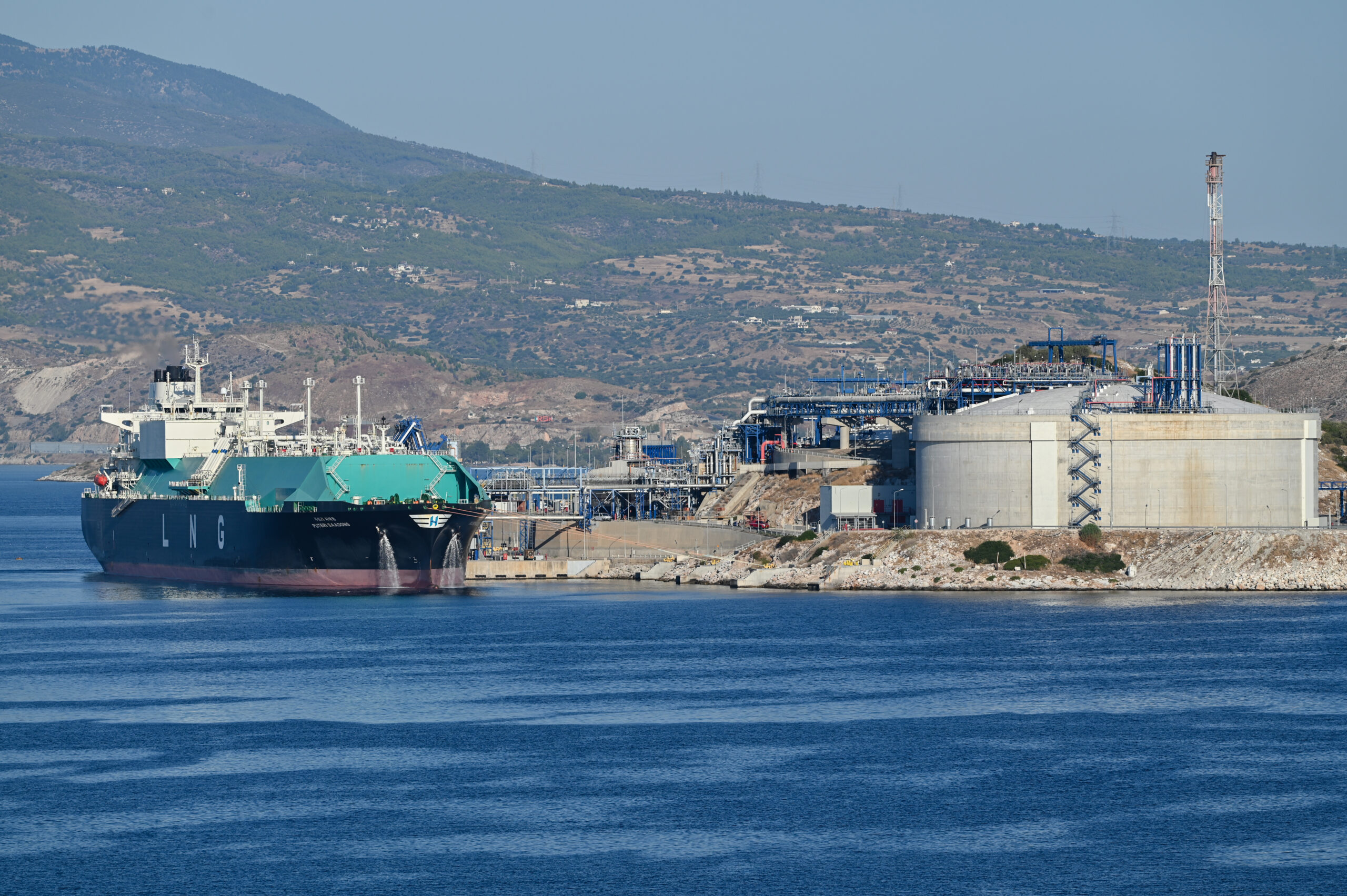
As Russia expands the bombardment of Ukraine’s civilian infrastructure, changes are taking place in the country’s energy sector with implications for the United States and the future shape of European gas markets. Since 2025, Ukraine has gone from having no meaningful direct relationship with US liquefied natural gas (LNG), to becoming one of the fastest-growing purchasers of American LNG in Europe. This transition underscores why Washington should view LNG sales to Ukraine as a strategic imperative. Russian attacks on Ukraine’s domestic gas production destroyed up to 60 percent of output capacity in 2025, forcing the country’s state-owned energy giant Naftogaz to rethink its import strategy. The response has been remarkable in terms of both speed and reach. Naftogaz has now established four distinct gateways for LNG imports from the United States. These include Poland’s Świnoujście terminal with Orlen, Lithuania’s Klaipėda terminal with Ignitis, a floating terminal at Mukran in Germany, and Greece’s Revithoussa terminal via the emerging Vertical Corridor, a north-south route through Bulgaria and Romania that the Trump administration has robustly backed. The numbers underline the pace of this acceleration. Ukraine contracted roughly 456 million cubic meters of LNG from the United States in 2025. During the first quarter of 2026 alone, the figure was 381 million, putting the country on track to dramatically increase its annual purchasing rate. Stay updated As the world watches the Russian invasion of Ukraine unfold, UkraineAlert delivers the best Atlantic Council expert insight and analysis on Ukraine twice a week directly to your inbox. There is a strategic dimension here that goes beyond import statistics. Ukraine sits atop the largest underground gas storage capacity in Europe of more than 30 billion cubic meters. Much of this storage capacity lies in western Ukraine, close to the border with the EU and at depths that offer real protection from Russian airstrikes. If logistical and security challenges can be successfully addressed, these storage facilities can potentially become as an important distribution hub for US gas serving Central and Eastern Europe. Europe is already on track to source roughly two-thirds of its LNG imports from the United States this year. This would position the US ahead of Norway as the continent’s largest supplier. Ukraine’s storage and import network offer a way to strengthen that position. This can help consolidate Europe’s turn away from Russian gas at a time when Russian LNG exports to some EU member states have been rising. With further investment to enhance connectivity, Ukraine can help provide Europe with the infrastructure to expand LNG imports and meet seasonal spikes in demand. Eurasia Center events This is where Ukraine’s US LNG purchases intersect with one of America’s most ambitious energy sector projects: The Three Seas Initiative. The initiative brings together thirteen EU states from the Baltic Sea to the Adriatic Sea and the Black Sea, with the goal of establishing a new north-south energy infrastructure serving Central and Eastern Europe. Launched during the first Trump administration, it has increasingly treated LNG diversification as its central energy mission, with US officials framing the region as the foundation of Europe’s energy future. Ukraine’s further integration would give the initiative something it has long lacked: A large-scale storage partner able to absorb and redistribute US gas across the region. The recently appointed Acting CEO at Ukraine’s Naftogaz, Sergii Fedorenko, has the necessary experience to take advantage of this opportunity. Fedorenko previously played a key role in the expansion of the country’s LNG imports and was instrumental in efforts to deepen cooperation with US, Polish, Lithuanian, and Greek partners. His appointment in July 2026 signals continuity rather than disruption. Further progress cannot be taken for granted and will require sustained US institutional engagement. This should include additional support for Ukrainian LNG imports and backing for Kyiv’s efforts to integrate the country’s gas industry infrastructure into the wider regional energy architecture. Ukraine now has an opportunity to consolidate its position as a strategic commercial ally of the United States and help ensure that emerging LNG corridors bringing US gas exports to Central and Eastern Europe become permanent features of the regional energy map. A greater Ukrainian role in support of US LNG exports to Europe would enhance the country’s energy security and boost European integration, while also contributing to the strengthening of long-term commercial ties between Europe and the United States. Crucially, the continued development of the Three Seas Initiative with Ukraine’s participation as a key storage partner can help ease Europe’s transition away from dangerous dependence on Russian energy exports. It would serve as a credible alternative for countries that have long looked to Moscow for energy supplies but now seek to reduce this reliance. For decades, Russian gas flowed west through Ukraine to European markets. This trade has been severely disrupted by the full-scale invasion of 2022, with European countries committed to ending Russian energy imports in the near future. Gas has now started flowing to Ukraine and into the country’s storage facilities from the United States. With sufficient additional support from Washington, this trend can benefit Ukraine, Europe, and the US economy. Stephen Blank is a senior fellow at the Foreign Policy Research Institute. Further reading The views expressed in UkraineAlert are solely those of the authors and do not necessarily reflect the views of the Atlantic Council, its staff, or its supporters. The Eurasia Center’s mission is to enhance transatlantic cooperation in promoting stability, democratic values, and prosperity in Eurasia, from Eastern Europe and Turkey in the West to the Caucasus, Russia, and Central Asia in the East. Follow us on social media and support our work Image: Nicolas Koutsokostas via Reuters Connect
Ukraine can play a key role enabling US energy exports to Europe
Full Article
Original Source
Read the full article at Atlanticcouncil →KhanList aggregates and links to publicly available news content. We do not host full articles from third-party sources. Always verify important information with original sources.