
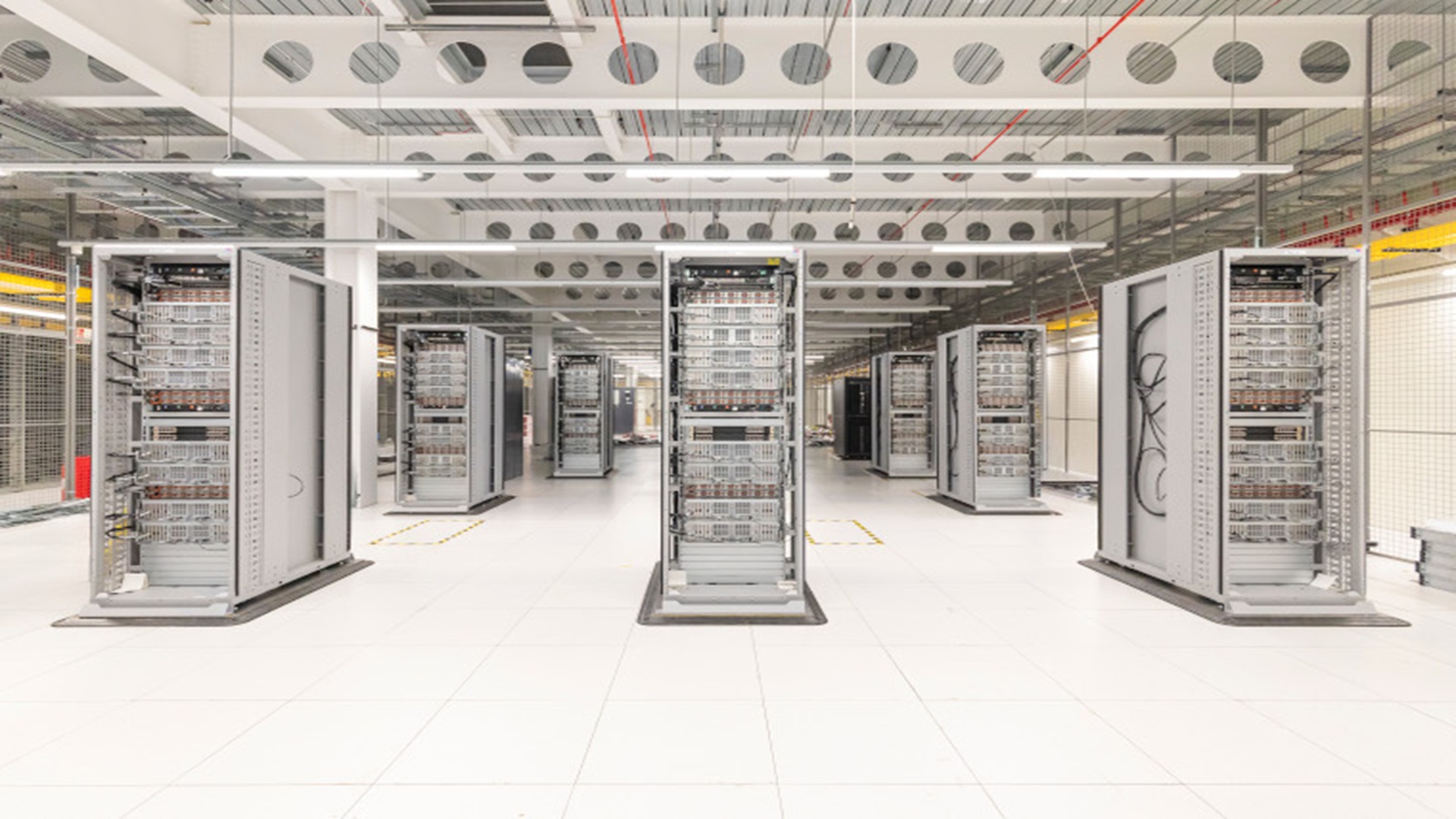
Two fusion supercomputers in the UK and US could be linked to train the same AI models on experimental data from separate fusion machines, potentially helping engineers design future power plants faster. The proposed SUNRISE-STELLAR-AI Federation would connect the UK Atomic Energy Authority’s (UKAEA) SUNRISE supercomputer with the Princeton Plasma Physics Laboratory’s (PPPL) STELLAR-AI platform. Researchers would use data from the MAST Upgrade facility in Oxfordshire and PPPL’s NSTX-U facility in New Jersey. The two facilities are compact spherical tokamaks with similar designs. That similarity could help researchers combine their experimental results and train models that are better at predicting how fusion plasmas behave across different machines. The partnership was announced at the Global Fusion Policy Summit in London on September 14. It builds on a memorandum of understanding signed by UKAEA and PPPL in June and is still at the stage of exploring how the computing platforms could be connected. Two machines, one model The proposed federation would allow both supercomputing platforms to train the same models using data from the two national laboratories. This matters because models trained using results from only one fusion machine can struggle when applied to another. By combining datasets, researchers hope to build machine-learning systems that capture more of the underlying physics and make more reliable predictions. The computers could also help fill gaps in experimental datasets through simulations, extending what researchers can study without running every scenario on a physical machine. “Fusion is one of the great scientific and engineering challenges of our time. To solve these challenges, fusion needs partnerships,” said Joe Milnes, Executive Director for Engineering and Computing at UKAEA. “The US and UK are two global leaders in fusion research, and the federation of SUNRISE and STELLAR-AI would build on a long history of transatlantic cooperation to further advance fusion development.” SUNRISE is the UK’s first AI supercomputer dedicated to fusion energy and is backed by £45 million in government funding. STELLAR-AI provides AI and high-performance computing capabilities at PPPL. The planned system is also intended to support the development of digital twins of the two tokamak facilities. Digital twins test fusion designs A digital twin would create a detailed virtual model of a fusion machine using data from experiments. Researchers could then use the model to test changes and predict machine behavior in software before attempting them on physical equipment. Rob Akers, Director of Computing Programmes and Senior Fellow at UKAEA, said the two laboratories could combine experimental data with simulations to explore operating conditions that have not yet been tested. “Together, we can develop digital twins of both machines to support the design of future fusion power plants, creating models of spherical tokamaks that are more predictive, more actionable and ultimately more useful to fusion engineers.” The federation could eventually support work on future projects including the UK’s Spherical Tokamak for Energy Production, or STEP Fusion, and PPPL’s proposed Spherical Tokamak Advanced Reactor. Researchers also plan to examine how computing jobs can move between the two platforms despite their different hardware. That would allow scientists to select the system best suited to a particular computational task. “Our goal is to let models and experiments move freely between the two systems. We will turn a collection of supercomputers into a single engine for fusion discovery,” said Shantenu Jha, Head of Computational Sciences at PPPL. The proposed federation is not yet an operational shared supercomputer, with the partners still working through its technical requirements and next steps. Get the latest in engineering, tech, space & science - delivered daily to your inbox.With over a decade-long career in journalism, Neetika Walter has worked with The Economic Times, ANI, and Hindustan Times, covering politics, business, technology, and the clean energy sector. Passionate about contemporary culture, books, poetry, and storytelling, she brings depth and insight to her writing. When she isn’t chasing stories, she’s likely lost in a book or enjoying the company of her dogs.
UK-US supercomputers team up to combine tokamak data and build smarter fusion twins
Full Article
Original Source
Read the full article at Interestingengineering →KhanList aggregates and links to publicly available news content. We do not host full articles from third-party sources. Always verify important information with original sources.