
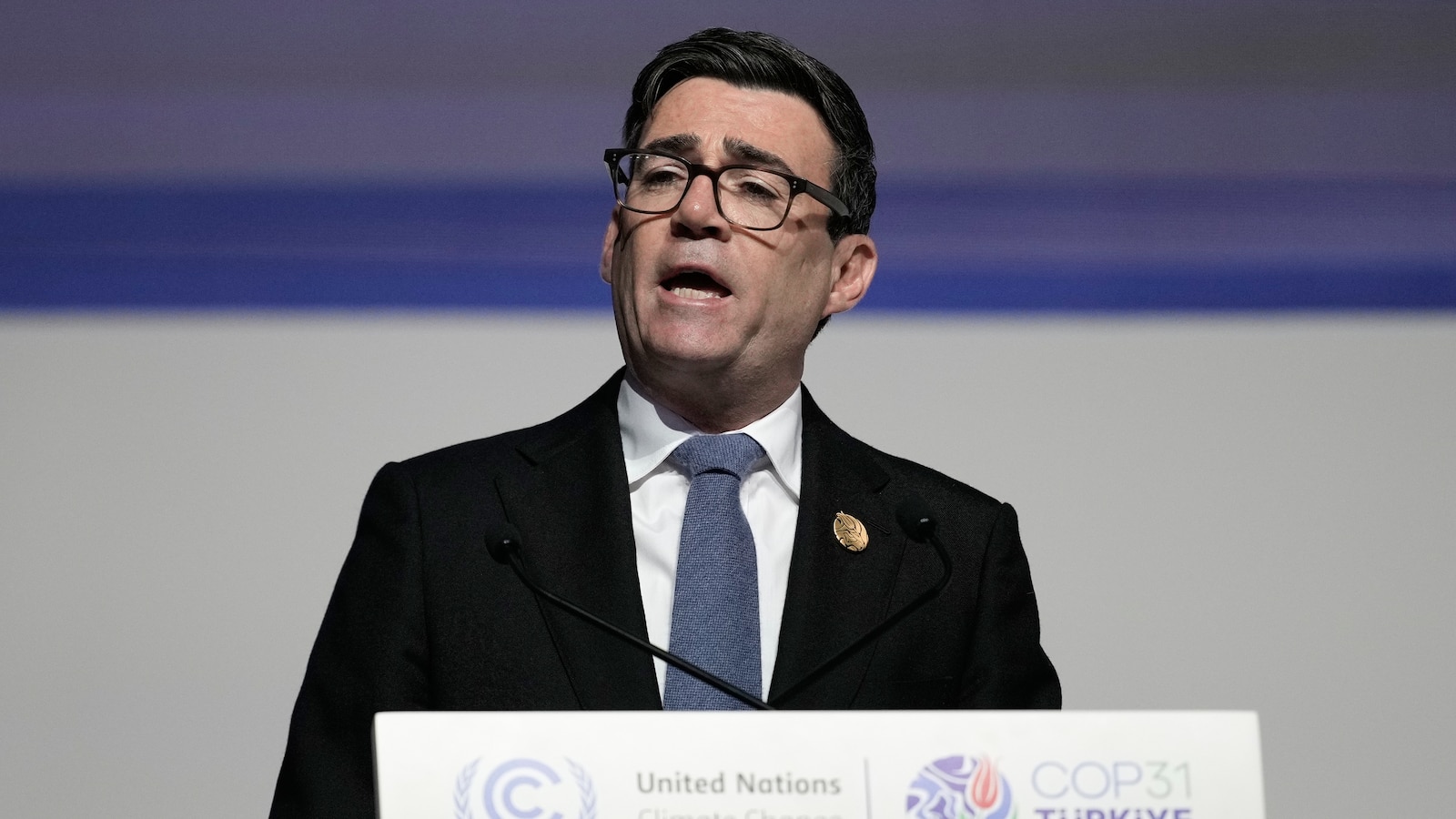
ANTALYA, Turkey -- The United Kingdom on Thursday announced the appointment of a special envoy to tackle security threats from climate change while small island leaders called for urgent action, describing the issue as a life-or-death issue for their people at the climate talks in the Turkish resort town of Antalya.“It is time to move past the talking," said Alix Sebastien Pillay, vice president of the Indian Ocean island of Seychelles. "For Seychelles, climate action is not simply an environmental priority. It is a fundamental issue to our national security, economic stability, sustainable development and our very survival.” Pillay was speaking on the second day of the leaders' summit at the U.N. climate summit, where government leaders addressed the state of a warming world and what to do about it. While all the globe is threatened by climate change’s souped-up storms, hotter heat waves, worsening droughts and floods, island nations are among the hardest hit as they also have to deal with rising seas swallowing up their land.Pillay said Seychelles is experiencing millions of dollars of damage as a result of storms and floods, made worse by climate change despite contributing few planet-heating gases that increase global warming.He said a U.N. fund created for compensating for climate-related loss and damage needs to be urgently strengthened. “Climate recovery must not come at the expense of our development or push vulnerable nations further into unsustainable debt.”Speaking at the talks, Dalton Tagelagi, prime minister of the small Pacific Island of Niue, said the El Niño conditions which have driven temperatures up across the world are a warning of what might happen if global warming is not controlled. “Sea temperatures in the central Pacific are more than three degrees above normal. It is a warning of what is coming if we do not cut emissions now," Tagelagi said.The comment came as a report said the world has failed to slow global warming trends in the past five years because plans weren’t realized and efforts that would have helped were canceled out.“Aggregated climate action has now essentially stalled for five consecutive years with positive and negative actions canceling each other out,” the independent Climate Action Tracker said in its report. The first five years after the 2015 Paris Agreement, the world did so much that it trimmed an entire degree Celsius (1.8 degrees Fahrenheit) from warming projections, but nothing has changed since, the report said.Climate change is caused mainly by the release of greenhouse gases, which happens when fuels like gas, oil and coal are burned. Confronting climate change means finding ways to drastically cut the amount of emissions put into the atmosphere each year. Countries establish plans to reduce emissions, called nationally determined contributions. The speed of reductions and ways to achieve them are different by country. Because collective efforts of countries haven't significantly reduced global emissions, the world is now “headed toward an irrecoverable overshoot of 1.5 degrees Celsius” (2.7 degrees Fahrenheit) above pre-industrial temperatures, which is the warming threshold the world adopted during the Paris Agreement, according to the report. The report said if the nations of the world fulfill all their climate promises — which is a big if — the globe will end the century 2.6 degrees Celsius (4.7 degrees Fahrenheit) warmer than preindustrial times. That’s the same pace the globe was on in 2024 and 2025, showing that new promises made last year have “failed to move the needle” of projected warming, said report lead author Sarah Heck, a climate policy analyst at Climate Analytics.“This is still not enough,” Heck said. “Countries really do need to strengthen their targets.”On Thursday, British Prime Minister Andy Burnham announced the appointment of a special representative to deal with security risks from the climate crisis, one of the first such appointments anywhere in the world.“Climate is a national security issue,” Burnham said at the summit. “The climate crisis is not a distant threat. It is upon us all now devastating lives and livelihoods everywhere."Popular ReadsHe said Britain would place climate resilience high on the agenda when it assumes the G20 presidency next year.The appointment of Madeleine Alessandri as special representative for climate security follows a British government assessment earlier this year warning that damage to ecosystems, driven partly by climate change, could disrupt food supplies and fuel conflict and migration since the island-nation imports about 40% of its food. Climate change poses security risks worldwide by worsening food and water shortages, displacing communities and aggravating existing tensions, according to the United Nations.“The future we feared has become the present we are living. Climate change knows no borders. No nation can face it alone. Solidarity must mean real action,” said Pakistani Prime Minister Shehbaz Sharif. Sharif, like many other leaders from countries ravaged by climate impacts, said adequate financing needs to be made available to deal with climate disasters, such as the 2022 floods in Pakistan that submerged over a third of the country and resulted in thousands of deaths and over $30 billion in damage.A day earlier, Marshall Islands President Hilda Heine described fossil fuel expansion as "something to fear."“Every new oil well drilled, every piece of coal extracted is a threat to my country’s future," Heine said. “No one has the right to pollute their neighbors.”Heine recalled coral that she watched go from “bright and lush” to white with bleaching this year. She said the response of the world to the inevitability of passing the 1.5-degree warming limit target “must be overwhelming or the world we know is over.”To fight climate change, the rich world needs to not just promise more, but also deliver more money to poor nations to help them recover from climate damage and adapt to a warmer world, Barbados Prime Minister Mia Mottley said Wednesday.“Pledges are not payments. But even the promised pledges are now 70% below previous levels,” Mottley told her fellow leaders. “So the applause in this room, let us be clear, has never rebuilt a single home in any country.”___Webber reported from Chicago, Borenstein from Kensington, Maryland, and Arasu from Bengaluru, India. ___The Associated Press’ climate and environmental coverage receives financial support from multiple private foundations. AP is solely responsible for all content. Find AP’s standards for working with philanthropies, a list of supporters and funded coverage areas at AP.org.
UK names a climate security envoy as island leaders warn of a 'life-or-death' crisis
Full Article
Original Source
Read the full article at Abcnews →KhanList aggregates and links to publicly available news content. We do not host full articles from third-party sources. Always verify important information with original sources.