
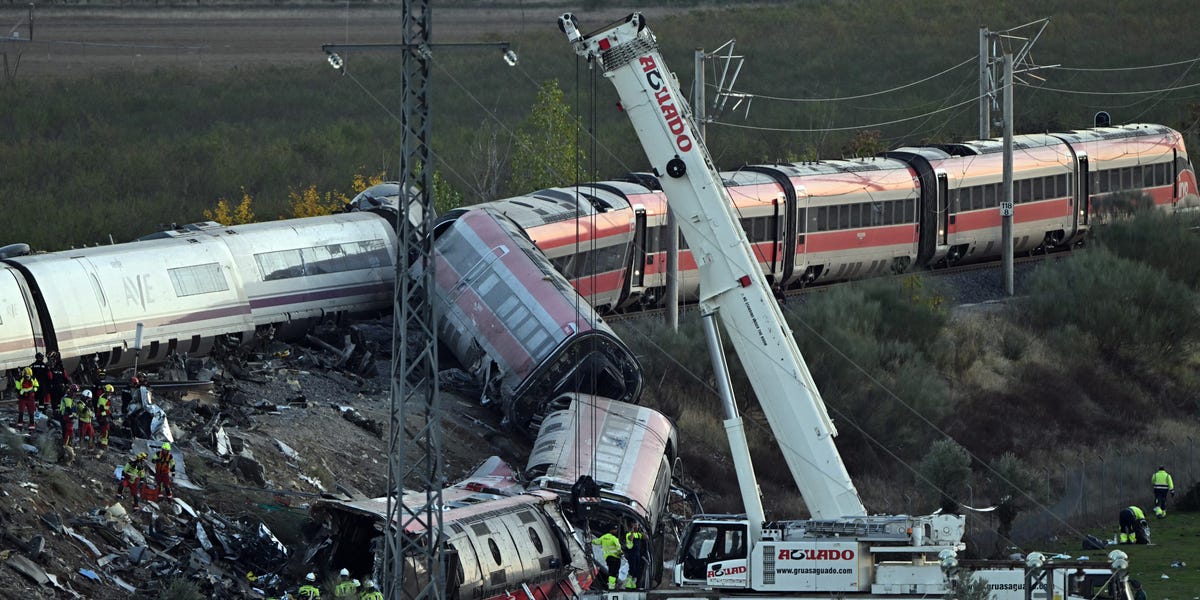
When a high-speed Renfe AVE train traveling from Madrid to Seville, Spain, suddenly stopped on the morning of Wednesday, October 28, passengers were told that the line was busy with other trains. But then their train started moving again—and soon, a violent jolt sent people grabbing for their seats, according to passenger accounts.The AVE had slammed into the back of another high-speed train, operated by Iryo and also bound for Seville, that was stopped on the tracks near Urda, in Toledo province. Passengers broke open windows to escape. By Thursday morning, at least 69 people had died, and more than 100 people were reported injured as a result of the violent collision.On the Iryo train, the driver had also received instructions to restart her train-protection equipment and resume normal running. But she called the control center run by Spain’s rail infrastructure manager, Adif, to report that the equipment wouldn’t boot back up—and her train stayed stopped, according to radio transcripts published by Cadena SER, a Spanish broadcaster.How Spain’s Train-Protection System WorksThe obvious question: Why was one train traveling toward another that was stopped on the same track?Earlier that morning, a computer malfunction had knocked out a train-protection system called LZB, according to Spain’s transport minister, Óscar Puente. Around 8:30 a.m., the malfunction caused six trains to stop automatically, Puente said. Six minutes later, the control center authorized the Renfe train to resume normal running, even though a red warning was showing that the Iryo ahead was occupying the track, he said.LZB helps a train driver know what’s coming up ahead. If a train is equipped with LZB, it sends its position and braking characteristics to equipment near the tracks through a cable along the railway. That equipment then sends information back to the driver’s compartment, including how fast the train can travel and how far it is from the point where it has to slow down or fully stop. If the train reaches LZB’s automatic-braking threshold, the system hits the emergency brake.JAVIER SORIANO//Getty ImagesWhat Happens When LZB Stops Working?But when LZB goes down, drivers still have other ways to navigate. Trains can keep going under trackside signaling, where drivers obey signals positioned along the line. The Madrid–Seville line also uses a system called ASFA, which picks up information from devices on the track and can automatically apply the brakes if the driver doesn’t respond as required. Investigators are examining whether additional failures in the train-protection equipment contributed to the collision near Urda.Under trackside signaling, a red light tells the driver to stop. But depending on the conditions, drivers can still pass the signal with specific authorization and compliance. Under what’s called “on sight” instructions, the driver must travel slowly enough to stop short of another train or obstacle. Puente said the Renfe train should have been limited to 40 kilometers per hour, or about 25 mph. On Wednesday afternoon, Euronews reported that authorities were still examining data to establish how fast the Renfe train was going.Another driver whose train had stopped during the outage questioned the same instruction to resume normal running, Puente said after listening to recordings of the exchanges. The driver reminded the controller that the train needed to proceed on sight. Investigators still need to learn why the Renfe train was told otherwise and what happened after it resumed travel.The collision near Urda came just nine months after another deadly crash involving trains operated by the same two companies near Adamuz in southern Spain. That January collision began when an Iryo train derailed into the path of a Renfe train traveling in the opposite direction, rather than one approaching from behind.Could a Similar Train Crash Happen in the U.S.?In a situation where continuous train-protection systems were interrupted and drivers were forced to rely on signals and instructions, it’s fair to wonder: Could a similar collision happen in the U.S.?American railroads use a system called Positive Train Control (PTC), which can automatically slow a train to help prevent collisions. Like LZB, it provides automatic protection, though the technologies and operating rules can vary. But even when PTC is working, railroads sometimes allow a train onto a stretch of track where another train is already traveling—or has stopped.That’s exactly what happened near Easton, Pennsylvania, on March 2, 2024, when an eastbound Norfolk Southern freight train had stopped because of traffic ahead. A second freight train approached from behind and passed a trackside signal that gave it permission to enter the same section at restricted speed.But why was it allowed in at all? As the National Transportation Safety Board (NTSB) explained in its final report, it’s because keeping trains closer together can help a railroad move traffic through a busy area—as long as the crew of the approaching train can stop short of the train ahead.In Easton, the engineer knew another train was ahead, but as he later told investigators, he thought it was still moving. As his train came around a curve, elevated ground and vegetation obscured the track ahead. By the time the engineer saw the stopped freight, it was about eight railcar lengths away. He tried to slow down, primarily using the locomotive’s dynamic and independent brakes, but they didn’t do much to reduce speed in the final 17 seconds. His train hit the other one at 13 mph.The collision derailed cars from the approaching train onto the neighboring track. Just over a minute later, a westbound freight struck them, derailing locomotives and more cars. Four crew members suffered minor injuries in the two collisions. The approaching train’s PTC was enforcing the maximum speed permitted by the signal—but that signal also meant the engineer had to go slowly enough to stop within the distance the rule required.OSCAR DEL POZO//Getty ImagesWhy Positive Train Control Can’t Prevent Every CollisionA crew operating at restricted speed must be able to stop the train within half the distance of clear track visible ahead. This helps ensure it can stop before reaching another train, a worker, or an obstruction. Let’s say a curve leaves 400 feet of clear track in view. The train must then be able to stop within 200 feet, even if that means going slower than the federally defined 20-mph maximum—or a lower limit set by the railroad.At Easton, while the engineer did keep his train below the speed limit, he was still going too fast to stop. The NTSB identified his failure to follow the restricted-speed rule as the probable cause of the crash. Investigators also found that while PTC could enforce the speed limit, it couldn’t prevent this restricted-speed collision.The accident in Easton wasn’t the only time a train couldn’t stop under a restricted-speed rule. In September 2026, the Federal Railroad Administration (FRA) described seven recent collisions involving failures to follow those rules or related signals. The FRA warns that PTC can often enforce an upper speed limit during restricted-speed operation without ensuring that the train can stop within half the distance the crew can see.Back in Spain, the Renfe driver was told to resume normal running. But we still don’t know the cause of the collision, as investigators are examining the instructions given to the trains and whether additional safety failures contributed to the crash.Here in the U.S., the FRA has urged railroads to check whether crews following other trains into occupied sections are staying below the speed limit and can stop within half the distance of clear track ahead.Andrew Daniels is the Director of News for Popular Mechanics, Runner's World, Bicycling, Best Products, and Biography. In a past life, he was a senior editor at Men’s Health and wrote for Playboy, among lots of other publications that have since deleted his work. He’s also the author of The Barstool Book of Sports: Stats, Stories, and Other Stuff for Drunken Debate, which one Amazon reviewer called “the perfect book for the crapper,” and another called “moronic.” He lives in Allentown, Pennsylvania with his wife and dog, Draper.
Two Trains Collided in Spain—and Killed 69 People. The Terrifying Truth? It Could Also Happen in the U.S.
Full Article
Original Source
Read the full article at Popularmechanics →KhanList aggregates and links to publicly available news content. We do not host full articles from third-party sources. Always verify important information with original sources.