
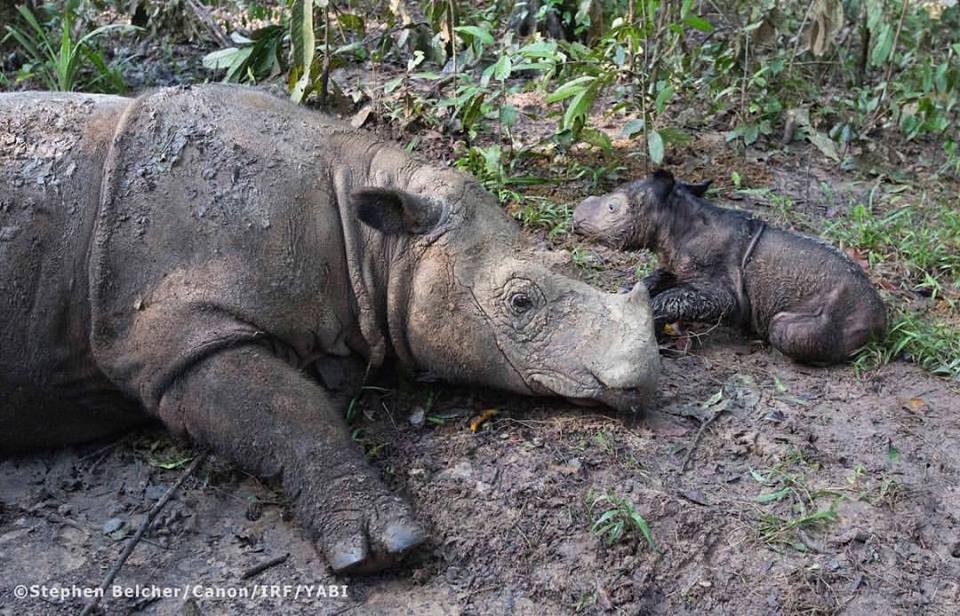
Two near-extinct Sumatran rhinos are pregnant at a sanctuary in Indonesia, offering a rare boost for a species that numbers only a few dozen in the wild.The pregnancies are the latest result of a decades-long captive-breeding effort aimed at helping the solitary animals reproduce as their wild populations become increasingly isolated.But the expected births also underscore the challenges of managing a small captive population with limited genetic diversity: the pregnant females are related, as are the two sires. Two critically endangered Sumatran rhinos are pregnant at an Indonesian sanctuary, a rare success for a species reduced to a few dozen animals in the wild. The pregnancies also highlight the genetic constraints facing the country’s captive-breeding program. Indonesia’s Ministry of Forestry and the NGO Yayasan Badak Indonesia (YABI), which manages the sanctuary, announced the pregnancies on Oct. 3. A female named Ratu is carrying her fourth calf, fathered by Andalas, while her daughter Delilah is carrying her second calf, fathered by Harapan. Both are due around May 2027. Ratu was captured from the wild in Sumatra in 2005, while Andalas and Harapan, who are full brothers, were born at Cincinnati Zoo in the U.S. in 2001 and 2007, respectively. Delilah was born to Ratu and Andalas at the Sumatran Rhino Sanctuary in 2016 — meaning the father of Delilah’s calf is her paternal uncle. Experts at the Sumatran Rhino Sanctuary seek to pair the least-related males and females possible, Nina Fascione, executive director of the International Rhino Foundation, told Mongabay in an email. They also must consider factors such as differences in body size, she said, but their choices are limited by the small number of rhinos under human care. The 11 animals in Indonesia’s breeding program are the only captive Sumatran rhinos in the world, and all of the males in the program are related. “The current critical situation outweighs the genetic diversity considerations,” Fascione said. Ratu, a captive female Sumatran rhino, is expecting her fourth calf. Image courtesy of the Indonesian Ministry of Forestry. A milestone If Ratu’s calf is born healthy, it would establish a new reproductive milestone for the species, said Ahmad Munawir, director of species and genetic conservation at the Ministry of Forestry, in the official statement. Ratu would be the first known Sumatran rhino to give birth to four calves, exceeding the previous record of three held by a female at Cincinnati Zoo. The U.S. zoo also features prominently in the ancestry of the captive rhinos at Way Kambas. Every male in the sanctuary’s captive population traces its lineage to Ipuh and Emi, Sumatran rhinos captured in the wild and later housed at Cincinnati. Two of their offspring, Andalas and Harapan, were brought to Indonesia for breeding efforts. Jansen Manansang, executive director of YABI, said veterinarians would continue monitoring both mothers throughout their pregnancies. “The SRS medical team will conduct intensive monitoring to ensure that Ratu and Delilah progress well through their pregnancies and give birth to healthy calves,” he said in the official statement. Delilah, a female rhino born at the sanctuary, is expecting her second calf. Image courtesy of the Indonesian Ministry of Forestry. The Asian Rhino Specialist Group at the IUCN, the global wildlife conservation authority, estimates that only 34 to 47 Sumatran rhinos (Dicerorhinus sumatrensis) remain in the wild in Indonesia. The animals survive in several isolated groups, with the largest population believed to be viable found in the Leuser Ecosystem at the northern tip of the island of Sumatra. The fragmentation makes natural breeding increasingly difficult. Unlike many other large mammals, Sumatran rhinos are solitary, and males and females need to encounter one another over large areas of rainforest to mate. Very small populations can therefore suffer from a demographic problem in addition to habitat loss and poaching, as there may simply be too few animals living close enough together to find mates. The captive-breeding program at Way Kambas was established in part to address that problem. The rhinos live in large forested enclosures designed to approximate their natural environment, while keepers and veterinarians provide reproductive and medical care. So far, five calves have been born at the sanctuary since the Sumatran rhino captive-breeding program began in 1984, the most recent in 2023. The newly announced pregnancies have both reached about eight months of gestation, which is significant because Sumatran rhinos reproduce slowly, with gestation lasting about 15 to 16 months, and calves remaining dependent on their mothers for up to two years. Miscarriages — due to lack of natural breeding that subsequently creates problems with reproductive systems — have also been reported at the sanctuary, with Ratu suffering two miscarriages before successfully giving birth to her first calf, Andatu, in 2012. Another rhino, Rosa, experienced eight miscarriages before delivering her first calf, Sedah Mirah, in 2022. “This is why every successful pregnancy is a reason to celebrate and gives hope for the future of the species,” Fascione said. Ratu gave birth to Delilah in 2016; Delilah now awaits her second calf. Image courtesy of the International Rhino Foundation Credits Topics
Two rare pregnancies spark hope for Sumatran rhinos — but also concerns about inbreeding
Full Article
Original Source
Read the full article at News →KhanList aggregates and links to publicly available news content. We do not host full articles from third-party sources. Always verify important information with original sources.