
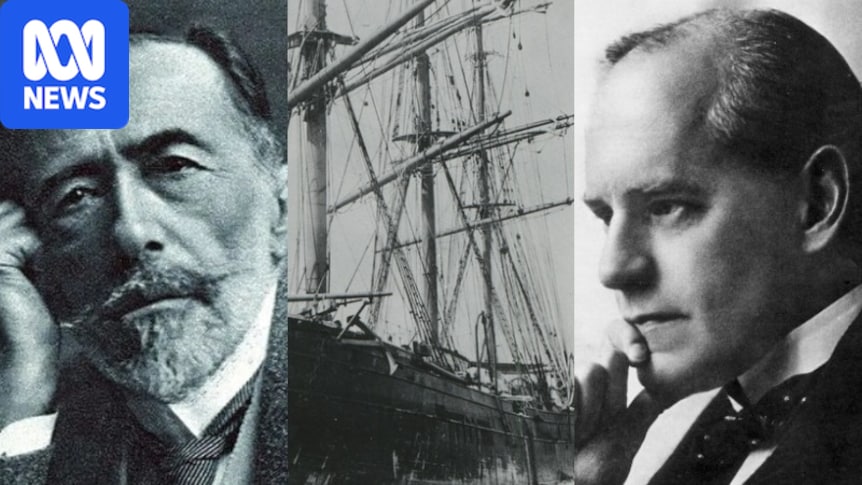
The oceans of the world do not allow us to retrace our steps, for the simple reason that the nature of waves is not conducive to the creation of footprints.But that doesn't mean treasure can't be pursued on the high seas of history.Indeed, it's on those waters that the scholarly wayfarer encounters strange flotsam, sometimes in the form of other human beings.When a young English law graduate met a Polish sailor aboard the clipper ship "Torrens" at Port Adelaide in 1893, neither could have realised they were participating in a moment that would fascinate future generations.But the lawyer was nevertheless prompted to write of the sailor: "He is a man of travel and experience in many parts of the world, and has a fund of yarns on which I draw freely. He has been right up the Congo and all around Malacca and Borneo and other out of the way parts."The most arresting clue in that description is the word "Congo". The portrait is of Józef Korzeniowski, better known to subsequent generations of readers as Joseph Conrad. The novelist's name is now associated with a series of masterpieces, including Heart of Darkness.A contested work, it has long since occupied an exalted place in the post-colonial canon as an indictment of European brutality in Africa, and was the inspiration for the film Apocalypse Now.Heart of Darkness was the inspiration for Apocalypse Now. (AFP/Zoetrope Films)Conrad's portraitist and fellow seafarer was John Galsworthy — a man who would attain an equal literary eminence.In 1932, he was honoured with the Nobel Prize, which was awarded to him largely in recognition of his social saga about a typically myopic upper-middle-class Edwardian family (the wryly named Forsytes) whose members are riven by conflicting senses of duty.The meeting of the two budding authors on the Torrens was purely serendipitous, but its ripples spread across the lives and works of both men, and continue to reach us today.Much has changed since the Torrens docked in 1893, but the maritime atmosphere remains. (ABC News: Che Chorley)Paths to, and from, a meetingIn 1893, neither Conrad nor Galsworthy was a published novelist, let alone a public figure, and the paths by which they converged on Port Adelaide were as dissimilar as they were remarkable.Conrad was the more worldly man. Born in 1857 into minor nobility in what is now Ukraine, he was the son of an insurgent opposed to Russian rule over Poland.A newspaper article from 1941 on the friendship between John Galsworthy and Joseph Conrad. (Trove: The Advertiser)After resolving while still a child to become a sailor, Conrad voyaged the world and made several journeys to Australia, collecting material for stories along the way.The Oxford-educated Galsworthy, on the other hand, was sent to sea by his father in order to hone skills in maritime law.He also hoped to cross paths with Scottish writer Robert Louis Stevenson, who had settled in Samoa.Instead, he found Conrad."In that meeting commenced one of the most loyal of personal and literary friendships, which grew deeper and stronger throughout all the subsequent years," The Age newspaper later reported.The clipper ship "Torrens" docked at Port Adelaide. (State Library of South Australia B 11871)The pair spent weeks aboard the Torrens before Galsworthy disembarked in South Africa.Conrad, who was already at work on his first novel, was perhaps less liable to literary influence than was the impressionable Galsworthy.In a late essay that was also an obituary to his old friend, the Englishman reflected on the times he stayed with Conrad and his wife Jessie, and on the impact Conrad had on his own career."[Conrad] was indefatigably good to me while my own puppy's eyes were opening to literature, and I was still in the early stages of that struggle with his craft which a writer worth his salt never quite abandons," Galsworthy wrote.A portrait of John Galsworthy from 1909. (National Portrait Gallery/Creative Commons)Further light is shed by Elsie Belle Champion, a Melbourne booklover who both visited and corresponded with Galsworthy.Newspaper reports from the 1930s attribute to her the following remarks:"Galsworthy told me that he first thought about writing after having met Joseph Conrad in Adelaide. They had many talks on literature on the ship's bridge at night."Ashes to ashes, waves to wavesNeither Galsworthy nor Conrad reached especially old age — Galsworthy died aged 65 and Conrad at 66 — but each, in a sense, achieved a tragic longevity.Both came from backgrounds that suited them for leisure and comfort, but both lived into a time in which it was increasingly impossible to ignore the plain fact of human misery, or to insulate oneself from the impulse to do something about it.They were not temperamentally suited to what is today called "activism" — which, in any case, is the wrong word for the way in which both responded to the iniquities of the time.European civilisation had produced things (art, culture and modes of living and thinking) they could not help but value, and its greatest gift to them was a kind of urbane conscience.But it was that exact same conscience that compelled these two men to attack at the base some of the unconscionable foundations upon which their own privilege rested.A memorial service was held for Galsworthy at Westminster Abbey, following his death in 1933. (Reuters: Clodagh Kilcoyne)They would perhaps not have wished it thus, but they are best remembered by us as pallbearers of empire. "We had been celebrating not only the departure of a noble character and a great writer, but the obituary of an age," journalist Henry Nevinson wrote after the public memorial service for Galsworthy, at Westminster Abbey in 1933.It was an age, Nevinson added, that "was crumbling into the ashes".Galsworthy had sung the swan song of a social class that prided itself on rectitude but that achieved decorum through a great deceit. It was Conrad who traced this deceit to its source. In Heart of Darkness, he savaged the savagery then being inflicted on those deemed "savages".After his death in 1924, Conrad was laid to rest in the cathedral city of Canterbury.A ferry sails across the English Channel towards Dover on the Kent coast, not far from Conrad's resting place in Canterbury. (Reuters:Toby Melville)Scottish author Robert Cunninghame Graham accompanied him on his final voyage, from church to burial ground, and penned a poignant reminiscence of the moments that followed the sinking of Conrad's coffin into the soil."And so we left him with his sails all duly furled … and with the anchor holding truly in the kind Kentish earth," Graham wrote."The gulls will bring him tidings as they fly past above his grave, with their wild voices, if he should weary for the sea."
Two men met on a Port Adelaide ship — a Nobel and Apocalypse Now ensued
Full Article
Original Source
Read the full article at Abc →KhanList aggregates and links to publicly available news content. We do not host full articles from third-party sources. Always verify important information with original sources.