
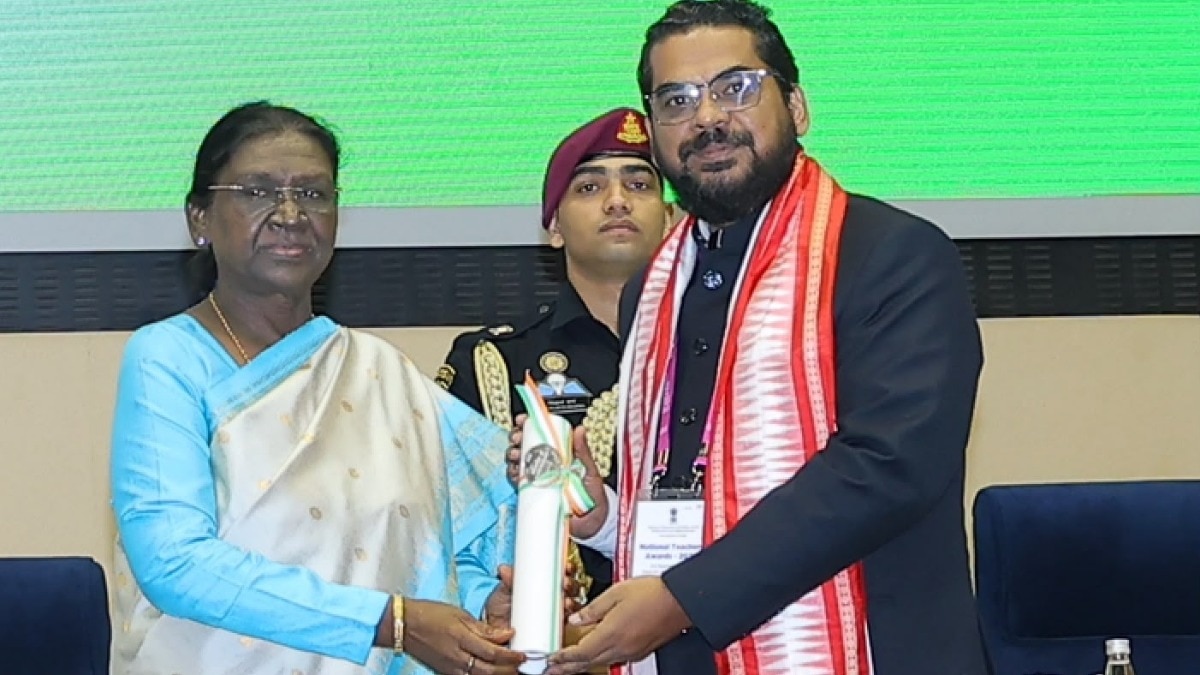
When Professor Ankuran Dutta looks at the National Teachers’ Award he received this year, he sees more than his own journey.He sees his mother, a school teacher and writer of children's literature, who received the National Teachers’ Award in 2010. He sees his father, another teacher, whose hands have spent more than six decades shaping clay and wood and whose replicas of Assam's historical and cultural landmarks stand as a testament to his artistry. And he sees his late wife, Dr Anamika Ray, herself a brilliant teacher, whose belief, intellect and companionship shaped his life and work.Then there is his daughter, Anrini, whom Dutta has raised since she was three, after losing her mother 11 years ago. Prof Ankuran Dutta while receiving the National Teachers Award 2026 from the President of India on September 5 at Vigyan Bhawan in Delhi Sixteen years after his mother received the national honour, Dutta, head of the Department of Communication and Journalism at Gauhati University, Assam, has received the same award in higher education. He is the first person from Assam to receive the national award in higher education. For Dutta, however, the recognition is not a destination. It is another reminder of what he believes a teacher owes to students.“If I am not able to guide someone, at least I must never misguide them,” he says.A TEACHING LEGACY THAT BEGAN AT HOME Dutta did not begin his career as a teacher. Before he stood before a classroom, he worked as a freelance journalist in print and television. But somewhere between deadlines and headlines, he felt a different calling.In 2004, nearly 22 years ago, he came to Guwahati from his hometown in Upper Assam and founded a media education centre at Cotton College, at a time when media education was not yet a widely established field.It was a leap of faith. He has never regretted it. The instinct to teach, however, had been shaped much earlier. Prof Dutta with PM Modi during the National Teachers Award 2026 Both his parents were school teachers known for their dedication. His mother was also a writer of children's literature whose gentle wisdom extended beyond the classroom. In 2010, the nation honoured her with the National Teachers’ Award.His father was honoured with the title "Guru Mahiyan", a mark of reverence. He is also a sculptor who has worked with clay and wood for more than six decades. Replicas of the Rang Ghar and several of Assam's historical and cultural monuments are among the works that reflect his artistry.Dutta grew up watching both parents teach and create.“Teaching is less a profession than a way of living, a light you carry and pass on,” he says.That idea eventually became his own.THE WOMAN HE STILL CARRIES INTO THE CLASSROOMThere is another name that Dutta returns to when he speaks about his journey: his late wife, Dr Anamika Ray.They studied together, grew together and wrote together. Ray was a teacher herself, and Dutta describes her contribution to his journey as the greatest of all.Her belief steadied him. Her intellect sharpened him. Her presence made his efforts meaningful.He lost her 11 years ago. Yet, he says, she has never truly left his classroom.In every lecture and every moment when a student experiences a spark of understanding, he feels something of her encouragement.Her memory has also found its way into his work. A charitable educational trust bears her name, while an audio hardware initiative called AAHBAN was named in her memory.The National Teachers’ Award has therefore brought both recognition and absence into the same moment.“She is not here to see this day, and that absence is part of the honour’s weight,” Dutta says. But he imagines what she would have told him.“I like to believe that somewhere in the quiet, she would simply smile and say, ‘Now go back to your students'.”And that is exactly where Dutta believes he belongs.THE DAUGHTER HE HAS RAISED WHILE TEACHING OTHERSAt home, Dutta says, he is not a professor. He is the father of Anrini, whom the family calls Aalphul, meaning “from tender”.Anrini was only three when she lost her mother in Delhi. For more than 11 years, Dutta has tried to be both mother and father to her. He knows that he cannot replace her mother. But he has never stopped trying to be present.Anrini wants to become an artist, and Dutta encourages her. His own father has been an artist all his life, and Dutta says he always wanted to be one himself. Instead, he became known as a communicator.A professor friend from the United States once told him that he was a communicator, not an artist. Dutta still questions that distinction.He has written poems and stories, trained in classical music, made films and photographs, produced radio features and directed puppet plays. Perhaps, he says, what he could not become himself, he can give his daughter the freedom to become.He wants her to grow into a person of compassion who is also well-spoken.That is partly why she was given the middle name Priyambada — a hope that she will be logical but articulate with kindness, and able to acknowledge others publicly rather than only behind closed doors.He tells her that meditation should ultimately be visible in the way a person behaves with others.Prayer or silence, he believes, means little if it does not make people gentler.THE PROFESSOR WHO PRACTISES BEFORE HE TEACHESDutta's teaching philosophy rests on an idea he calls the “practitioner-researcher”. He does not believe a teacher of media should stand at a safe distance from the subjects being taught. Before asking students to study community radio, he built one.Jnan Taranga became the first community radio of Northeast India, followed by e-Jnan Taranga, its first web radio.Before teaching educational media, he established a multimedia production centre and produced hundreds of audio and video programmes.When the Covid-19 pandemic brought an “infodemic” alongside the health crisis, he did not simply teach the theory of misinformation. He worked on the Check the Fake campaign and COVID Katha, and took puppetry into villages to communicate about health, nutrition and school dropout.When he taught science communication, he produced hundreds of programmes on public understanding of science and received his first national award for science communication from the Government of India.Before teaching health communication, he had drafted a charter of Patients’ Rights and Responsibilities and taken it into hospitals.Before teaching cultural theories, he had already initiated thousands of cultural activities and learnt from those experiences.“Practice gives me the questions, and research gives me the discipline to answer them honestly,” he says.His films, including Stalking the Storks and the ethnographic journey of a Baul singer in Khepa Bauler Banshi, taught him patience and humility before a story.His work, consultancies and projects with the Ministry of External Affairs, ICCR, Commonwealth of Learning, UNICEF, UNESCO, CEMCA, ICRC, York University, Ohio University, University of Essex, UCLA, different ministries of India and Sri Lanka, and grassroots organisations across South Asia have also taken him far beyond the conventional classroom.His teaching presentations are freely shared under open licences, while curricula he designed are now used by several universities.For Dutta, experience gives knowledge weight.WHAT THREE YEARS IN COLOMBO TAUGHT HIMFrom December 2022 to January 2026, Dutta served as Director of the Swami Vivekananda Cultural Centre at the High Commission of India in Colombo, with the diplomatic rank of First Secretary.He returned to the classroom in February.He does not describe those three years as a break from teaching. Instead, he considers them one of the deepest field-study periods of his career — an opportunity to understand international communication and India's soft power diplomacy from inside.With his team, he organised more than 1,200 activities over three years, ranging from yoga festivals and Sanskrit gatherings to film retrospectives, exhibitions, book releases and the Gita Mahotsav.The centre drew more than 10,000 visitors a month and was recognised as the best among India's 37 cultural centres worldwide.But Dutta says the numbers were not what mattered most.It was the people.A monk learning spoken Sanskrit. A young artisan meeting a craftsman from across the Palk Strait. A student discovering Indian culture for the first time.Much of his work involved translation.The Bargeets of Srimanta Sankardev and Madhabdev were translated into Sinhala, and performed in a foreign language for the first time in more than 500 years. The Hatha Yoga Pradipika was translated into Sinhala, while Panchatantra and Jataka stories were adapted for children.He worked on books including Civilisational Twins, Ramayana in Sri Lanka and Sacred Shrines of Sri Lanka.Dr Bhupen Hazarika's Manuhe Manuhar Babe was sung in Sinhala and Tamil.A puppet play based on the Sundar Kand, performed through Sri Lanka's own string-puppetry tradition, was included in a welcome for the Prime Minister of India.There was also institutional work: a Hindi course at the Open University of Sri Lanka, another at Kotelawala Defence University, the Tagore Foundation at the University of Visual and Performing Arts, the Prof Ranganathan Centre at the University of Kelaniya, Bharat Kosh at the Colombo Public Library and a concept note for a national film school in Sri Lanka. Prof Dutta also edited books on the shared heritage of India and Sri Lanka, including Civilisational Twins (Prof Dutta with Sarbananda Sonowal) Dutta says the experience taught him that soft power lasts longest when it becomes a classroom, library or course that survives the diplomat.Now, when he discusses soft power with students, he draws from experiences in Anuradhapura, Kandy, Jaffna and Colombo.For communication students, he says, diplomacy is ultimately communication practised at the scale of nations.His earlier two-year stint at CEMCA, where he worked extensively across India, Bangladesh, Maldives, Malaysia and Pakistan, had similarly broadened his understanding of communication.Those years, he says, made him a better learner and, he hopes, a better teacher.THE STUDENTS WHO TAUGHT HIM WHAT TEACHING MEANSDutta cannot identify just one student who made him proud. His memories come in smaller moments.Former students sometimes stop him on the road to the airport, where Gauhati University is located, just to ask, “How are you, Sir?” and then ask about his daughter.A former ULFA cadre once welcomed him into her home and remembered his classes at Central Jail.A Panchayat president acknowledged his lessons on digital literacy during a speech at a weekly market.Someone from an extremely marginalised community has spoken to others about his radio sessions.Another student told him that teachers were using his open-access presentations with attribution.For Dutta, these moments are a better report card than marks or positions.He says he has never seen a student of his deliberately turn away to avoid greeting him.He knows students find him strict.But he hopes they eventually remember that the strictness was about fairness.One student, deeply fond of him, missed an MPhil seat by one or two marks. The student was hurt, but Dutta refused to intervene. A teacher's heart, he says, can pull one way while a teacher's duty pulls another. Had he favoured the student, someone else who had earned the place would have lost it. Today, that former student is doing good work in health communication.Dutta says he is proud — not because he gave the student something, but because the student found his own way.Another former student criticised him after news of the award, which Dutta believes was based on misinformation. He holds no grudge.He remembers that when he was conducting the student's examinations, he personally ensured the student did not miss a first class by one or two marks. “What he deserved, he had to get, no less,” he says.For Dutta, the incident is painful precisely because the student was his own. He sees it as a reminder that there is always something more a teacher can teach.A CLASSROOM THAT STARTS AT NINEWalk into Dutta's department on an ordinary morning and he says students will find him in the classroom at nine. The press, the radio station and administrative files come later.“I have always felt that I am accountable to my students before I am accountable to administration,” he says, adding that a teacher who is absent from the classroom has, in a quiet way, already resigned from it.His classroom discussions may move from a PowerPoint to a conference room, the staircase or the rooftop.Students speak, argue and question. He listens as much as he talks. He calls himself a mediocre learner and says he does not like disruptions during class. But his idea of teaching extends beyond lectures.Students may find him cleaning the department, repotting flower plants or trimming the lawn. He does not see it as humility. He sees it as ownership.“A department is not a building that someone else maintains for us. It is a home we share,” he says. Gauhati University Press, which he describes as the only university press in the Northeast, is another part of that ecosystem. So is Radio Luit, the community radio service preparing for its relaunch.For Dutta, these are classrooms of another kind — places where students can learn by doing, with a microphone in hand rather than only through textbooks.He describes himself as an ordinary teacher, but a passionate one. And his passion, he says, is not loud. It is simply showing up every morning, on time, with his sleeves rolled up. He is now considering fixed office hours for administrative work so that the rest of his time can belong to students without interruption.WHAT HE WANTS STUDENTS TO REMEMBERDutta did not want the National Teachers’ Award to become the centre of his relationship with students. He says he never told a single student about it himself. He did not inform the media houses where many of his former students work and quietly asked several of them not to highlight it.He has also declined invitations for felicitation. He acknowledges the recognition with gratitude, particularly because he is the first person from Assam to receive the national award in higher education. But he does not want students to remember him as an award-winning teacher. He wants them to remember him simply as their teacher. Someone who was strict but fair. Someone who was present in the classroom at nine, on the rooftop during discussions and sometimes trimming the lawn beside them.Someone whose door was open. Someone who tried to guide them even when it was inconvenient. Someone who wished them well even when he could not help.The award, he says, has made him feel more accountable. He prays that he does not make a mistake, even unknowingly.“If I am not able to guide someone, at least I must never misguide them,” he says.He believes teaching does not end with a certificate or convocation.“Once a teacher, always a teacher.”His students are not only those whose names appeared on his register. Anyone who asked him a question, sought his counsel or learned something from him — in a classroom or outside it — remains his student-friend. And he remains answerable to them.Perhaps that is why the National Teachers’ Award feels less like a crown and more like a mirror. In it, Dutta sees the mother who showed him that teaching could be a way of life, the father who taught through both classrooms and art, the wife whose belief continues to accompany him, the daughter for whom he is still trying to be both parents, and the thousands of students who have become part of his journey.His mother won the National Teachers’ Award in 2010. Sixteen years later, her son received the same honour. But for Dutta, the legacy is not really about the award. It is about what happens after it. The next morning, he will still have to be in class at nine.- Ends
Two generations, one teaching legacy: Mother won it in 2010, son gets it now
Full Article
Original Source
Read the full article at Indiatoday →KhanList aggregates and links to publicly available news content. We do not host full articles from third-party sources. Always verify important information with original sources.