
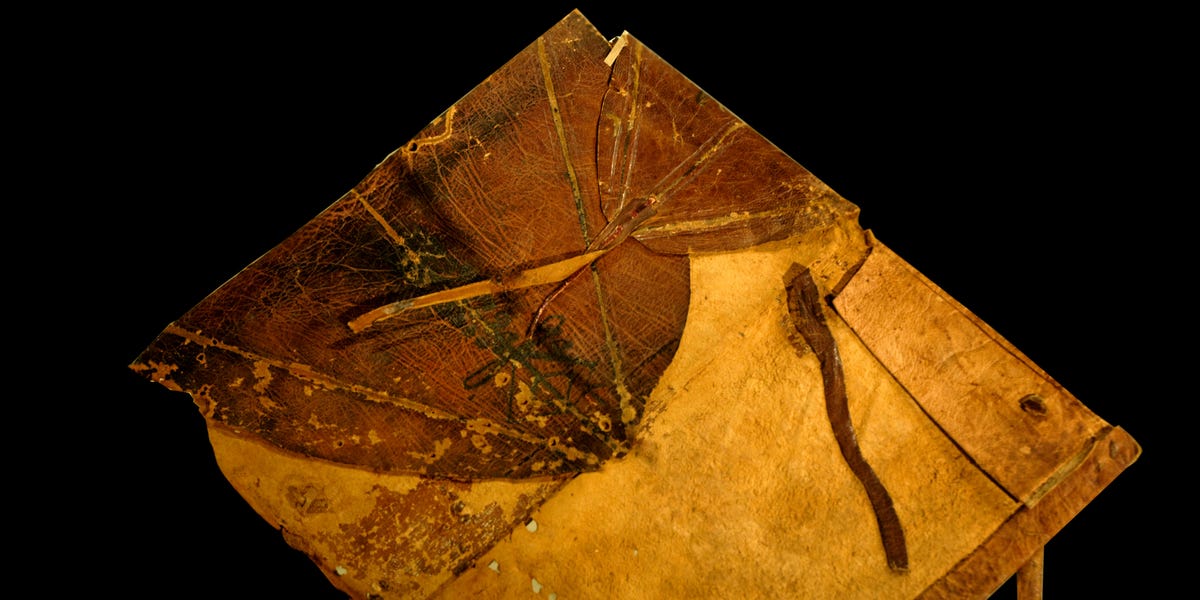
The texts now known as the Nag Hammadi Library sent shockwaves through the scholarly world when they first surfaced on Cairo’s black market for antiquities in 1946.Up until that moment, the beliefs and practices of the early Christian sect known as the Gnostics survived only through the writings of their rivals, the orthodox sects that would to some extent evolve into the Christian faiths we know today. Those condemnations of the Gnostics pilloried the “heretics” with accusations of “wife-swapping, cannibalism, and profane Eucharists in which they consumed bodily fluids,” as National Geographic put it. But suddenly, after nearly two millennia, the rediscovered texts finally allowed the Gnostics to speak for themselves.Composed in Coptic in the fourth century, the twelve papyrus codices contained fantastical stories that strayed wildly from orthodox Christian doctrine. As National Geographic recounted, the texts told of “elaborate myths about creation in which a lesser malevolent deity split off from the true transcendent deity.” They also taught of 74 angels, each responsible for a different part of the human body. In the Gospel of Thomas, we learned the “secret sayings” attributed to Jesus Christ, and in the Gospel of Philip, disciples lamented how frequently the Messiah lavished affection, including kisses, on Mary Magdalene.The lost gospels were an extraordinary find, and decades later, when the man who found them was finally tracked down, his account of the discovery proved just as extraordinary. The French scholar Jean Doresse spent the late 1940s combing the Nag Hammadi region for clues about who had unearthed the codices and how. But it wasn’t until the mid-1970s that the American scholar James M. Robinson put a name to the local farmer who, Doresse had been told, dug up the texts. That man was Muhammad ‘Ali al-Samman, and the story he told Robinson involved a startling discovery and a bloody family feud.As Robinson recounted it, at least, al-Samman’s tale would have been at home in the very kind of religious texts he’d found. Albeit, less the “Jesus in Jerusalem” kind, and more like Nephi confronting Laban.The story goes that Muhammad ‘Ali al-Samman and his brother (accompanied by others, depending on which version of the story you hear) had ventured out to the Jabal al-Tárif archaeological site in the cliffs along the Nile, north of Nag Hammadi. The men were in search of sebakh, the decomposed remnants of mudbrick, to use as fertilizer.During their dig, Muhammad ‘Ali uncovered a large earthenware jar. Far from taking on the role of eager amateur archeologist, however, the modest farmer reportedly found himself caught in the throws of superstition. He was resistant to disturb the vessel, lest it contain a jinn, which might bring some evil upon him. Only when Muhammad ‘Ali considered the gold and treasure which might await him inside did he smash the jar and discover the thirteen bound papyrus books within.From there, the saga takes a dramatic turn. Al-Samman brought the books back to his home in al-Qasr, supposedly placing them on a pile of straw near the family’s oven. He could not immediately take them anywhere to be analyzed or appraised, as he had more pressing matters to attend to: avenging his father’s murder.Not long after the texts were discovered, al-Samman’s mother passed along word to Muhammad ‘Ali and his brothers that his father’s nemesis, Ahmed Isma’il, was nearby and vulnerable. Muhammad ‘Ali and his siblings supposedly sought out the man they blamed for their father’s death, and took revenge by hacking off his limbs and devouring his heart “as the ultimate act of blood revenge.”Knowing the police would come looking for him, Muhammad ‘Ali handed the papyri over to a Coptic Orthodox priest named al-Qummus Basiliyus Abd al-Masih for safe-keeping. Already, in a twist befitting a tale of Scheherazade, some of the texts had been lost when al-Samman’s mother ‘Umm-Ahmad burned them as fuel for her oven. While in al-Qummus’ care, the surviving papyri came to the attention of a local academic, who was unable to secure their purchase. So the lost Gospels travelled to the black markets of Cairo, where they were ultimately intercepted by Egyptian authorities, who brought them to the Coptic Museum in Cairo.It was a remarkable tale, one that James M. Robinson would relish retelling over the years, beginning with his 1977 work The Nag Hammadi Library in English. Scholar Elaine Pagels would also recount the tale of bloody revenge and burned papyri in her deeply influential assessment of the texts, 1979’s The Gnostic Gospels. In a field of scholarship where so many discoveries are made during the shady, not to mention narratively rote, practice of “graverobbing,” here was something far more engrossing.Which is why the “official story” merits a reasonable amount of scrutiny.In 2013, Mark Goodacre of Duke University published a study in the Journal for the Study of the New Testament titled, “How Reliable is the Story of the Nag Hammadi Discovery?” Goodacre didn’t call into question the veracity of the documents themselves; they’d been authenticated and dated by scholars to around the fourth century. Instead, Goodacre questions Robinson's account of the discovery. Knowing exactly how the Nag Hammadi Library was found, he argues, is crucial to understanding the texts themselves: where they came from and how they survived to the present day.Goodacre noted that inconsistencies appear even within Robinson’s recounting of the story over the years. Depending on when Robinson was retelling it, the group that first ventured out in search of sebakh was variously “two-person (1977), seven-person (1979) and eight-person (1981).” The size of the jar they found also grew over the years, with Robinson first estimating it at 60 cm, only for Pagels to later report it as “almost a meter high.” As such, Goodacre notes, “the jar has grown from just under 2 ft to well over 3 ft.” In later tellings, Pagels would increase the size even more. In a 1987 TV special called The Gnostics, Pagels is shown telling a classroom that the jar was actually six feet tall.The same 1987 documentary shows another problem Goodacre points out: al-Samman’s own account doesn’t match Robinson’s. The filmmakers interviewed al-Samman himself, a decade after Robinson first published his story, and the version he gave on camera was very different. Speaking through an interpreter, al-Samman said he had been alone when he found the jar. “I smashed the pot on my own and inside I found these old books,” he says “Then I brought the others over to see.”One could argue that al-Samman’s memory had simply faded in the decade since he spoke with Robinson, which would explain the discrepancy. But that argument cuts both ways. Robinson interviewed al-Samman some 30 years after the discovery, so the version Robinson recorded may have been just as distorted by time.Ultimately, Goodacre observed, there’s ample reason to be skeptical of the story. There’s little to back it up, and plenty of red flags that present themselves at even the slightest probing. Yet, Robinson’s story continues to be perpetuated by scholars even now (with Goodacre taking time to note the blatant plagiarism in some retellings, including the phrase “the ultimate act of blood revenge”).Even in the field of theological study, where scholars are meant to turn a skeptical eye to the religious texts of the past, it seems we humans can’t resist adding a bit of flair to our origin stories.Michale Natale is a News Editor for the Hearst Enthusiast Group. As a writer and researcher, he has produced written and audio-visual content for more than fifteen years, spanning historical periods from the dawn of early man to the Golden Age of Hollywood. His stories for the Enthusiast Group have involved coordinating with organizations like the National Parks Service and the Secret Service, and travelling to notable historical sites and archaeological digs, from excavations of America’ earliest colonies to the former homes of Edgar Allan Poe.
Two Brothers Avenged Their Father, Ate His Killer’s Heart, and Found the Lost Gospels. Or Did They?
Full Article
Original Source
Read the full article at Popularmechanics →KhanList aggregates and links to publicly available news content. We do not host full articles from third-party sources. Always verify important information with original sources.