
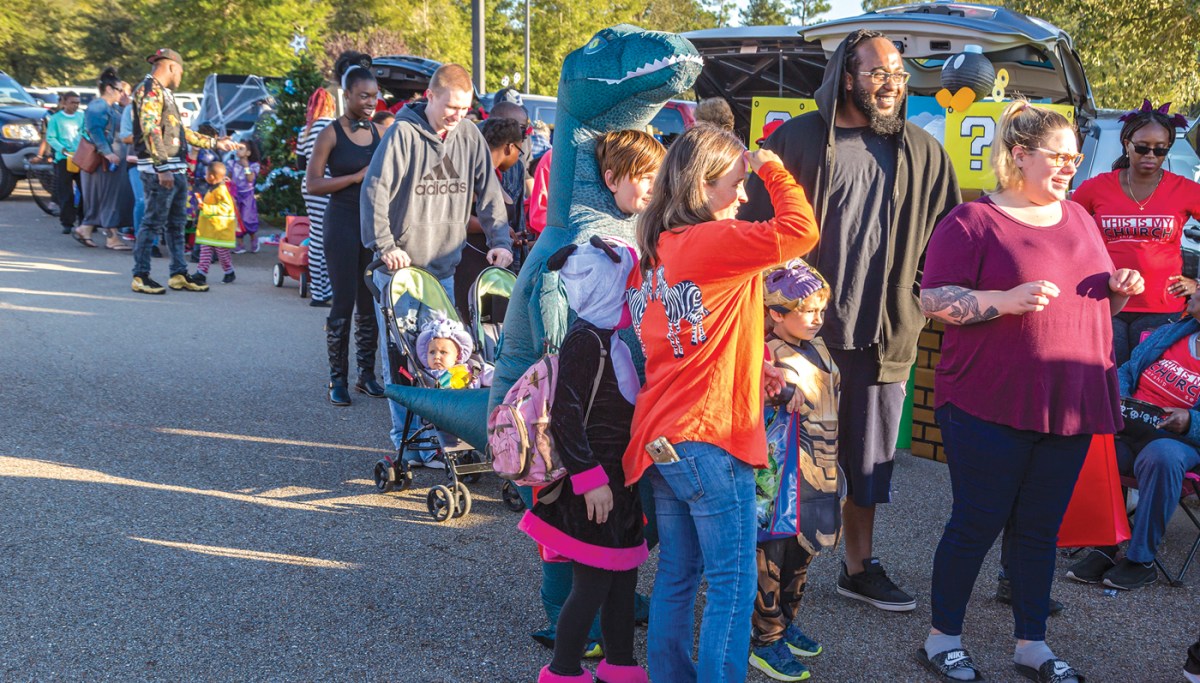
The next sociologist to update Robert Putnam’s Bowling Alone ought to write about “trunk or treat.”The declines in neighborhood cohesion and childhood freedom can both be traced to the replacement of trick-or-treating with its sanitized simulacrum, in which kids in costumes go around a parking lot, collecting candy from the rear of their friends’ moms’ CR-Vs and Odysseys.Trick-or-treating had all sorts of virtues. You got to know the neighbors — Halloween with my little kids was how I finally met the family five houses down. In particular, roving families and kids got to meet the older, more shut-in neighbors, for whom it was a delight to see dozens of smiling, cute kids. Children and families participate in “Trunk or Treat” during the Fall Festival at Crosspoint Church in Gulfport, Mississippi. (Ron Buskirk/UCG/Universal Images Group via Getty Images) Plus, there was the aspect of childhood freedom. Middle schoolers were left to wander the streets alone. Little kids sometimes had only older siblings as escorts. Mom and Dad could stay home (or, better yet, drink on a neighbor’s front porch) and just trust that the kids would return.And as a kid, the farther you were willing to walk, the more loot you earned. There was something almost capitalistic about these handouts.But a million scare stories sprang up starting in the late 1980s. Parents became convinced that abductors were stalking the streets. Officials laughably told families to finish all trick-or-treating before dark. And, of course, there were the stories about razor blades in Milky Ways or heroin-laced KitKats — stories sometimes repeated by media figures.With these fears in mind, parents began ushering their kids into the walled gardens of school parking lots for a controlled, contained, sanitized way to distribute free candy.There’s more than fear behind this, though. It’s also about self-selection in an age that worships self-determination and hates the unchosen.One colleague said he first noticed trunk-or-treat at Catholic schools. That is, folks whose community is more cultivated and less simply given want to do Halloween with their people. Thus, actual neighbors grow even further apart.But one virtue of actual neighbors is precisely that they are unchosen. These days, we need to rub elbows more with strangers and folks with whom we might not have much in common besides living on the same street.CELEBRATING CHRISTMAS IS APPARENTLY RIGHT-WINGCustoms and traditions (which, like neighbors, we didn’t create or choose) tend to do just this: They make us do something we normally wouldn’t. Modern man tends to benefit from being thrust into the great unchosen. But, of course, these days, he can just retreat back into his Honda CR-V.Boo.
‘Trunk or treat!’
Full Article
Original Source
Read the full article at Washingtonexaminer →KhanList aggregates and links to publicly available news content. We do not host full articles from third-party sources. Always verify important information with original sources.