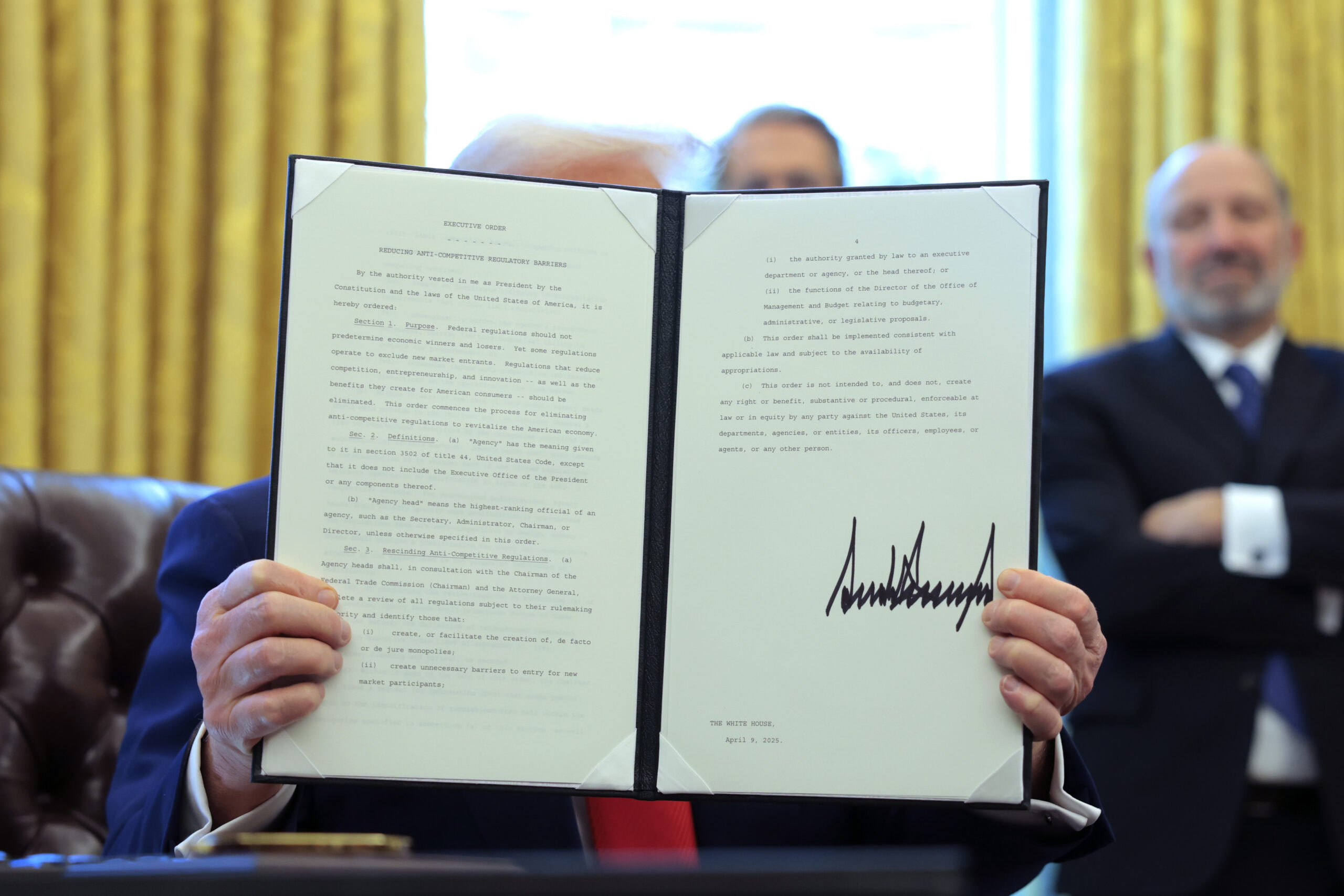
Politics The administration has made serious progress toward ending antiwhite racism and restoring equality under the law. Featured in the September/October 2026 issue On the first and second days of his second term as president of the United States of America, Donald J. Trump issued two Executive Orders, “Ending Radical And Wasteful Government DEI Programs And Preferencing” on January 20, and “Ending Illegal Discrimination and Restoring Merit-Based Opportunity” on January 21. These two directives serve as a watershed and turning point in, and arguably the end of, a particular era of American history: the rise, and now, the fall, of diversity, equity, and inclusion (DEI). DEI was the formalized and corporatist articulation of the set of policies that were once bracketed under the term “affirmative action,” which dates to the Civil Rights era of the 1960s. They aimed at closing the socioeconomic gaps between blacks and whites, putting both of America’s historical racial groups on equal footing. DEI, a term that became prevalent after 2015, was the culmination of the high-stakes game to fix America’s racial inequalities, a turnkey “out-of-the-box” solution that was the left’s “fix the race problem” press-one-button. While earlier attempts to end the evils of racism focused on establishing fair competition and equality of opportunity, DEI had a more ambitious goal: to establish a framework to enforce total equity for all. During the period that the former Vox columnist and now Substack writer Matthew Yglesias termed the “Great Awokening,” which began in the second Obama term, ideas like DEI that would have heretofore been outlandish became part of the mainstream discourse. In October 2019, Ezra Klein, now a columnist and podcast host at the New York Times, then a host of the same eponymous show on Vox’s podcasting network, was joined by Ibram X. Kendi. Born Ibram Henry Rogers, Kendi had just published How to Be an Antiracist. This book heralded the rise of the term “antiracism” into public discourse and serious policy discussions. Kendi, a mediocre student propelled to the heights of the professoriate by affirmative action, became a prolific expositor of his ideas because of the platform given in places like Klein’s podcast and the editorial pages of the New York Times. His arguments were simple, almost naively child-like. If an organization’s demographics did not reflect the general population, then that was ipso facto evidence of the impact of systemic racism. The equity element in DEI firmly fixates on these sorts of outcomes. Rather than equality of opportunity, equity is the equalizing of outcomes across races, or, operationally, a skew in favor of nonwhites. Meanwhile, inclusion is the most vibes-based of the three legs of the DEI stool, emphasizing psychological safety and centering previously marginalized voices. If diversity and equity are racialized, drawing from the black American struggle, inclusion reflects a typically feminine view of how groups should operate, through mutual acceptance and cooperation rather than agonistic debate and argumentation. Once the purview of the faculty lounge, DEI rapidly suffused the thinking of American institutions in the 2010s, signaled by Joe Biden’s day one Executive Order in 2021 that asserted that “advancing equity, civil rights, racial justice and equal opportunity is the responsibility of the whole of our government.” Though the fury of Black Lives Matter cooled off with Biden’s election, his administration arguably saw the high tide of DEI as a functioning philosophy in American society. This was most famously illustrated by his judiciary appointments; though white men make up 40 percent of attorneys, they were only 13 percent of judges he appointed. Though 80 percent of the legal profession is white, 60 percent of Biden’s appointments were nonwhite. White females are about 30 percent of the U.S. population, and 30 percent of Biden’s appointees—a proportional share. But while black men are seven percent of the population and two percent of lawyers, they were 11 percent of the appointees, while black women were 16 percent of the appointees despite being only two percent of lawyers. Hispanic men, who represent three percent of lawyers, received appointments at a rate of five percent. Hispanic women also make up three percent of lawyers, but received appointments at a rate of 10 percent. About half of Biden’s cabinet comprised non-Hispanic whites, but reflecting the post-2020 mood, the representation of black Americans was about twice their proportion in the US population. The new Republican administration in 2024 was up against not just two generations of affirmative action, but a DEI regime modeled from on high that had swept through the institutions with broad elite support and made anti-white racism meritorious. But instead of just standing athwart history and simply slowing down the train to the progressive future, as you might expect from the precedent of earlier Republican administrations, Trump has halted and reversed the DEI juggernaut. The Manhattan Institute’s Christopher Rufo, who has been campaigning against DEI’s theoretical handmaid, critical race theory, since 2020, says of the 2024 executive orders that the “immediate blitz of EOs from President Trump on day one of the administration was an enormous vindication. He slashed DEI from the administration and then put enormous pressure on private institutions to comply with anti-discrimination law.” Within the executive branch, people also well understand what is at stake. A top official in the administration opines that “DEI is a dumb, destructive framework that elevates incompetents and lies about it and brags about it, all at the same time.” The tip of the spear against DEI has been Harmeet Dhillon, U.S. assistant attorney general for the Civil Rights Division of the Department of Justice since April 2025. She immediately opened investigations into dozens of universities’ compliance with the 2023 Supreme Court decision in Students for Fair Admissions v. Harvard, which ruled that race-based affirmative action programs in most college admissions violate the Equal Protection Clause of the Fourteenth Amendment. DOJ pressure was instrumental in the resignation of a UVA president who refused to dismantle DEI, resulting in the university’s compliance with SFFA v. Harvard. Dhillon’s office also challenged Hennepin County’s race-based plea deals, the city of Providence’s discriminatory hiring practices, and Evanston’s race-based reparations program. These are just a few of the dozens of investigations currently being pushed by the Trump DOJ under Dhillon. She told Eli Lake of the Free Press that she would “like to eradicate affirmative action and DEI every place that the federal government touches it.” But the Trump administration has not simply rolled back DEI in the public sector. The corporatist aspect of “Woke 1.0” and the educational slant of DEI meant that its impact was often felt most strongly in the private sector. Previous to Trump 2.0, businesses were brazen in their violation of equality before the law under the guise of DEI; to take one high-profile example, Uber Eats gave black-owned businesses free delivery in 2020. In contrast, the current DOJ forced IBM to pay $17,000,000 to resolve DEI-driven discrimination. Whereas the previous administration pursued a policy of ignoring and even dismissing antiwhite discrimination, the Trump administration has leapt into the breach. It revoked Executive Order 11246, which required federal contractors to maintain affirmative-action programs for women and minorities. The Equal Employment Opportunity Commission (EEOC) has also warned several large law firms that their DEI programs were discriminatory. Subscribe Today Get daily emails in your inbox The broader impact of these actions has been clear: Trump has created a permission structure for large corporations to turn away from DEI. Walmart wound down its Center for Racial Equity and phased out the term DEI in corporate materials. Target eliminated its DEI goals and its REACH racial-equity initiative. Meta, Amazon, and Alphabet all rolled back or eliminated DEI programs and demographic representation goals. Goldman Sachs no longer mandates diversity for the boards of companies it takes public. Bank of America, Citigroup, and Accenture all eliminated their diversity goals in hiring. In his January 20 executive order, the president asserted that “illegal and immoral discrimination programs” in the name of DEI had to end. On this issue, there is no doubt that Donald J. Trump and his whole administration have moral clarity. As with abortion rights, it is likely that we will see this administration as the turning point when the left-liberal Civil Rights project finally ran out of time, and confronted an immovable object. In 2003, the late Supreme Court Justice Sandra Day O’Connor suggested that, by 2028, race-based admissions could be eliminated. Though the court ruled against these policies in 2023 in SFFA v. Harvard, it is the Trump administration that has to execute and apply the ruling. Because of the administration’s will, O’Connor’s original prediction may not be that far off. It takes a president and political party that understands the stakes for a multiracial democratic republic to effect actual change, charting a genuinely colorblind path into the future. Earlier Republican administrations had taken a position against affirmative action, DEI’s less all-encompassing predecessor, but Trump and his advisors have followed up the rhetoric and campaign promises with sharp and aggressive execution, rolling back a system of de facto antiwhite discrimination in both the public and private sectors with punitive enforcement actions and moral suasion. This may be the administration that fulfills the ideal that American citizens will no longer be judged by the color of their skin but by the content of their character, or at least their qualifications.
Trump’s Successful Campaign Against DEI
Full Article
Original Source
Read the full article at Theamericanconservative →KhanList aggregates and links to publicly available news content. We do not host full articles from third-party sources. Always verify important information with original sources.