
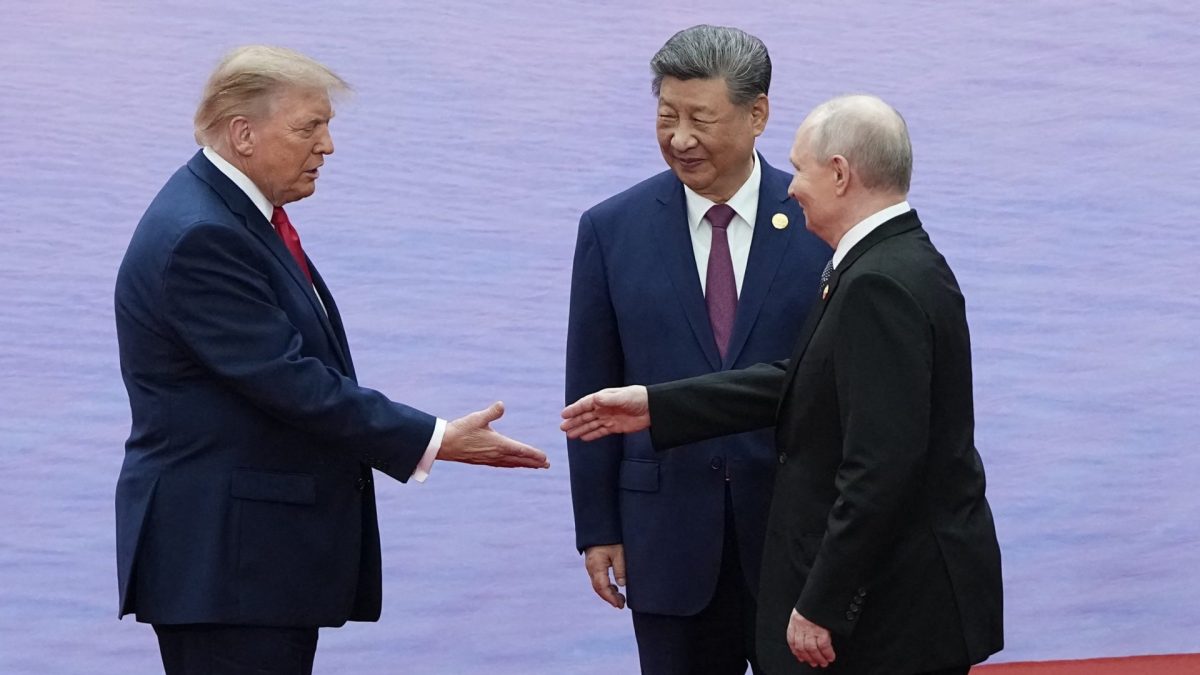
All eyes will be on Donald Trump and Vladimir Putin in the Chinese city of Shenzhen this week, but it’s Xi Jinping who may walk away with the biggest win. The presence of Trump and Putin – with Xi in the middle – has some reaching for a comparison with the Yalta conference of 1945, and the troubling vision of three great powers carving up the world. Back then, Winston Churchill, Franklin D Roosevelt and Joseph Stalin met at the Crimean seaside resort to decide the fate of large swathes of Europe and beyond. A world war was raging. Adolf Hitler’s suicide and the two nuclear bombs dropped on Japan were months away. Stalin agreed to join the Pacific conflict after Germany was defeated. That summit outlined what these world powers intended to do in the aftermath of the most ruinous war in world history, including establishing a United Nations with a ruling Security Council. Today’s leaders are not gathering for a one-off event at a time of war. Instead, China is seizing an opportunity to help it reshape the world order – or at the very least showcase its power to convene major global powers. Xi welcomes Trump at Shenzhen Bao’an airport. Many assume that the baton of global hegemony will soon pass to China (Photo: Kevin Frayer/Getty) In the past seven decades, there has been only one half-hearted attempt to remake the world order: in 1989-90, after the collapse of the Soviet Union. In the aftermath, the US was left as the only major superpower. Many assume that the baton of global hegemony will soon pass to China – that America’s time as the leading superpower is over, squandered in Afghanistan and Iraq, the 2008 financial crash and Trump’s six years and counting of “America First” aggressive unilateralism.The three leaders’ trilateral meeting on the sidelines of the Asia-Pacific Economic Cooperation (Apec) summit this Thursday would in theory be a key moment in this transfer of power, with a much-weakened Trump now a deferential supplicant, and Putin’s war economy reliant on trade with China. But optics is not the same as substance. True, China has economic heft and the largest navy in the world, but Xi’s approach if far more subtle than Trump’s. In recent years, China has swapped aggressive “wolf warrior” diplomats for “Confucian gentlemen” as embodied by the superbly suited Wang Yi, China’s foreign minister. Xi’s China emphatically supports multilateralism and the UN, provided the UN and other international bodies accept its reading of the rules. And if it can’t insert more of its personnel into such organisations, then it simply moves to replicate them in a way that gives it more power. There is also the age-old approach of not interfering when your rivals – or “frenemies” – make mistakes. The Iran war has been a major error for Trump, certainly in terms of political support back home, not to mention his obvious partiality for Putin over Ukraine. Shenzhen skyscrapers highlighting the Apec summit taking place this week. The event offers China another moment to show it is the adult in the room (Photo: Cheng Xin/Getty) Xi knows how to play the long game. This will be his 50th meeting with Putin. The two men have a deep understanding, and China doesn’t want to lose its main strategic partner and a very useful distraction for the West’s attention. If Russia – or Iran – is enemy number one, there is little room for China in the conversation. Russia still occupies land taken from China under the “unequal treaties” signed over a century ago, and the two countries have clashed over their borders within living memory. But it suits China not to dwell on this, right now. For China, Shenzhen offers another moment to show it is the adult in the room. Putin and Trump will get their photo opportunities, but Xi is looking to walk away with much more. In the long run, optics don’t mean much. Xi won’t mind flattering his guests and providing them with all the symbolism they want, provided Trump doesn’t press for issues like nuclear disarmament – at a time when China is doubling its stockpile of warheads – and Putin doesn’t try to push too hard for a “great power” solution to his war in Ukraine. Xi may even be more accommodating on regulations for AI, but Shenzhen is not a meeting of equal powers deciding the fate of others. China’s leader is well aware of the glaring weaknesses of the men across the table from him. In Shenzhen, we won’t see a flexing of Chinese muscles – and Putin and Trump are likely to dominate the headlines. But for China, meetings like this are steps along its path to global dominance. Michael Burleigh is senior fellow at LSE Ideas and the author of Best of Times, Worst of Times: A History of Now (2017)
Trump’s rivals are more than happy to watch their frenemy mess up
Full Article
Original Source
Read the full article at Inews →KhanList aggregates and links to publicly available news content. We do not host full articles from third-party sources. Always verify important information with original sources.