
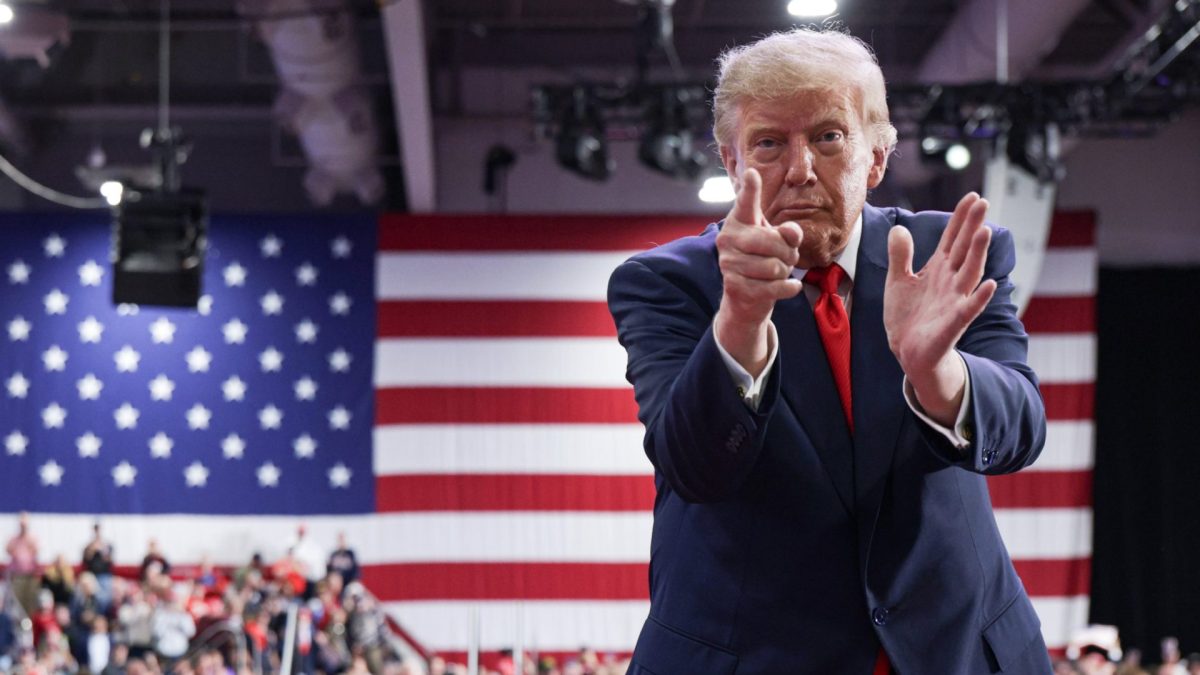
With less than one month until US midterm elections – and a projected Republican defeat in Congress – Donald Trump made a stunning reversal of years of pressure on Russia over its war with Ukraine in his latest attempt to win back voters. Trump announced a deal on Friday to import Russian diesel to the US. The agreement will see Vladimir Putin release 300,000 tonnes of diesel immediately “to the American and global marketplace”, Trump said, followed by 500,000 tonnes in November and another three million “within a short period of time” after that Trump’s announcement was in stark contrast to a sweeping Russia sanctions law he signed last month that aimed at clamping down on the oil and gas revenues that fuel Russia’s war against Ukraine. With Democrats leading or within striking distance in Senate and House of Representatives races across a series Republican stronghold states, analysts told The i Paper that the reversal appeared to be Trump’s ploy to win back back voters due to soaring diesel prices cause by the Iran war. The latest polling suggests the Republican Party is facing a much broader threat than expected. RealClearPolitics figures published on Monday put Democrats ahead for Senate seats in Texas, Alaska, Georgia, Ohio, Iowa, Michigan, North Carolina, Maine and New Hampshire. If the Democrats win control of Congress, Trump’s agenda would be greatly constrained for the last two years of his term. Trump’s midterm peril Scott Lucas, Professor of American Studies at University College Dublin’s Clinton Institute, said Trump had “gotten himself into trouble over the war on Iran”, which has resulted in the doubling of the US diesel price from last year, to set a record high of $6.51 per gallon last month.“The Republicans are in running into some serious trouble and even some states where they should normally have no problems,” Professor Lucas told The i Paper. Trump had privately urged Ukraine’s Volodymyr Zelenskyy to halt attacks on Russian refineries last month, and repeatedly suggested in public that Ukraine’s strikes are to blame for the squeeze on global fuel supplies. Despite the warning, Kyiv has continued its targeted strikes. US President Donald Trump at the Republican National Midterm Convention in Dallas, Texas, last month (Photo: Kent Nishimura / AFP via Getty Images) “Russia’s been using this economic leaver or to try to manipulate the Trump [administration], and diesel proved to be the key pressure point,” Professor Lucas said. Tim Armitage, investment strategist at Quilter Cheviot, told the BBC that the apparent agreement and quantity of diesel mentioned by Trump were “relatively small”, and therefore may not have much tangible impact. The first tranche equated to approximately 2.25 million barrels, less than the daily US consumption of around 3.8 million barrels. “Granted, there are then two more releases to come, but it does appear to be a slightly desperate move by President Trump to try to lower inflation ahead of the midterms,” Armitage said. Professor Lucas agreed that the deal was “not really that much”, and far less than the 20 million barrels of oil that were previously transported through the Strait of Hormones each day. The Trump administration “choked off that supply by allowing Iran to take control of the strait”, he added. “Trump simply wants to take a take over the news cycle and show that he’s doing something about” the price of fuel in the US. US-Russia partnership Keir Giles, associate fellow of the Russia and Eurasia Programme at Chatham House, agreed Trump was facing significant pressure ahead of the November midterms. “The pressure had been building for Trump to do something to at least claim he’s tackling the cost of living and energy crisis that he’s caused himself,” Giles said. By Trump agreeing the diesel deal with Putin “he’s found a means of doing so which is possibly the most damaging and least productive that he could have chosen to a ceasefire deal – but that too is in keeping with the nature of the current administration,” Giles added. Giles said the diesel deal was “another demonstration – as if any were needed – that the United States does not see Russia as an adversary, and instead sees it as a partner.” Vladimir Putin shakes hands with Jared Kushner, Donald Trump’s son-in-law, as US. Special Envoy Steve Witkoff stands nearby during a meeting at the Kremlin in Moscow last month (Photo: Mikhail Metzel/Reuters) The working relationship between Washington and Moscow continues to have “serious implications for anyone that does see Russia as a problem – not only Ukraine but the rest of Europe”, he added. “People always react with surprise when there’s a new demonstration of the length that the United States will go to pull the rug from under its allies in favour of partnership with Russia – by this time we should not be surprised.” Deal leaves Ukraine stranded In a lengthy post online reacting to the deal, Zelenskyy said Russia would repay it “with further terror and perfidy.” He cast it as an investment in the war, allowing it to be prolonged. “It plays into Russia’s hands — allowing it to kill more, wage war for longer, have even less respect for America, and inflict even greater losses and damage on the world,” he said. According to a statement released by the Ukrainian Embassy in Washington, Zelenskyy called it “a weak decision, unfortunately, a weak decision by strong partners.” Trump announced the deal as his envoy Steve Witkoff and son-in-law Jared Kushner were meeting with Ukrainian officials in Miami to discuss a proposal to end the war. “I believe our team is simply being used as a smoke screen. And that is certainly not fair. It is certainly not how partners should treat each other,” Zelenskyy said. Lucas said Trump’s deal with Putin now “completely undermines Ukraine’s resistance” against Russian, ahead of what is expected to be a severe winter of fighting, and any potential for a ceasefire.
Trump’s Putin deal is a desperate attempt to win voters – Ukraine will pay for it
Full Article
Original Source
Read the full article at Inews →KhanList aggregates and links to publicly available news content. We do not host full articles from third-party sources. Always verify important information with original sources.