
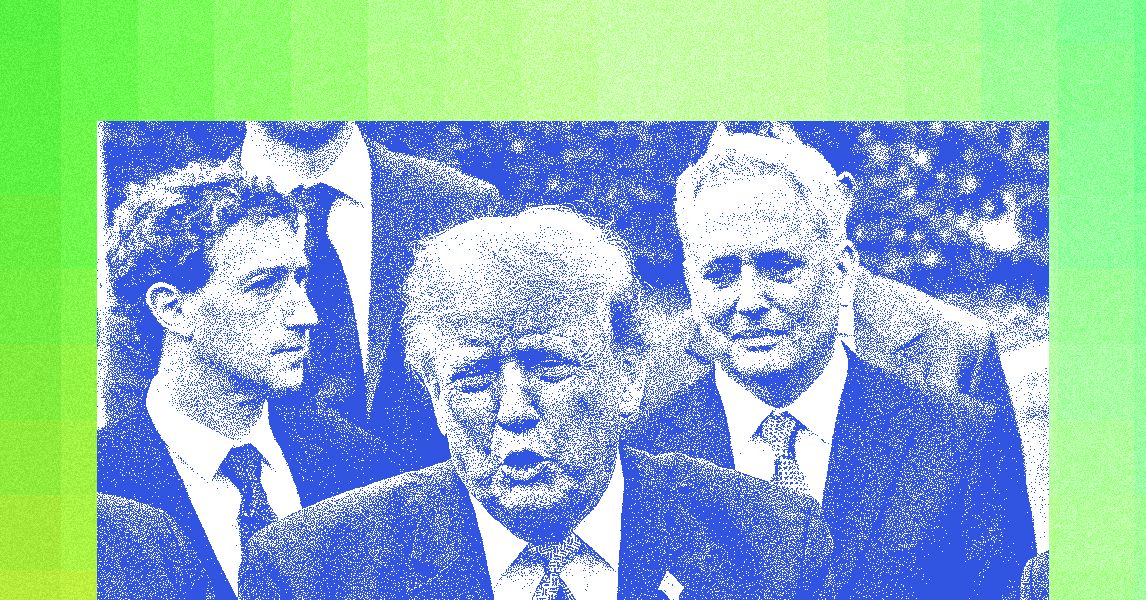
This week on Uncanny Valley, we discuss the voluntary AI safety agreement tech executives signed, AI agents for normies, and extremist candidates running for office in the US midterms.Photo-Illustration: WIRED Staff; Getty ImagesThis week on Uncanny Valley, Brian Barrett, Zoë Schiffer, and Leah Feiger discuss the “morally binding” AI accord tech executives signed following a meeting with Donald Trump. They’ve agreed that AI labs will regulate themselves—should work out great. Plus, the team digs into OpenAI’s Developer Day, where CEO Sam Altman introduced AI agents for normies, otherwise known as Dots; how AI agents are coming to workplaces near you; and a quick rundown of the most extremist candidates running for office.Articles mentioned in this episode:Trump’s AI Safety ‘Accord’ Is a Fancy Pinky SwearThese Extremists Are Running for Election in NovemberA Pentagon Influencer Called Liberal Women a ‘Pestilence’ Who Will End Western CivilizationThe White House is Starting to Panic Over the MidtermsI Think I Found an AI Agent Worth the RiskAI Agents Are About to Flood the WorkforceI Built AI Clones of My Coworkers. Things Got WeirdWhy No One Wants To Date Tech BrosYou can follow Brian Barrett on Bluesky at @brbarrett, Zoë Schiffer on Bluesky at @zoeschiffer, and Leah Feiger on Bluesky at @leahfeiger. Write to us at [email protected].How to ListenYou can always listen to this week's podcast through the audio player on this page, but if you want to subscribe for free to get every episode, here's how:If you're on an iPhone or iPad, open the app called Podcasts, or just tap this link. You can also download an app like Overcast or Pocket Casts and search for “uncanny valley.” We’re on Spotify too.TranscriptNote: This is an automated transcript, which may contain errors.Brian Barrett: Hey, this is Brian. Two quick things before we dive in. If you've been listening for a while and you haven't rated or reviewed the podcast yet, this is your sign. Give us a rating, tell us what you think. Five stars is nice, but we'll take the feedback too. It really helps more people find the show. Also, if you're in the Bay Area, we will be doing a live audience recording of the podcast on Thursday, October 8, at 7 pm at The Commons, headquarters of our KQED friends in San Francisco. You can buy tickets on kqed.org or check out the show notes for the link. You won't want to miss it. OK, onto the show.Zoë Schiffer: Welcome to WIRED's Uncanny Valley. I'm Zoë Schiffer, contributing editor.Brian Barrett: I'm Brian Barrett, executive editor.Leah Feiger: And I'm Leah Feiger, director of politics and science.Brian Barrett: This week we've got a new proclamation or rather a "morally binding" AI accord from the White House. After a meeting between tech executives and Donald Trump, it basically says the AI labs are going to regulate themselves. Should work out great. Plus we'll talk about OpenAI's Developer Day, where CEO Sam Altman announced the company's new always-on AI agents for regular folks. More AI agents again, should work out great. Everything's working out great today.Zoë Schiffer: Yeah. And as AI agents become way more popular in Silicon Valley and beyond, employers are pushing to have these agents harmoniously work alongside human employees. We'll get into how that process is actually going and what the chances are that we're all going to have to welcome some bot colleagues very soon.Leah Feiger: And with the midterm elections closing in, we're going to be talking about some of the extreme candidates running for office. It's not just political candidates who feel emboldened to say whatever they want. It's also people who are currently or have been recently working for the government, including a retired army colonel turned Pentagon influencer who WIRED reported this week, posted plenty of praise for dictators and has a plan to strip the vote from anyone without kids.Brian Barrett: Let's start though with a nice luncheon that happened on Tuesday. President Trump invited all his favorite AI executives over to the White House. He had Sundar Pichai, Elon Musk, Dario Amodei, Mark Zuckerberg, Jensen Huang, OpenAI President Greg Brockman, not OpenAI CEO Sam Altman, plus a lot of companies that I was less familiar with. It felt like a little bit of a motley crew in some ways, but that's neither here nor there. They came out with a signed document called the White House Accord on Super Intelligence. Super intelligence, of course, how the government is now referring to AI, artificial intelligence. But in this accord, the companies agree that they should put their models through four layers of controls and audits. That includes internal evaluations, letting an outside audit firm come in and make sure everything's OK, and having the company's own board review those audits. And it's all voluntary.Leah Feiger: That remains the keyword here. When it ever comes to any sort of proposed regulation at all that we've seen thus far in the AI space when it comes to the White House, voluntary is the word. I don't know, is it so silly of me to be so hung up on this that none of this is real? This is all fake.Zoë Schiffer: Yeah, I don't think we were expecting the Trump administration to come out with real regulations for AI companies. Their big thing is—Leah Feiger: For sure.Zoë Schiffer: AI growth. But yeah, I mean when they came out, Trump came out in front of the White House with all of the CEOs, their kind of takeaway message was like, "We got this. We take it seriously. Don't worry about it." And I think it was actually stated by someone there like, "We'll regulate each other. We're looking out for each other."Leah Feiger: I mean, we have to talk about this one particular moment. It's been gathering all sorts of attention online, where Dario Amodei is sort of awkwardly pushed to the front of the microphone to share some words and Trump praises him saying "Whatever he says is OK," which is great. So here's what he said.Archival audio: Can we just bring Dario to the front for a second?Donald Trump, archival audio: Where's Dario?Brian Barrett: He does not want to be in the front, at all.Donald Trump, archival audio: Whatever he says is OK.Archival audio: So I just want to hear from you after this big summit where you are today.Dario Amodei, archival audio: Look, I mean I will say what I've always said, which is that AI has incredible benefits. I've talked about them ...Leah Feiger: I have so many thoughts. The first of which is Mark Zuckerberg trying to have a side chat with Trump during that.Zoë Schiffer: Mark Zuckerberg—Leah Feiger: Just happy to be in the room.Zoë Schiffer: —and Trump are just off to the side making faces with each other.Leah Feiger: I mean, look, this was all clearly such a rushed job. I can't help but think this is just sort of a way to tell the American public a couple of weeks ahead of midterms, "Don't worry, we have the regulation situation under control. Here are the richest, most powerful men in the country lined up telling you we're going to regulate it. It's all good. We're aware this is not doing well with polls right now, but we've got this." It just feels like a grab bag. Which perhaps is most emphasized by the fact that the words US were quite literally misspelled in the accords document. It reads President of the Unites States under Trump's signature, which is, I don't know, I'm not saying they quickly rushed this together, slap dash, signed it on, flew people out, but I'm not saying it doesn't look like they didn't do that either.Brian Barrett: Can I say one thing that is weird about this to me? Or not weird, but the AI labs are in such an uncomfortable position, not that I have that much sympathy for them, but they want some meaningful regulatory framework because they're worried about being investigated for antitrust if they don't have some sort of go ahead to slow down, all this. But then the day after, so on Tuesday they have, hey, here's this framework. Everything's going to be fine. Y'all self-regulate. And then on Wednesday, the FTC says that they are ramping up a big probe of Anthropic and OpenAI and other frontier labs about the dangers that their technology poses to consumers. So you're sort of getting it from both sides from the government.Zoë Schiffer: Yeah. And we have Lina Khan writing an op-ed in the New York Times today saying they actually can be tried under existing laws. We don't necessarily need to make new laws, with the big caveat that Congress would have to act.Leah Feiger: And senior political correspondent Hugo Lowell for his newsletter this week for WIRED also wrote about how team Trump is very aware that the polls are not in their favor. It does not look like they're going to be winning Congress. And as a result, they're starting to look ahead into the future and to how to avoid all of these subpoenas and investigations the Democrats are sure to slap them with. So with that in mind, I have no doubt that you are right, Brian. Everyone's kind of looking at this going, okay, this is our moment right now, but what is this going to look for us, not even just in a couple of years when Trump's out of office, but in a couple of months when Democrats ostensibly are going to control the House and Senate.Zoë Schiffer: I personally think Republicans are going to do great in the midterms, but you can cut that because I am not reporting on politics and that's just my vibe check.Leah Feiger: I'm changing my mind constantly. Right now, I think that with gas prices the way that they are and certain polls coming back the way that they are, it will be really surprising to me if the Democrats manage to lose this. Not Republicans win this, this would require the Democrats messing up, which again, all possible.Zoë Schiffer: Going back to the AI summit and luncheon, Brian, were you or were you not surprised to see not a hint of an Apple representative?Brian Barrett: A little bit. Apple has been, they were the ones who memorably Tim Cook presented Donald Trump with a golden trinket.Zoë Schiffer: Apparently not big enough.Brian Barrett: No big enough. Not a big enough trinket. Do you read it, Zoë and Leah, as Apple just not being relevant enough in AI still today?Zoë Schiffer: 100%.Brian Barrett: I think they would be there in a heartbeat if they were invited.Zoë Schiffer: It's not that they were bad at diplomacy.Leah Feiger: But is Mark Zuckerberg that relevant?Brian Barrett: Yes. 100%.Zoë Schiffer: Yeah.Leah Feiger: You think? OK. All right, I'm wrong.Brian Barrett: Meta has the most popular consumer AI agent today.Zoë Schiffer: Not because the AI agent ... They just have distribution and so Meta's AI can be so popular so fast because they can shove it down everyone's throats and that's exactly what they're doing. And they're basically promoting a free AI agent that they're subsidizing pretty heavily at the moment. And so yeah, but I think Apple is just frankly not in the game. Not in the game.Brian Barrett: Talking of AI agents and Muse is what we're talking about. Meta's Muse AI agent has taken the app store by storm, but that's because it hasn't had much competition until on Tuesday, as we said, OpenAI had its Dev Day. And in his big keynote speech, Sam Altman walked on stage and devoted most of his time to Dots, which is OpenAI's answer to Muse. It's their always-on agents. You can interact with them through ChatGPT or Slack. The features are pretty established at this point. You can basically tell your agent to go do whatever task online for you and they will get it done. Zoë, I know, has been playing around with her own agents. You're much deeper into that than Leah and I are. Two things here. One, how much does OpenAI need Dots to connect in order to maintain its position in the AI race? And two, how'd they do in terms of adorability? They're really going for adorability, they're trying to make them adorable, I don't think they quite connected. I think Muse is cuter. There, I said. It doesn't mean you should use either of them.Zoë Schiffer: This is a conversation?Brian Barrett: It is though. So I'm talking over you because—Zoë Schiffer: No, no, do it.Brian Barrett: I'm joking, but the whole point of I think the fact that they're making these so cutesy and fluffy and adorable is obviously intentional. It is what is going to win over the average consumer and make you forget that you are giving away all of your privacy and all of the information and all of your accounts to this adorable fuzzy-wuzzy little thing instead of a data center.Leah Feiger: Is that part of internet safety conversations now, Brian? When you sit around with your kids and you're like, you're going to have access to this, don't be fooled by the fuzzy avatar. They just want your bank details.Brian Barrett: Yeah, I think don't hang out with fuzzy avatars online is a well-established directive for children.Leah Feiger: Brian's rules for the road folks. You've heard it here.Brian Barrett: Yeah.Zoë Schiffer: Yeah. Well, I was just going to say, I was at the Developer Day yesterday, and I had a few observations. On one hand, OpenAI does seem really focused right now. I heard from people at the company that they shipped Dots, these kind of cute, fuzzy, always-on agents within a matter of weeks. They saw Instinct and Muse, these other kind of OpenClaw for normie-type agents and were like, "OK, we have to play this game." And they got it together really, really fast. I think it's interesting because a lot of these capabilities have actually existed for a minute now, but when you talk to people in the industry, they'll talk about form factor a lot. The new agents have to download a new app or learn new tools, and they're actually proactively learning about your life and then suggesting things they can do for you versus you seeing this blank text box and being like, “I can build anything. What would I want to build,” is actually a big difference. I was really struck yesterday thinking, "Wow, Anthropic is on the back foot," which hasn't happened a lot recently. And they, I think, really do need to ship something interesting in this space sooner rather than later. But like you both said, there's just this constant tension and trade-off, which is to make these agents useful, you have to give them a lot of personal information. Otherwise, they just can't frankly do that much. And to give them that much personal information, you're taking a risk. It's totally reasonable to decide you don't want to go that route. Dots gets access to your email, your calendar, sometimes your financial information, and then it can do things on your behalf. The kind of gateway drug, if you talk to people who use these, and I'm one of them, is restaurant reservations. You can say, "Hey, I'm going to New York at this time. Can you book these tables for me?" And it'll wait for when the reservation block opens and it'll book you a table. I was actually, I have to say, Noah Shinn, who's the CEO of Instinct, he's 23 years old. I repeat, this man is 23 years old. His company, less than two years old, valued at $10 billion now. He gave his first longform interview since his app completely blew up, and he talked about restaurant reservations. I was really waiting to be like, "This man has thought deeply about what happens to the internet when agents are doing all of your browsing and booking." No, sir. No. Mm-mm. He was like, "It's going to be great because previously restaurant reservations were first come first serve, and now your agent can say if it's your birthday or an anniversary and then the restaurant can prioritize you." I was like, "You only have to think about this for two seconds to realize that then everyone will just say it's their anniversary or birthday. What do you mean?" Anyway.Leah Feiger: Oh, my God, I'm so depressed.Brian Barrett: It's funny, that reminds me of, we're getting a little bit off topic, but another in that same vein, there was a warning this week from one of the banks, I believe, or just sort of an observation that as everyone gets these agents, they're always going to be optimizing and they're always going to be looking for the best result for their user. And we're not set up in a world where everybody's optimizing all the time. The example they gave was banking. If everyone takes all of their money from low to no interest rate savings accounts and puts them all into money market accounts where they're making 3% to 6%, whatever, on that account, the US financial system could collapse basically. It's like a run on the bank, because we are built for, that system is built on assuming that people are going to have very low to no interest rates because that's how banks can make their own interest on it. So yeah, when we have this world where everybody has their own AI agent looking out for their best interests, negotiating with other AI agents to figure out who gets the best result, I think we're going to run into some really interesting unintended consequences.Zoë Schiffer: For sure. And the other thing that I was really struck by yesterday, going back to Leah's point, is it just felt like there were a lot of different messages being said about what an agent like Dot can do. It's like this cute, fuzzy agent, except they kind of brushed away the restaurant reservation thing. It was like, of course they can book tables for you, but it can also do all of this hardcore engineering bug bashing stuff. And mentioned security and privacy, I do think this is something they're thinking about, but it just feels like the messaging around them is really confused. Ben Thompson talked about this recently on TBPN, and he was like, "Most people don't want to be more productive. They want other things. You shop because shopping's entertaining." This idea that we're all builders and we all want to optimize every area of our life, do more work, I don't think speaks to a lot of people.Leah Feiger: I think that's the thing that I keep coming back to. Even with the restaurant reservation world, and look, this isn't for everyone, but you say to an agent, "I want to go to three of the best restaurants in New York City that will be priced under 150 a person." That's a very specific liminal space. Obviously, I get it. If you don't have a lot of time, you have a work trip, you have whatever. There's a lot of people who really enjoy reading the New York Times best restaurant reviews and combing through the blogs and this is where this person I really trust has told me that I should go. So the idea of optimizing everything also feels like then we lose so much, right?Zoë Schiffer: Totally.Leah Feiger: And again, I get that it's not for everyone. No everyone has the same interest here, but there is this very weird missing piece, missing cultural piece that all of a sudden goes.Zoë Schiffer: Yeah. The other thing that Noah Shinn, again, the CEO of Instinct, talked about on that podcast when the interviewer, who again is setting up a pretty slam dunk interview, these questions were not super hard-hitting, but he's like, "What are you excited about?" He named the restaurant reservation thing. And then he's like, "Also, people are taking photos of every item in their closet and then Instinct is suggesting outfits for their week." And I was like, obviously, I'm not the core demographic here, but you think an agent built by a 23-year-old engineer is going to give you sartorial advice that you actually want to follow?Leah Feiger: Again, it's the what culture are we losing people? I find a new argument every week for something making me mad, and that might be it today.Brian Barrett: Well, I'll say not only that, not only is there the question of how many people really want these? And to be clear, maybe everyone wants these. Maybe these could be huge, a lot of people are enjoying their Muse.Leah Feiger: I mean, not everyone is against this. Zoë, not to call you out, you want this life. You want the robot command center.Zoë Schiffer: Yeah. I mean, I'm using the agents, and this is what is interesting to me, is I do think that they are useful and valuable. Last night, Andrew asked me when a babysitter was coming next week, and I had the agent put together a shared calendar, a child care calendar with the dates that the girls don't have school, the dates we have coverage, the dates we need coverage, share it with everyone relevant. That would've taken me an hour and it happens in less than a minute. It is really nice. Of course, to make that happen, you have to have an agent have calendar access, access to your email, be able to share a calendar with other people in your email. Again, these are all risks. But what's interesting to me is when you hear the AI executives talk about the technology and the possibility of the technology, to me, it feels like they don't even get what they're building. I don't know a lot of people, and certainly I don't want this, that want an AI agent to give them fashion advice. The stuff that they want, that I want is really basic and mundane.Leah Feiger: You want an assistant.Zoë Schiffer: Yeah, because the agents can do so much more, they're like, "Well, yeah, of course it can do that, but here are all these other things." But people actually just want the basic things done and done reliably and well and without putting all their information at risk, and we need to nail that in order for this to really go mainstream.Leah Feiger: Do you have fears? OK. Yeah, I'm just so curious because in so many ways me not doing this is not because I decry the usefulness. Honestly, like you describing a shared family calendar, I'm like, "I need that. I need that yesterday and I just haven't gotten around to it," but I haven't done it because I'm scared, full stop. I'm just actively scared. How do you manage that?Zoë Schiffer: I mean, I am scared. I talked about this in the article I wrote about Instinct last week. I live in fear of my personal information getting out, getting beyond my control, all of that stuff. And I think I'm more scared now with agents than I was before, for sure. At the same time, the agents can be useful for, the other week, a friend sent out a paperless post for a barbecue. My dad clicked on it. I was instantly warned by my agent that it was a phishing scam, and so I didn't. And so my kind of read was, I'm really busy. I could make a mistake just myself going around my life because I'm trying to multitask and pick the girls up from school while I'm working and all of this stuff. And so it's helpful having another set of eyes. The fact that set of eyes could then be its own security risk sucks. I think about that all the time, but right now I'm willing to take the risk, because I am finding value from them and that might change.Brian Barrett: Zoë, right now, you are making a personal choice to use an AI agent in your life, which is great. Increasingly though, people don't have that choice, right? The AI agent coworkers are becoming increasingly the norm. WIRED senior writer Kate Taylor reported on it this week. How do you feel about AI agents in the workplace, Zoë, pinging you on Slack?Zoë Schiffer: Yeah, so this was actually something that OpenAI talked about at their Developer Day. They had an OpenAI employee come up and demo how she uses her Dot, I think the name was Dottie, as kind of a colleague. She can add it on Slack. She can mention it in documents and it can respond and go back and forth. Obviously, that's someone who is actively choosing to do that. I think having an agent forced on you is different, honestly. I mean, sorry if this is the dumbest take, but I'm like, it all comes down to how good the agent is. We've all had the experience of having to talk to a robot on a customer service call and having it be so frustrating because it just cannot understand what you're saying and you're just dying to talk to a human. If that call worked, I don't know if you'd be sitting there being like, "Oh, this is a tragic situation." You would still understand the job loss and the misfortune of that, but you personally wouldn't necessarily be completely aggravated.Brian Barrett: One thing that was interesting to me in Kate's story was there seems to be, and it makes sense, a difference of opinion about how much you anthropomorphize. Do you have an agent coworker who you treat like a human and you have that kind of casual conversation that represents as such? Or is it a tool and you treat it like a tool and you don't give it a human name, you just sort of know that it's there doing the work for you? There's a real divide there in terms of what role they should play, how you should treat them, how you deal with them in this environment, these agents.Leah Feiger: Oh, that freaked me out. I mean, the fact that that's the thing, that's what they're trying to do here.Zoë Schiffer: Yeah, I mean, I feel like that is a question that has existed since OpenAI launched ChatGPT in 2022. The thing that LLMs can do is talk to you with natural language, is sound more human than a traditional bot. And I think that the company saw really, really quickly that from their point of view, this was a feature, not a bug. People liked interacting with something that felt more human. And you can see in these specific circumstances with apps that are used to tutor kids, it's helpful ... A good human tutor isn't just throwing math problems at you. It's also saying, "You're doing really good." It's being a little bit encouraging, and so it can be helpful if the app is doing that. The flip side of that is that you can forget that what you're talking to is a system, it's software, and we've seen, obviously, people get really attached to these systems. They form relationships with these systems.Leah Feiger: I was also really struck though in the article about the risk of dehumanizing. It's not just these very, I'm sorry, bizarre parasocial attachments to not human colleagues. It's the risk that humanizing these AI agents actually really lowers everyone's guard to catching mistakes and actually doing your job. Kate cited that BCG Research found that managers caught 18% fewer errors when told work came from an AI employee versus an AI tool, which is a fascinating difference.Zoë Schiffer: Can I say something that's kind of vaguely related, but a little bit of a pivot? I installed the Pangram extension on Chrome, and so now I can click any webpage and see how much of it is AI generated, and I have been testing myself with Substack and some of the more longform newsletters that I read. I can tell the moment that it switches. It's like, I'm interested, I'm interested, and then my eyes start to glaze over and I'm like, God, am I not able to focus? And I'll look and it's like, no, the AI generated stuff just starts to get so verbose. It's so long. It loves bullet points so much. These tools are not an excuse to just output bad work. And if it's taking you less time to create the work than someone has to take to consume it, if that makes sense, I think that that's a huge problem.Leah Feiger: To me, the framing is, is it an assistant or is it a colleague? I think that hierarchy is really important here.Zoë Schiffer: Mm-hmm.Brian Barrett: And I do think that's the difference between having ChatGPT integrations all over your workspace and having AI agents in your workspace. It's a fundamentally different thing that's happening now. I think it's a tool at best, but I don't know. I think in five years, maybe we'll have a fourth cohost of this podcast.Zoë Schiffer: Podcast host. Oh my God.Leah Feiger: Oh, that's—Brian Barrett: Dottie.Leah Feiger: It won't be a fourth because if it is, I'm out, to be entirely clear. Welcome, Dottie. I bid adieu. I'm wrenching this back into the political realm. Is that OK with you guys?Zoë Schiffer: Yeah.Brian Barrett: Do it.Leah Feiger: All right. We have five weeks left until the midterms. I'm so excited. Primaries are over, candidates are running. It's all very official. People are spending money. We have so much to say about all of this, but for this episode, I want to talk about some of the very specific candidates. Obviously, there's a couple of national races that have gotten a lot of attention, but I want to talk about some that really haven't, more specifically, candidates that are extremist or have espoused extremist views or employ extremist colleagues. It's a very open tent, I would say. But again, there's this massive subset of candidates that are in the running despite all of these controversies. WIRED reporter David Gilbert reviewed many of these candidates running for statewide and federal positions in November, found hundreds of Republican candidates espousing all sorts of hateful ideologies. They share racist comments online, have close ties to white supremacists who are antisemitic figures, members of far-right online groups, over 500 candidates specifically running for state legislature positions in November, and I want to talk to you guys about them. Who caught your attention? Who should we talk about first?Brian Barrett: Why don't we start with my favorite, a race that I care deeply about, Texas Railroad Commissioner.Leah Feiger: Good. Bo French.Brian Barrett: I was following this one even before. We got Bo French, GOP candidate. Leah, tell us about Bo French.Leah Feiger: Oh, I mean, this man is so extreme that Republican strategist Carl Rove has said he would vote for a Democrat rather than support a "bigot." He is currently a slim favorite to win the seat. And if that Carl Rove indictment doesn't get you, I'm not 100% sure what will. But a couple of other anecdotes is earlier this month, French posted racist comments about students of South Asian descent celebrating University of Texas Austin football victory over Ohio State, said some terrible stuff about "foreigners." There's no, we found bad tweets of his when he was in high school. This is currently happening. And to get back to this position that he's running for, Texas Railroad Commissioner does sound like a position on a monopoly board game, but it's actually really important. Doesn't have any role in regulating railroads. It actually oversees the state's oil and gas industries, which drill more oil and hydrocarbons than the rest of the US combined. Especially as we are in this era of data centers and AI growth, this is an important position in a really important state that also has other key races happening that'll determine the flipping of the House and Senate. So I'm fascinated by the Bo French controversy of all.Zoë Schiffer: I think it'll be really interesting because one thing that I've noticed when listening to Republicans talk about this is that the ones that are against people like Bo French say it's bad for the party. Having these views is not good for Republicans. I think if people start winning these races, I'm curious how that flips. If it doesn't look like it's bad for the party, how that changes things.Leah Feiger: I mean, people who have espoused not dissimilar views have held even higher positions of power. And so in some ways, it's like a ton of extremists are running for office, and perhaps the notable part of this is a ton of extremists are running for office again. They were validated in the last several elections. We are in a different era of American politics. The thing that I keep coming back to is it's really not hard to find dirt on people. We were going through fact check for this article and our wonderful research team is like, "Where did you find this? Where is this?" And David's just like, "Here's the X post, here's the Facebook post." It's right there. This was a week ago," which is a wild thing.Brian Barrett: Two of the things that really got me with this story. One, when I heard we were doing the story and we talked about it beforehand, I was assuming, wow, there's going to be dozens of extremist candidates, but there are hundreds and hundreds, 500 just for state legislatures alone. And then the other thing is how many of these people are probably going to win. Not all of them. Some of them already lost the primaries, but a surprising and disappointing number of these people are going to come out ahead, including a Senate candidate, Georgia Senate, Mike Collins, running pretty close, is it fair to say, against Jon Ossoff and has a lot of ties that are concerning to people who are close to white supremacy, antisemitism, pretty rough stuff.Leah Feiger: I want to talk about this other race as well. It's also in Texas. It's Texas's 23rd congressional district race. Trump has recently endorsed Brandon Herrera, the GOP candidate. He rose to fame as a so-called gun tuber, aka a lot of gun talk on YouTube. I hate that there's a name for it. He's running for Congress in Texas in the district that represents Uvalde. Herrera has an incredibly long history of very, very openly sharing virulently sexist, racist, antisemitic opinions. He said that the Nazi era submachine gun was the original "ghetto blaster," "Hitler's street sweeper," has said really horrible stuff about activists who are part of Moms Demand Action that I honestly don't really want to say out loud. Go to the article for more, but really, really gross stuff. Trump in March wrote, "He will never let you down." This isn't fringe. I think that's the thing that I want to get back to here is that these are not actually fringe candidates. Herrera's in a tight race with the Democratic nominee, Katy Padilla, but there is this, I think a wild notion of the word extreme, to me at least, has lost a little bit of meaning. But these aren't very extremist viewpoints to your point, Brian, in so many of these races at this moment.Zoë Schiffer: I mean, yeah, I think it's important that we still continue to use that word, because even though the views are getting more widely adopted, it is important to say that. Again, the reason this is, to me, so shocking is Uvalde is the site of a horrific mass shooting that took place at a school with really young children not that long ago.Leah Feiger: Right. Right. While all of these candidates, we're going to see how it goes for them in November, I'm sure that I'll be back to tell you details from David Gilbert. But we also reported this week on a man with not dissimilar views who has been working in government, specifically with the Pentagon. You may have seen this a couple of weeks ago, I was very obsessed with this story. The Washington Post broke it and they were looking into the Pentagon's employment of influencers in civilian roles, very specifically employment of. So we're talking people who are supposed to be in support of Secretary Pete Hegseth's de-wokifying the military plan, but they're actually working for the government. So the Washington Post named this man, Kurt Schlichter, a retired army colonel turned social media influencer, as one of these people. They did not report on anything else that he has said, which was a bummer for them, but a boon for us because he has said insane things. This guy has over 600,000 followers on X. David Gilbert found and reported that his social media posts included exactly what you think they did, inflammatory, racist, misogynistic statements, including probably my favorite quote of all, which is calling liberal women a "pestilence, a plague upon Western society." I thought that was unique at the very least. I get a lot of mean emails all the time. I've never been called a pestilence. I might reply if you say that to me in an email from here on out. This was in a July 2026 article for the conservative website Town Hall where he said those things. This person was brought into the government. According to the post, he appeared in the government database with a designation HQE, which could stand for highly qualified expert. These kinds of things have been surfacing for years, but it's still, every single time, it gets me.Zoë Schiffer: Yeah, I feel like, I mean, it's good to be surprised and at the same time, I'm not entirely surprised because so much of the current culture feels like a backlash to "cancel culture," this idea that you could say something online and then you'd have stuff taken away from you supposedly. Now I feel like, especially in the current administration, the current Trump administration, their stance is like, no, no, no. If you support the president, if you support the Trump administration, you can say a whole lot of things and you're still part of the party.Brian Barrett: Yeah, and if anything, you are encouraged to say them. That same rhetoric also got him to the hundreds of thousands of followers in the first place. Leah, is it fair to say that people like Schlichter wind up in the White House, not in spite of comments that they've made in the past, but because of comments that they've made in the past?Leah Feiger: Yeah, absolutely. I mean, these are comments that are being echoed or championed by the commander-in-chief. What we're going to see is I'm watching as polling is coming out for the midterms. For example, governor of Texas, Ken Paxton, who's running for Senate in Texas against James Talarico, he has apparently, according to reporting from the New York Times, come out and said that associating with Trump really hasn't been the best for him so far. That is starting to come out slowly. I've heard that from a number of other people, from a number of other consultants. To me, I then wonder what's the next step of that? Do you then kind of stop espousing similar extremist views? Was it all for the polling? Was it all to get you into these positions? I think we're going to see a very interesting switch because regardless of what happens in the midterms in the coming weeks, by early next year, Donald Trump is going to be a lame duck president.Zoë Schiffer: Coming up after the break, we're sharing our WIRED/TIRED picks for the week. Stay with us.Leah Feiger: It is time for our WIRED/TIRED segment. Whatever is new and cool is WIRED and whatever passé thing we're over is TIRED. Brian, do you want to go first?Brian Barrett: I do, and I know I have a reputation here of caring more about consumer tech certainly than you two do, and maybe than I should, but it's important. So here's my WIRED. My WIRED, not intentionally, is a literal wired thing. Bose this week announced its first wired headphones in years. Everything has been Bluetooth. Everything is Bluetooth all the time. Bose, makes very good headphones, they have introduced wired headphones for a couple of reasons. One, because apparently teens really want them because they're tired of Bluetooth. But two, it's just nice to have the option of plugging something in and not worrying if the Bluetooth is connecting and not worrying about are my headphones charged? It hearkens back to simpler times of headphones. So I am glad that we are giving people the option to plug things in instead of relying on Bluetooth and battery-powered devices. That's my WIRED. My TIRED, we talked about Kate Taylor earlier, terrific senior writer at WIRED. Last week for a different story than the one we talked about, Kate actually made AI bots of me and senior editor Sophie Kleeman and interacted with them for several weeks to a month. I hated it. I hated having a Brian Bot, made me very uncomfortable. Don't make Brian Bots. They're bad. They're TIRED.Leah Feiger: But read the article because it's very good.Brian Barrett: But do read the article, it's a great article, but forget everything about the Brian Bot part.Leah Feiger: Zoë, what are yours?Zoë Schiffer: Okay. My TIRED is AI leaders who are being paid hundreds of millions, possibly billions of dollars, posting whatever jokey, lame, sexual stuff on X all throughout the day and night. I am talking here specifically about Alexandr Wang, head of AI at Meta, head of Meta Super Intelligence Labs. He has been posting incessantly about how OpenAI's logo looks like a butthole. He's been posting, "Do you get turned on when you look at the fluffy Muse logo?" I just am like, "Sir, this stuff is actually serious and you do not appear to be a serious person in any way whatsoever." Thus, WIRED is like, sorry, corporate communications. He has said like, "Oh, I don't let those corporate hacks anywhere near my Twitter account." And I think you should. I think you should have them run it, because right now you're embarrassing everyone, including yourself.Leah Feiger: That's really good.Zoë Schiffer: Thank you.Leah Feiger: Wait, is that your TIRED?Zoë Schiffer: That was both My TIRED and my WIRED.Leah Feiger: And your WIRED. OK. That actually perfectly relates to mine, which is an article that was written by WIRED's Elana Klein a couple of days ago titled "Why No One Wants to Date Tech Bros." Every couple, I don't know, every couple of weeks, every couple of months, depending on the season, I have group chats that will be like, "Oh, this WIRED article has made it out of containment. Everyone is sending it to me. Who wrote this? This is so funny. What's the backstory?" Et cetera, et cetera. That story of this week was "Why No One Wants to Date Tech Bros." It's an excellent tale about people watching the turn. We're watching the turn against tech bro culture in the larger cultural landscape. I lived for it. I loved it. I highly recommend this read. It's a really good one. That is, I suppose, my combination of WIRED and TIRED, which is yeah, rough.Zoë Schiffer: It's really good that I am married because I do identify as a tech bro and I just wouldn't want to live through this current backlash.Leah Feiger: I mean, when I talk about having one, one tech bro friend, it's you. That's who I'm referring to.Zoë Schiffer: Thank you.Brian Barrett: And thank you for excluding me from that too.Zoë Schiffer: Brian Bot, tech bro. Brian, not a tech bro.Leah Feiger: Exactly. That's our show for today. I want to remind you that you can listen to this show along with our weekly download as well as audio versions of WIRED articles on the WIRED app. You can even curate playlists and share content. So check out The WIRED app. This episode was produced by Kate Osborn and Adriana Tapia, mixed by Kyle Murdoch. Our studio engineer was Vince Fairchild, fact checking by Matt Giles. Our global editorial director is Katie Drummond.Big Story: Her life was destroyed by the burnerverse—so she fought backIn your inbox: Go inside the world of digital security with Kernel Panic
Trump’s ‘Morally Binding’ AI ‘Accord,’ the Rise of AI Agents, and Extremists on the Ballot
Full Article
Original Source
Read the full article at Wired →KhanList aggregates and links to publicly available news content. We do not host full articles from third-party sources. Always verify important information with original sources.