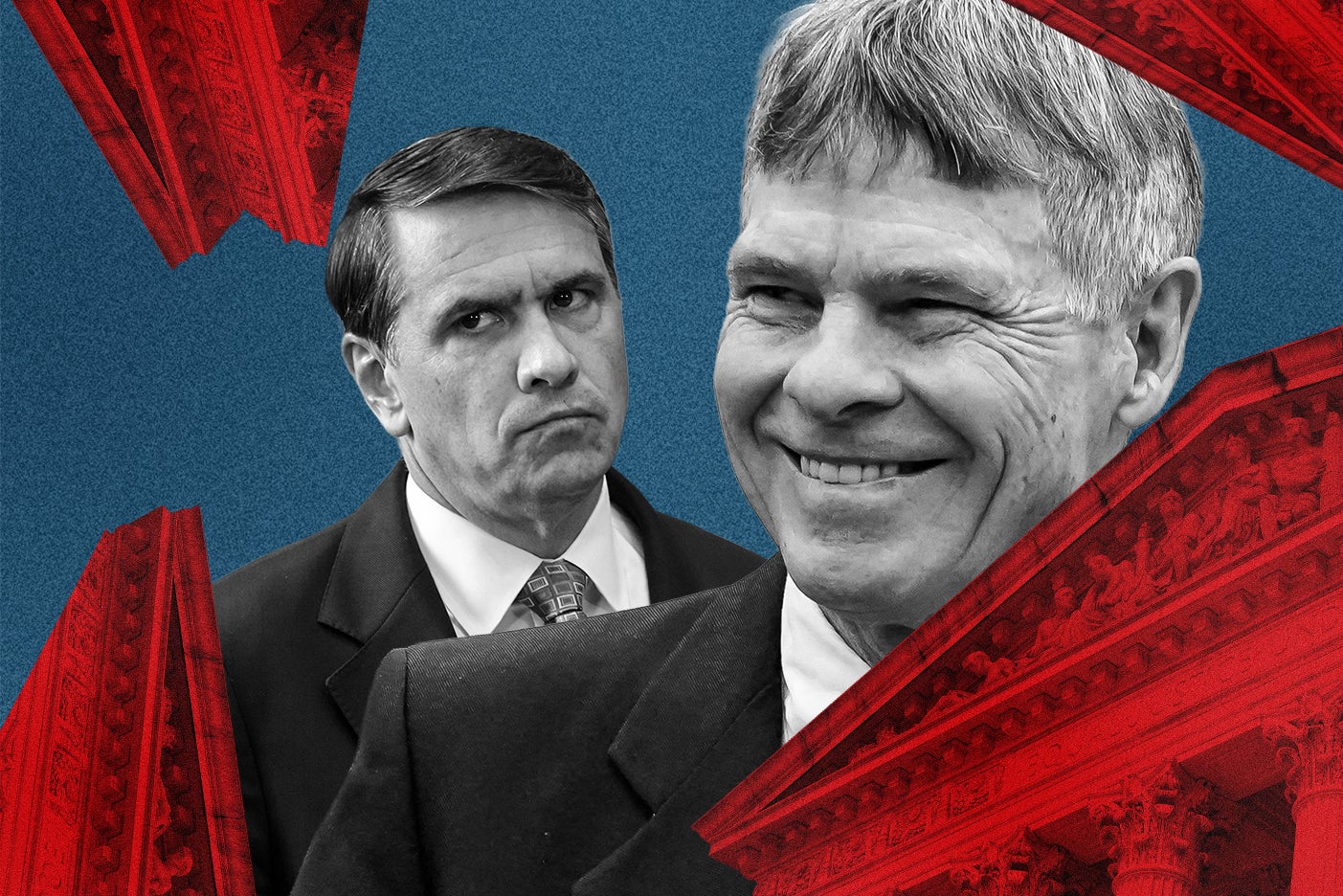
Jurisprudence By Enter your email to receive alerts for this author. Sign in or create an account to better manage your email preferences. Unsubscribe from email alerts Are you sure you want to unsubscribe from email alerts for Shirin Ali? Aug 13, 20265:45 AM Photo illustration by Slate. Photos by Alex Wong/Getty Images and Reuters/Elizabeth Frantz. This is Executive Dysfunction, a newsletter that highlights one under-the-radar story about how Trump is changing the law—or how the law is pushing back—and keeps you posted on the latest from Slate’s Jurisprudence team. Click here to receive it in your inbox each week. It’s been another week of President Donald Trump wasting the U.S. taxpayers’ time and money. Trump’s most recent obsession is still the Lincoln Memorial Reflecting Pool, damaged by construction work he himself ordered, despite his own Department of Justice giving up on absurd vandalism charges against citizens who had allegedly removed peeling material from the pool. Democrats are taking the hint, though, and attempting to hold his administration accountable here. Through the investigative powers of the House Judiciary Committee, Maryland Rep. Jamie Raskin initiated an investigation into the office of U.S. Attorney for the District of Columbia Jeanine Pirro and how her prosecutors secured a grand jury indictment against 67-year-old David Hearn for “vandalizing” the Reflecting Pool, only to dismiss the case within weeks. And the very same day Raskin announced this, the Wall Street Journal reported the White House is in discussions with the Justice Department to potentially consider new charges against Hearn. It’s safe to say that newly minted Attorney General Todd Blanche has his work cut out for him. The president has been bizarrely fixated on the Reflecting Pool since the start of his second term, forcing a $15 million taxpayer-funded renovation to repair, resurface, and paint the pool “American flag blue.” Within weeks of the renovation’s completion, numerous defects were spotted, with a liner installed on the bottom of the pool peeling in various places, and algae again infesting the water. Trump quickly claimed vandals were responsible for the pool’s issues, without citing any real evidence, but nonetheless, Pirro had her marching orders. Within days she secured a grand jury indictment against Hearn, who on June 19 had stopped by the Reflecting Pool while on a bike ride and briefly touched a chunk of pool liner that had detached and floated to the top. In a letter to Pirro and Interior Secretary Doug Burgum, Raskin said Hearn was subsequently arrested and charged with a felony destruction of government property. He was detained for five hours and eventually let go. Less than two weeks later, Pirro moved to dismiss the charges against Hearn, telling the court that Interior Department officials failed to give her key exculpatory evidence, including documents that indicated “damage to the Lincoln Memorial Reflecting Pool in June 2026 was the result of flawed installation by the contractor,” and not Hearn’s actions. Pirro squarely placed the blame on Burgum’s office, which she claimed provided “barebones police reports” despite her asking for “everything.” Raskin wasn’t buying this. “Despite DOJ’s attempt to point the finger at DOI, recent filings show that Ms. Pirro’s team of prosecutors was perfectly aware of Mr. Hearn’s likely innocence before they charged him with a felony,” arguing that a Reflecting Pool damage-assessment report that was dated two days before Hearn’s indictment revealed “systemic failure and peeling of the liner around the area where Mr. Hearn’s alleged vandalism occurred.” He also noted that an expert who testified to the grand jury on behalf of prosecutors also said that existing damage to the Reflecting Pool’s liner was so extensive that Hearn’s actions held no additional cost. “Why didn’t your factual assertions about the case hold water? Did DOJ prosecutors knowingly bring a bogus indictment? Did DOI withhold key evidence to blame the disastrous pool renovation on an innocent man?” Raskin posed to Burgum and Pirro. “Did President Trump pressure or influence either Department to retaliate against and scapegoat an American citizen?” These are fair questions to ask the Trump administration, considering there is a documented trend of federal prosecutors dropping cases based on Trump revenge plots or judges dismissing them. Just this week the Trump administration abandoned its efforts to challenge a subpoena that sought the medical records of transgender young people. And in May, federal prosecutors dropped a massive indictment against the Broadview Six, a group of Chicago protesters, after grand jury transcripts revealed shocking misconduct. Also in May, a judge dismissed a dubious criminal indictment against Kilmar Abrego Garcia, the Maryland man prosecutors admitted was deported to El Salvador by mistake, concluding it was a blatantly tainted investigation “with a vindictive motive.” Perhaps it’s obvious why Pirro, Burgum, and other Trump administration officials continue to pursue questionable cases. Days after Pirro moved to dismiss her indictment against Hearn, Trump told a room full of reporters that she “choked” under pressure. Last week, he again pressured Pirro on Truth Social to “re-visit her hastily made decision.” Former AG Pam Bondi can attest to what happens when a Trump official becomes a target of the president and how that ends. It seems Trump has renewed faith in his new AG to get this job done, though, as unnamed sources told the Wall Street Journal that White House officials have asked the DOJ to consider a new prosecution of Hearn, despite how unusual such a move would be. Plus, next month a judge has scheduled a hearing to decide whether Hearn’s dismissed charges should be held with prejudice, so the DOJ can’t charge him again for the same alleged conduct. “You dismiss w/ prejudice when there’s a risk of repeated harassment & bad faith. Look at Trump’s social media & tell me that risk isn’t real,” Norm Eisen, Hearn’s lawyer and co-founder of Democracy Defenders Action, said on Wednesday. Based on this week’s reporting, that certainly still seems to be very much a risk. We hope you learned a thing or two from this edition of Executive Dysfunction. If you enjoyed reading it, please consider supporting our legal journalism by becoming a Slate Plus member! Elsewhere in Jurisprudence On this week’s Amicus, Dahlia Lithwick and Mark Joseph Stern chat with New York Times columnist Jamelle Bouie to unpack how you, an everyday American, can reclaim constitutional power. They explain how this has worked in the past and how it could look in the modern day, incorporating constitutional meaning within your community, at your day job, and in your personal life.For the Amicus bonus episode, Dahlia and Mark reunite to indulge Amicus listeners’ biggest questions, like who really writes Supreme Court opinions? And where do the court’s originalists get their fake facts from?Friend of Slate Alan N. Walter, founder and principal of an eponymous law firm, argues that the settlement reached between President Donald Trump and the Internal Revenue Service over his $100 billion lawsuit is unenforceable. The plaintiff here sued for money, but settled for an apology and something he never formally requested: immunity.President Trump unveiled two new executive orders that take aim at birthright citizenship by stretching an exception that’s been exclusive to children of foreign diplomats. Alexis Romero, attorney specializing in economic and environmental justice, argues in Slate that these new orders push the boundaries of both U.S. and international law.When a prison cell in a tiny New York town caught fire and killed 35-year-old inmate Marcos “Bori” Alcaraz last month, it barely made any headlines. Robert Lee Williams, an incarcerated journalist, wrote about this story and the recent issues plaguing New York’s prison system for Slate. He explains how he believes Alcaraz’s tragic death likely came to be and how officers have become desensitized to issues afflicting America’s prisons. Thank you for reading Executive Dysfunction! We’re thrilled to be in your feeds and will be back with more dysfunction analysis next week. Sign up for Executive Dysfunction Delivered every Thursday morning. Department of Justice Donald Trump Jurisprudence Executive Dysfunction
Trump’s Latest Obsession Will Be a Huge Headache for Todd Blanche
Full Article
Original Source
Read the full article at Slate →KhanList aggregates and links to publicly available news content. We do not host full articles from third-party sources. Always verify important information with original sources.