
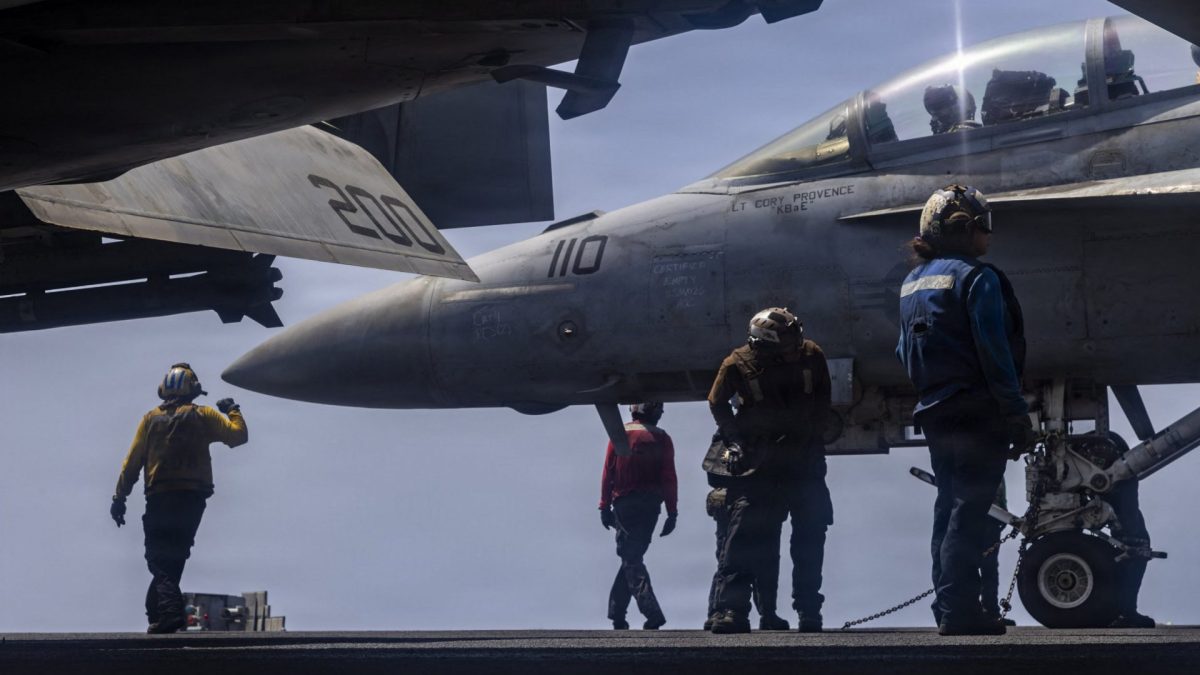
United States President Donald Trump has ordered the Pentagon to scale back joint military exercises with South Korea, the latest in a series of moves minimising America’s presence in the Asia-Pacific region. In a social media post just days before the drills were set to commence, Trump said they sent a “totally inappropriate and hostile” signal to North Korea who had been “unthreatening and respectful”. Pyongyang had only days earlier restarted ballistic missile testing banned by the United Nations and North Korean officials threatened unspecified responses to the exercises on Friday. Trump’s announcement also comes as the US withdraws its last aircraft carrier from the region, further reducing America’s presence as rival superpower, China, ramps up its assertiveness. Beijing is likely to welcome the downscaling of joint US-South Korean exercises, with one security expert telling The i Paper China was increasingly “the winner” from Trump’s approach. Shorts Trump says US will ‘substantially reduce’ involvement in South Korean drills US and South Korean military leaders held a joint press conference announcing Ulchi Freedom Shield last week, with the 11-day exercise aimed at helping build readiness for North Korean threats. Some 18,000 South Korean soldiers were due to take part in drills alongside several thousand US colleagues. The exercises were intended to reinforce “the role of the alliance as the linchpin for regional peace and security”, US officials said at the time. Trump, however, took a different view. In a social media post on Sunday evening, he claimed the drills “send a signal that is totally inappropriate and hostile” to North Korea. “Therefore, and based on the fact that it is too late to cancel, I have instructed Secretary of War, Pete Hegseth, to substantially reduce the Joint Military Exercises!” the President wrote. He also cited the “costly” nature of the exercises and South Korea’s decision not to join the US’ war with Iran as reasons for downscaling America’s involvement. This is not the first time the President has scaled back military drills with South Korea. Trump completely suspended planned exercises in 2018 as he sought direct negotiations with North Korean leader Kim Jong Un over the country’s nuclear program. However, the announcement was unusual given it was apparently a unilateral decision made just days before the drills were set to begin. Trump claimed the drills “send a signal that is totally inappropriate and hostile” to North Korea (AP Photo/Julia Demaree Nikhinson) China ‘the winner’ from US shift away from Asia Trump’s decision to reduce US involvement in the exercises came as the country withdraws its last aircraft carrier from the Asia-Pacific region. The USS George Washington is en route to the Middle East in order to relieve another carrier, leaving Asia without the presence of one of the US Navy’s most potent weapons for at least several months. Despite the US Defence Department having designated the Pacific as the second most important region behind the Western Hemisphere for maintaining America’s global influence, security analysts say Trump’s actions are opening the door for China to assert dominance. Jane Hardy, a former Australian envoy to the US Indo-Pacific Command and now Non-resident Senior Fellow at the Australian Strategic Policy Institute, told The i Paper “China is the beneficiary of almost everything that Trump does”. “China, now, holds so many cards,” she said. “It is a country that dominates the world economy, it is developing highly sophisticated industry, it has overtaken Japan and Germany, I believe, in its assessed production of strategic goods, and it is the only country in the world that can rival the US on the new front – the new front, of course, being artificial intelligence.” Beyond economic leverage, the absence of any US carrier in the region may allow Beijing to further increase aggression in key waters, particularly the Taiwan Strait and South China Sea. Chinese forces have also recently conducted live-fire exercises off Japan, another key US regional ally, and in the past year have been involved in a number of near misses with Australian the military. Instability and the risk of miscalculation could have major impacts outside the region, including by posing risks to commercial shipping and disrupting already stretched global supply chains. Either outcome would likely generate further inflationary pressures, and be felt far beyond the Asia-Pacific. EXPLORE MORE ON THE TOPICS IN THIS STORY
Trump’s latest move shows he has abandoned Asia – the world will pay the price
Full Article
Original Source
Read the full article at Inews →KhanList aggregates and links to publicly available news content. We do not host full articles from third-party sources. Always verify important information with original sources.