
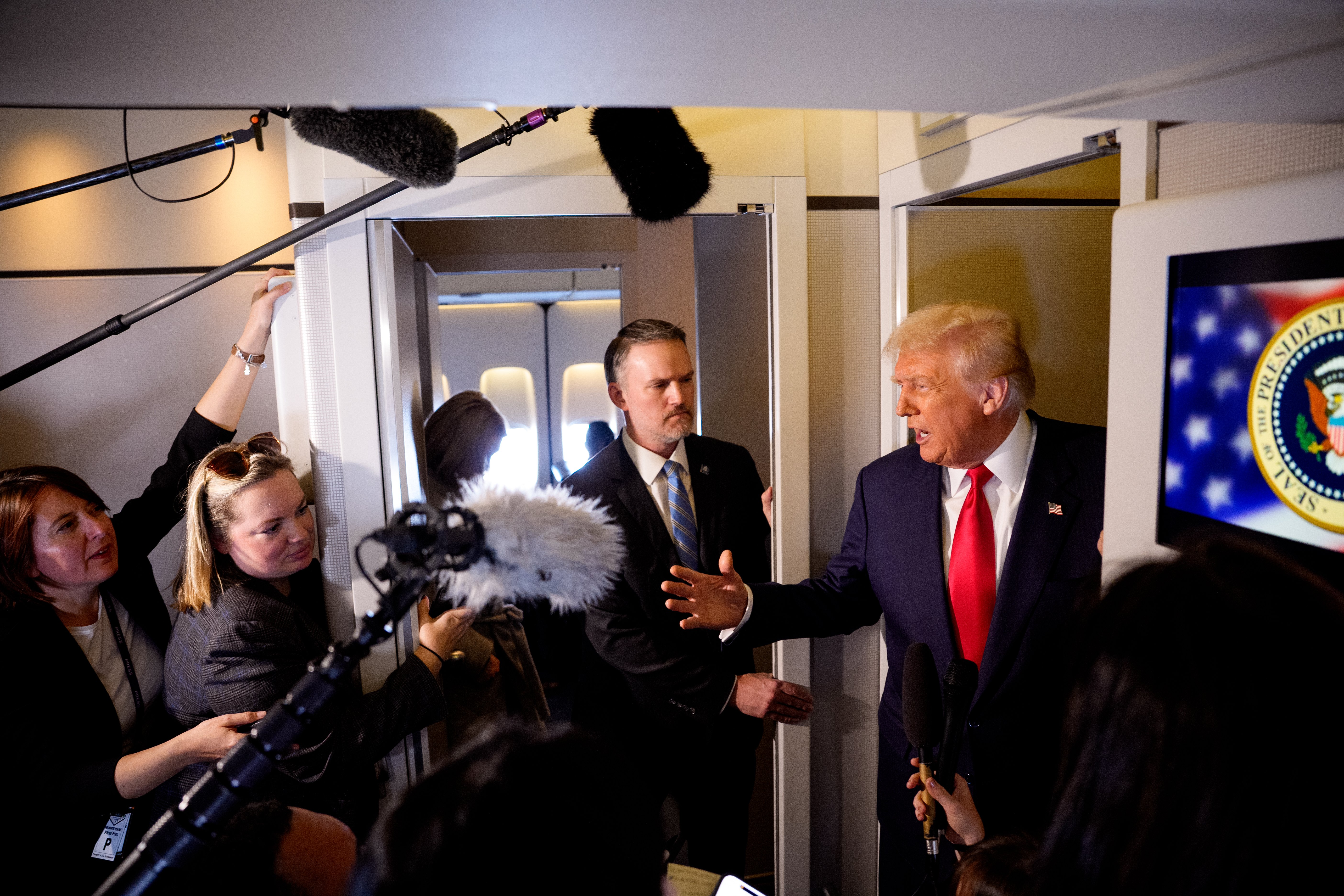
Despite having a better legal foundation than past attempts, these duties may also be struck down. U.S. Trade Representative Jamieson Greer and President Donald Trump speak to members of the media aboard Air Force One. U.S. Trade Representative Jamieson Greer and President Donald Trump speak to members of the media aboard Air Force One on Oct. 30, 2025. Andrew Harnik/Getty Images September 29, 2026, 1:15 PM On Wednesday, U.S. President Donald Trump’s third attempt to levy global tariffs will face a challenge in court, after his first two attempts were ruled unlawful, including a landmark ruling earlier this year by the Supreme Court. While the latest batch of tariffs appears to rest on sturdier legal ground than the two that were struck down, they, too, will likely be ruled out of bounds by the U.S. Court of International Trade. At issue is the implementation this summer of tariffs of between 10 percent and 12.5 percent on nearly every U.S. trading partner, ostensibly because all of them—59 countries and the European Union—fail to police the use of forced labor in their supply chains. That failing, the U.S. trade representative surmised, must somehow cause damage to U.S. companies. At the time, trade experts and lawyers saw the move for what it was: a replacement, in a new guise, for the blanket International Emergency Economic Powers Act (IEEPA) tariffs that the Supreme Court struck down in February. On Wednesday, U.S. President Donald Trump’s third attempt to levy global tariffs will face a challenge in court, after his first two attempts were ruled unlawful, including a landmark ruling earlier this year by the Supreme Court. While the latest batch of tariffs appears to rest on sturdier legal ground than the two that were struck down, they, too, will likely be ruled out of bounds by the U.S. Court of International Trade. At issue is the implementation this summer of tariffs of between 10 percent and 12.5 percent on nearly every U.S. trading partner, ostensibly because all of them—59 countries and the European Union—fail to police the use of forced labor in their supply chains. That failing, the U.S. trade representative surmised, must somehow cause damage to U.S. companies. At the time, trade experts and lawyers saw the move for what it was: a replacement, in a new guise, for the blanket International Emergency Economic Powers Act (IEEPA) tariffs that the Supreme Court struck down in February. But the challenges to the latest round of tariffs (actually, the second-latest round of tariffs, because Trump later slapped fresh duties on Canadian imports under a different authority) argue that the administration has again overreached and abused the very specific trade authority that Congress has delegated. One of the companies suing over the latest tariffs led the successful charge in the Supreme Court. In a nutshell, the authority that the administration used—Section 301 of the 1974 Trade Act—allows for tariffs on a specific country (not countries) that is burdening U.S. commerce through its policies. It was drafted and passed into law to give the executive branch negotiating leverage to seek better terms with trading partners over specific disputes, such as access for agricultural products in Europe’s common market. Nothing in the statute’s language or legislative history suggests that Congress sought to hand over the entirety of its constitutional oversight of the powers of trade and taxation, nor that the statute could be made to apply to scores of countries in one fell swoop. (The Trump administration has an additional batch of Section 301 tariffs, based on the notion that countries with excess manufacturing capacity are harming America’s trading prospects, that has not yet been finalized.) “In short, the Section 301 tariffs appear to be a thinly disguised pretext for reimposing the President’s IEEPA tariffs under the guise of dealing with forced labor, after all too often sham ‘investigations,’” wrote a trio of trade experts in a friend-of-the-court brief filed ahead of Wednesday’s oral arguments. Alan Wolff, a senior fellow at the Peterson Institute for International Economics and one of the signatories of the amicus brief, helped draft and revise the original statute that became Section 301 of the 1974 trade law when he served in the Nixon administration. He noted that it was a carefully circumscribed delegation of trade authority to enable negotiations over thorny trade issues, not a one-size-fits-all ticket for tariffs on the entire world. “We’re just doing it all again—first it was the International Emergency Economic Powers Act, then it was Section 122 of the 1974 law. It is beyond anything contemplated by the statute,” Wolff said. “Never before today has the U.S. trade representative set a whole new tariff schedule for the United States. Congress has always been careful about delegating trade authority. They are time-limited, the amounts of tariffs are limited, and they certainly did not delegate all of their tariff authority to the president or the U.S. trade representative.” While the United States is hitting all of its major trading partners with tariffs on the grounds of weak regulation of forced labor, Trump and Chinese leader Xi Jinping just agreed to reduce tariffs on a total of $60 billion worth of goods. The U.S. State Department and Department of Labor have said that China uses forced labor in Xinjiang. This latest legal challenge is critical, and not just because there is another round of tariffs using the same authority waiting to be unveiled. Tariffs remain central to Trump’s economic playbook and his economic message; his trade representative, Jamieson Greer, cites the Trump administration’s rising taxes on imports as reason for cheer for working-class Americans. In fact, almost two years of intensified tariffs on nearly every country the United States does business with have done little to address the U.S. trade deficit, which Trump and Greer repeatedly cite as a reason for hiking costs for U.S. businesses and consumers. Year-on-year, the U.S. trade deficit in goods has gotten bigger, not smaller, despite the tariffs. Nor have they done anything to encourage a manufacturing renaissance. What they have done, in conjunction with the war in Iran, is raise prices, which in turn forced the U.S. Federal Reserve this month to raise interest rates for the first time in three years, which will make everything from auto loans to mortgages more expensive. It’s not clear when the court will rule on the latest challenge after Wednesday’s oral arguments. But it’s unlikely to be the last court case testing Trump’s affinity for tariffs, after he hit Canada with duties on $20 billion worth of goods under yet another novel trade authority, one dating back to 1930. That trade bill helped make the Great Depression even greater; Trump should hope history doesn’t rhyme. This post is part of FP’s ongoing coverage of the Trump administration. Follow along here. Economics United States China Europe Keith Johnson is a staff writer at Foreign Policy covering geoeconomics and energy. Bluesky: @kfj-fp.bsky.social X: @KFJ_FP Read More People stand under umbrellas while facing the steps in front of the U.S. Supreme Court building under an overcast sky. Trump’s Tariffs Are Unlawful, Supreme Court Rules But it’s unclear what happens to the tens of billions of dollars already taken from U.S. businesses. Trump, in a black overcoat and red tie, is seen from above as he speaks into a boom mic, while Mullin stands behind him with hands clasped. At the top of the image one can see the feet of spectators standing in a line, letting in beams of sunlight through the gaps between their legs. Trump’s Tariffs Just Got Struck Down in Court—Again Courts keep taking a skeptical view of the executive branch’s overreach. OTHER SUBSCRIPTION OPTIONS Stories Readers Liked Go to slide 1 Go to slide 2 Go to slide 3 Go to slide 4 Go to slide 5 Go to slide 6 Go to slide 7 Go to slide 8 Go to slide 9 Go to slide 10 A statue of a seated, bearded man with a bare torso and draped cloth around his waist, holding a scroll in one hand, positioned in front of a row of large classical columns. An illustration of Donald Trump in a blue suit and long red tie gesturing with open hands in front of a grid patterned background with jagged red, blue, and black line graphs diving downward. Five people sit in folding chairs pushed up against a wall, all of them on their phones and several looking board. Text on the wall behind them says "AI for Real" with images of robotic arms and household appliances printed around it. An illustration depicting a man submerged up to his nose in water. The wavy water is divided horizontally into three color bands that mimic a flag: white foam at the very top peaks, a deep blue middle section filled with bubbles, and a red lower section covering his neck and suit jacket. His blue eyes look upward with a wide, strained expression. As the Tide Turns Against Putin, Beware the Drowning Man By Peter Frankopan Negotiators from the United States, Canada, and five European countries converse after finishing the draft of the North Atlantic Treaty in Washington on March 18, 1949. Trans-Atlanticism Isn’t Dead—It’s Being Renegotiated By Alexandra de Hoop Scheffer A woman crosses a road in front of a mural depicting Russian President Vladimir Putin in Kashira, Russia, southeast of Moscow, on Oct. 16, 2017. The Western Myth of Russian Greatness By Christian Caryl An illustration of a vintage-style map featuring North America and parts of Europe and Africa. Overlaid on the map are 3D red brick walls shaped exactly like the borders of the contiguous United States and Alaska, casting long shadows to the right. America, the Once Global Nation By Odd Arne Westad A creative illustration against a pale yellow background showing a garden planter containing a dense green hedge. Five human arms emerge from the hedge, with four of the hands holding small flags of China, Russia, the United States, and the European Union, while the fifth hand holds the flag of India. An illustration showing a pair of hands tightly wringing out an American flag. Water droplets shaped like missiles squeeze out of the twisted fabric and fall toward a puddle shaped like the map of Iran on a red background. An aerial photo shows Doha in the booming petrostate of Qatar.
Trump’s Global Tariffs Are Likely to Fail in Court (Again)
Full Article
Original Source
Read the full article at Foreignpolicy →KhanList aggregates and links to publicly available news content. We do not host full articles from third-party sources. Always verify important information with original sources.