
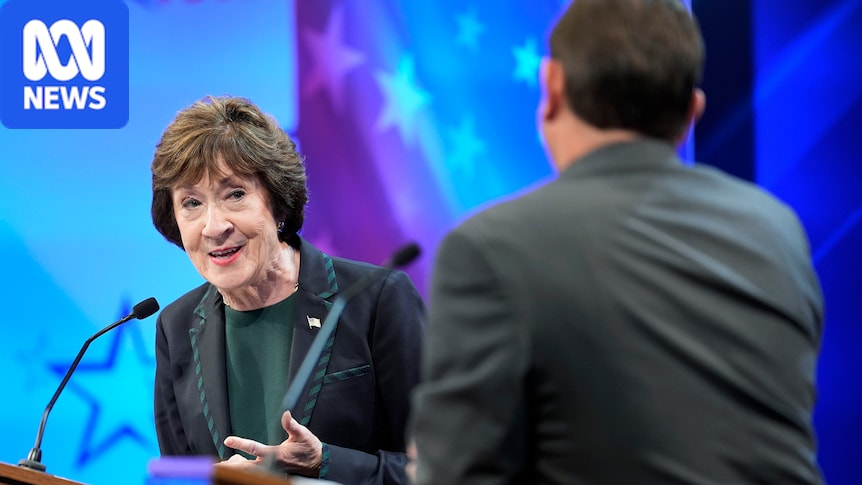
Susan Collins carries herself like she could have run an etiquette school if she hadn't spent her life in politics.The Republican senator has a genteel air of grandmotherly decorum. It distinguishes her from many of her MAGA colleagues.And it made for a more striking moment when her Democratic opponent turned to her and said, "Shut up," during a debate this week.Troy Jackson is a former logger with a rough-and-tumble brand of working-class politics. He was annoyed that Collins had accused him of planting a protester in the crowd."This is obviously one of Troy's supporters," Collins said as the audience member started screaming about data centres."Oh, shut up," Jackson replied. "I did not. I don't even know that kid."The protester had actually posed as a journalist. Wearing an oversized laminated "press" lanyard, he convinced a worker he should have been on her media list and was escorted inside with me and another reporter.But his outburst was more than a moment of isolated debate drama. It represented one of the big dangers to Donald Trump ahead of the midterm elections.Polls show Democrats and Republicans both generally hate data centres and their explosive growth across the country.But Trump has shrugged off their concerns.He says people who oppose them "want to end up being backwards and poor". He labels the backlash "a sick conspiracy".It's on a growing list of issues motivating voters to punish Trump at the midterms, where he keeps telling voters to pretend he is on the ballot.Anger with TrumpMaine's Senate race is one of the midterms' most important. It's one of a handful of toss-up contests that could cost Republicans their majority.The debate, in the regional centre of Bangor, was only interrupted once. But it had several similar reminders of times Trump has dismissed voters' concerns as either conspiracy or stupidity.This attitude towards voters' concerns has been forcing Republicans onto the defensive when faced with angry constituents on the campaign trail.Maine is a key state in the battle for a Senate majority, and pollsters rate the race as a toss-up. (Portland Press Herald: Gregory A Rec via AP)Affordability is an obvious one of those issues.Collins and Jackson sparred over who to blame for rising prices. But Trump has repeatedly described the issue as a "hoax" concocted by Democrats.All the surveys show it's a burning concern for voters and a big reason his approval rating keeps sinking further underwater.In one recent poll, 65 per cent of Americans blamed high prices on Trump policies rather than on factors out of his control.That's much higher than the proportion of Americans who blamed Joe Biden for high prices (44pc) before the 2022 midterms, when Republicans seized control of the House from Democrats.Immigration and deportations are another issue that was once seen as a Republican strong suit but is now backfiring.In January, ICE launched an immigration crackdown in Maine called "Operation Catch of the Day", a pun for the fishing state.Many Mainers didn't appreciate the joke, or the operation itself. After public pushback, the operation was abruptly terminated, and Collins took credit.But ICE operations later ramped up again in Maine. Three months ago, a 25-year-old Colombian father who had a US work permit was shot dead by an ICE agent during a traffic stop."One of those bullets went into that car seat that was in the back seat of his car," Jackson told the debate. "Luckily his daughter wasn't there, or she wouldn't be with us either."Collins said she had made progress pushing for safeguards like body cameras for ICE agents. But she agreed more reforms were needed to improve how they operate.Polls now show most Americans were not in favour of the crackdown. A Fox News poll last month found 53 per cent thought it had gone too far.Then there's the increasingly unpopular war in Iran.Collins told the debate that Trump "definitely" should have consulted Congress before attacking Iran, and he should have had a plan for the Strait of Hormuz.Once the war started, she said, the War Powers Act gave Trump broad authority for 60 days. "After 60 days, that's when I voted every single time with Democrats to bring the conflict to a halt."Distancing from the presidentCollins, more than any other Republican senator, has worked to distance herself from Trump."I vote very independently," she told the debate. "The studies show that I am the most bipartisan member of the Senate."Jackson mocked this claim."100 per cent of the time Donald Trump needs her, Susan Collins is going to be there," he said.At one point, Collins helped to prosecute Jackson's point that she is not an effective check on the president.When asked to name a time she successfully changed something by opposing Trump, she cited Pete Hegseth's nomination as defense secretary."At one point, I had organised people to vote against Secretary Hegseth," Collins said.It was a curious example to choose. Her effort failed, the Senate confirmed Hegseth, and there is no sign he has held back on any of the contentious moves he planned.Jackson wants to link Collins to Trump as much as possible because so many voters are angry with the president over so many issues.The audience member who sat next to me during the debate could be an indicator that that strategy is working.He told me he hoped Collins didn't spot him in the audience.He knew her and had voted for her previously, but he was attending the debate as Jackson's guest."It's hard because she has helped us," he told me. But she had also done too much to "enable" Trump, he said."He's nuts," he added. "So we need a change."
Trump's big midterm problems emerge in small-town debate
Full Article
Original Source
Read the full article at Abc →KhanList aggregates and links to publicly available news content. We do not host full articles from third-party sources. Always verify important information with original sources.