
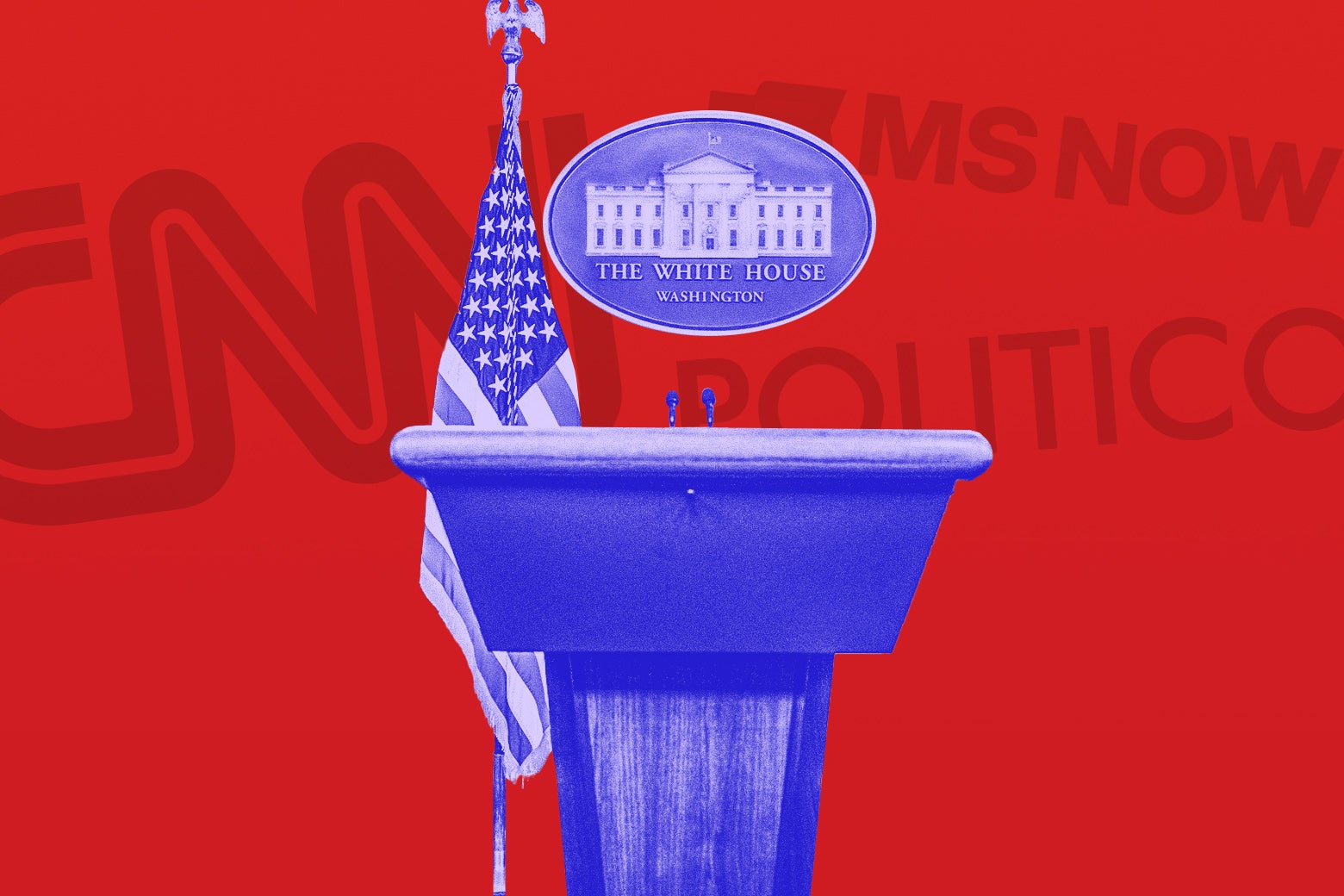
The Slatest The president’s latest attack on journalism has united much of the media in opposition. Photo illustration by Slate. Photo by Nils Huenerfuerst on Unsplash. This story is adapted from the Slatest newsletter. You can sign up here to get it in your inbox every day. Liberals have long accused journalists of letting Donald Trump walk all over them, lying to reporters’ faces and using them as political punching bags even as he basks in the glow of their camera lights. But the press’s posture may now be changing. After Trump announced he was banning three news outlets from the White House, the major TV networks—including Fox News(!)—acted as one to protest the president’s decision. The dustup carries important implications for the First Amendment and journalists’ ability to tell the rest of us what’s going on inside this administration’s inner sanctum. Back up. How did this whole thing start? With a Truth Social post, as Trumpian brouhahas often do. On Friday afternoon, the president put out a lie-filled, haphazardly capitalized post announcing he’d banned CNN, MS NOW, and Politico from the White House. Trump claimed the ban was “a result of their constant ‘reporting’ FAKE NEWS” and pledged that “Other Fake News Media Outlets” would get the same treatment. By Saturday, reporters from those three organizations were being denied White House access. How have journalists responded? CNN, MS NOW, and Politico jointly sued the administration, arguing that the ban “could not be a more direct assault on the First Amendment.” On Monday, the administration barred CNN from the “pool,” a rotating crop of TV journalists who film presidential events. So the other four major networks—ABC, CBS, Fox, and NBC—decided to suspend the pool indefinitely. Media outlets unaffected by the ban, like the Atlantic and the Washington Post, issued statements of solidarity. What’s lost when reporters aren’t allowed into the White House? In fairness, most reporters still are. Print, online, and radio journalists continued to follow Trump as normal today. But even though everyone has a camera in their pocket these days, the TV pool is how news outlets around the world get footage of presidential events in sensitive areas, like Trump’s Oval Office meetings with world leaders or appearances aboard Air Force One. Without it, the only footage the public will see from those places is what the White House wants it to. The administration has teased that it could soon replace poolers with its own video feeds, which would effectively amount to state television. “The public has a vital interest in receiving accurate, independent information about its government,” the five major networks said in a joint statement. “No administration should restrict a news organization because it objects to its reporting.” What happens next? A federal judge named Timothy Kelly will hear the three banned outlets’ lawsuit. Trump appointed Kelly in his first term, but the judge sided with CNN in 2018 after the White House tried to yank a reporter’s press credentials. Kelly has scheduled a Wednesday hearing, which could make Trump’s ban short-lived. The president has preemptively vowed to appeal any adverse ruling. In the meantime, the ban is already having an effect. On Monday, Trump cut the ribbon to open his new White House helipad, but the TV pool was missing and the administration’s feed was inaudible, resulting in footage of the president speaking over the sound of static. So what’s the bigger picture? Deciding which journalists deserve access to the White House isn’t an easy question. The press briefing room has a finite number of seats, and who should get them has been a contentious question under many administrations. But this is a naked effort to punish outlets for coverage the president doesn’t like—and it’s likely aimed at having a chilling effect. Being on site helps reporters cultivate sources and break news, which in turn helps inform those of us who don’t have access to the building. If covering the president aggressively risks getting your outlet banned, it pressures reporters to pull their punches or shy away from stories that could anger the administration. Trump has already used the bully pulpit and lawsuits to try to wring more sycophantic coverage out of the media. “There’s something wrong with a country that can allow people to write purposely negative stories,” he said in the Oval Office on Friday, shamelessly trampling the founders’ vision of a country in which a free press was sacrosanct. Trump’s ban is another attack on that freedom, and it’s unlikely to be the last. Tolga Akdoğan Looking for an evening escape from the latest erosion of our constitutional rights? My colleagues have some suggestions. Meet the men who still love Bitcoin: Cryptocurrency’s power has declined, but it still holds a powerful allure to some people disillusioned with America’s economic system. Nathaniel Moore went to Las Vegas to see why some lost boys are still pinning their hopes on Bitcoin. Read about a beloved author’s new novel: John Green, author of classic young-adult books like The Fault in Our Stars, hasn’t published a novel in a decade. Now, he’s back with his first-ever book for adults. Laura Miller writes that Hollywood, Ending is potent “enough to make you wonder why anyone ever thought his earlier books were just for kids.” Raise a glass to a classic cocktail: The margarita’s ingredients may be simple, but its origin story is far more complicated. N.C. Stevens digs into the drink’s history and tells a fascinating tale about Prohibition and the delicious outcome of cultural fusion between the U.S. and Mexico. Watch a scary new film: Video games are notoriously difficult to adapt to other media, but, according to Sam Adams, the new Resident Evil movie makes the leap from console to screen “with the right mixture of fidelity and irreverence.” And, if you’re a gamer but not a horror connoisseur, Nadira Goffe helpfully breaks down whether Resident Evil will be too scary for you, using Slate’s highly scientific Scaredy Scale. Whether you’re watching with excitement or hiding under the covers, I hope you have a great evening! See you tomorrow.
Trump Went So Far This Time That Even Fox News Won’t Stand for It
Full Article
Original Source
Read the full article at Slate →KhanList aggregates and links to publicly available news content. We do not host full articles from third-party sources. Always verify important information with original sources.