
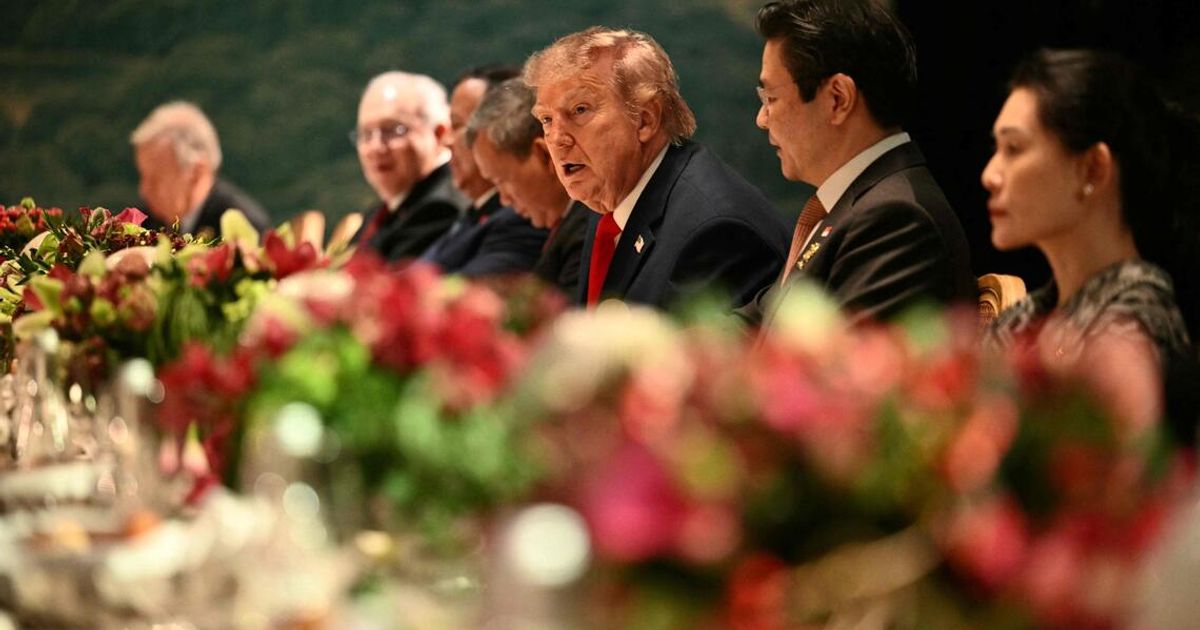
MANILA – With warm words and effusive praise, US President Donald Trump sought to demonstrate US commitment to South-east Asia during his brief jaunt to the Philippines at an inflexion point of his presidency, with the heavy losses suffered by his party during the recent midterm elections putting question marks over the remaining two years of his term.The Trump who arrived in Manila on Nov 17, in the wake of not only the election drubbing but also the fallout of the crisis at chipmaker Nvidia, was markedly different from the one who headed to Kuala Lumpur for the same summit in October 2025,.Then, he had positioned himself, grandly, and with the help of Malaysia as ASEAN chair, as a peacebroker for the Thai-Cambodia conflict and dealmaker for an agreement on reciprocal trade with Malaysia.Not surprisingly, he spared no effort to laud these efforts again, noting that the Thai-Cambodia ceasefire had “saved thousands and thousands of lives, and maybe much more than that”.But the change in tone was decidedly different.He had lots of warm words for the region’s leaders, calling them friends he has “known for a long time” and giving personal shoutouts to Thai Prime Minister Anutin Charnvirakul for a fresh trade deal and Indonesian President Prabowo Subianto for a defence pact signed earlier this year.For Philippine President Ferdinand Marcos Jr, Trump’s presence in Manila added a feather to his cap as the rotating ASEAN chair, even if the American president was fashionably late to the point that he missed the entire ASEAN Summit.From the grand welcome the moment he stepped out of Air Force One, complete with guards of honour and flag-waving children, the Philippines had pulled all the stops to welcome Trump – even months ahead of his arrival.A diplomatic source told The Straits Times that organisers had shifted the summit’s dates by a few days to accommodate Trump’s schedule. And in a break from tradition, the ASEAN leaders’ special summit with Trump was scheduled after the closing ceremony and Philippine President Ferdinand Marcos Jr’s press conference to wrap up the meetings.“We are looking forward to ASEAN’s constructive engagement with the US,” Marcos said at his press conference. “And that’s why, actually, we already had the closing ceremony – the 49th ASEAN (Summit) is over – but we asked the leaders to stay for a little longer so that we could have this ASEAN-US Summit.”Later, just before the Trump and region’s leaders had dinner, a beaming, gratified Marcos said: “Your presence confirms what we already know: that Asia and the United States are partners in shaping the region’s future.”Yet, for high-context Asia, where showing up is as important as the deal, actions will be valued over rhetoric.Trump would no doubt want to claim more political victories from this year’s summit, but Kevin Chen, associate research fellow at the S. Rajaratnam School of International Studies, told The Straits Times that regional governments would likely take “a more guarded approach”, mindful that the incoming Democratic majorities in Congress might hinder or distract from the implementation of his foreign policy.It could explain the relatively low-priority agreement that emerged from the US-ASEAN Special Summit, which called for the adoption of “10 public-private partnership principles” to tackle online scams, rather than deals addressing the most pressing economic or AI concerns for South-east Asia.It left observers wondering if Trump was “really just here for the vibes”, to borrow Gen Z parlance, ahead of a much bigger show at the Asia-Pacific Economic Cooperation meetings in Shenzhen in the coming days, where he will meet Chinese President Xi Jinping and Russian President Vladimir Putin.Still, that is not to say that the region sees Trump as merely a lame duck president.Trump also joined the leaders of India, Australia, and Japan at the first summit of the so-called Quad group in two years on Nov 17, where he highlighted the importance of collaborating on AI with Quad partners. Trump said the group will launch an AI accelerator, and spend more than US$85 million (S$109.6 million) to expand access to trusted AI ecosystems across the Indo-Pacific.Quad leaders also agreed to conduct their first maritime surveillance training flights in the Pacific in 2027.US President Donald Trump arriving at the Ninoy Aquino International Airport to attend the 49th ASEAN summit, in Pasay City, Metro Manila, on Nov 17. PHOTO: EPAThe region’s leaders are likely to be wary of an “unbounded” president who continues to wield extraordinary powers through executive orders that have prerogative over foreign policy, said Tang Siew Mun, an independent researcher who studies regional affairs.Indeed, on the eve of his arrival, the US government issued a new rule to curb remote Chinese access to AI servers in five countries – four of which, including Singapore, are in South-east Asia.It marks concrete steps taken towards decoupling US-led artificial intelligence ecosystems and supply chains from Chinese ones that may ultimately culminate in what ASEAN does not want: having to choose between the US and China.Joanne Lin, senior fellow at the ISEAS–Yusof Ishak Institute, told ST she does not think ASEAN countries will necessarily be forced to make an outright choice, but “the space for maintaining technological neutrality is becoming increasingly constrained”.“AI involves an interconnected ecosystem of semiconductors, computing infrastructure, cloud services and applications, which makes it difficult to separate technological choices from broader strategic alignments,” she said.“ASEAN countries would generally prefer to retain access to technologies, investment and expertise from both powers, while avoiding excessive dependence on either side,” she added.She added that they are likely to respond pragmatically by assessing the benefits and implications of individual initiatives but added that their responses may vary since they have different technological capabilities, economic interests and relationships with both powers.“The challenge will be to preserve as much strategic flexibility as possible while avoiding technological fragmentation that could undermine regional digital integration and ASEAN’s own AI development,” she added.
Trump wants to make a pitch for the US in ASEAN, but will the region buy it?
Full Article
Original Source
Read the full article at Straitstimes →KhanList aggregates and links to publicly available news content. We do not host full articles from third-party sources. Always verify important information with original sources.