
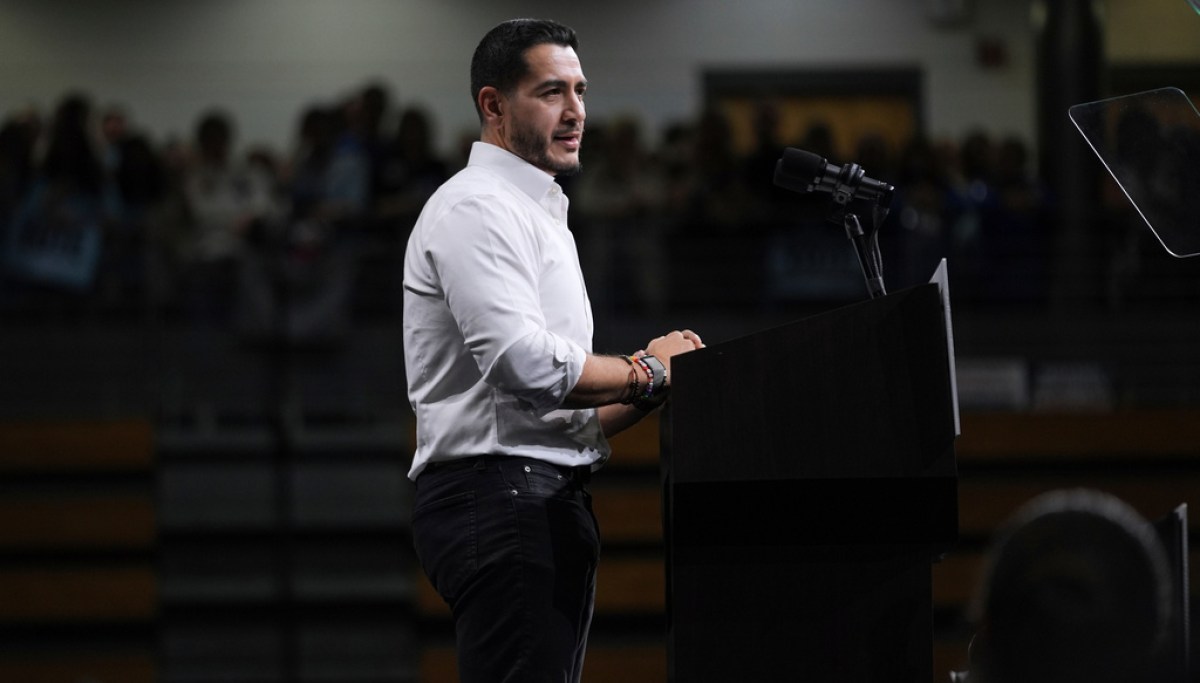
TRUMP, VANCE, AND THE “JIHADIST” EL SAYED. During a trip to Michigan on Monday, President Donald Trump focused on Democratic Senate nominee Abdul el Sayed and said, “I’m here to keep a jihadist Muslim Brotherhood member from becoming a United States senator.” A moment later, Trump added, “Mohamed is a jihadist lunatic who hates our country, the black people of Detroit, and wants to see the U.S. fail.” (The president was referring to el Sayed’s full name, which is Abdulrahman Mohamed el Sayed.)Even with the intense rhetoric that has characterized this race, Trump’s use of “jihadist” seemed a step beyond. So the next day, as Vice President JD Vance arrived at Joint Base Andrews to board Air Force Two for his own trip to Michigan, I asked Vance, “Is Abdul el Sayed a jihadist, as the president said?”“Well, look, he certainly has a lot of weird friends, and he said a lot of crazy stuff,” Vance answered. “And he has identified himself with a segment of the Democratic Party which, by the way, I don’t think represents most Democrats in the country. But unfortunately, it represents a lot of elected Democrats who seem to align with people who justify violence against the United States of America. I don’t know what’s in the guy’s heart. I just know he has a lot of weird friends.” What to make of Vance’s answer? For one, he seemed to be saying that he, JD Vance, would not have used the word “jihadist” to describe Abdul el Sayed. On the other hand, Vance seemed to suggest that Trump was on to something that needed to be discussed in the Michigan Senate race.That something was the subject of Vance’s speech at a rally at an airport in Howell, Michigan, about an hour northwest of Detroit. Vance, the former senator from Ohio, began by making light of the rivalry between his home state and Michigan. But he quickly moved to the similarities of small towns in those states — idyllic, upright, American to the core.“Both are filled with Americans who work hard and have sacrificed much for their country,” Vance said. “And I’m talking particularly about the grandsons and granddaughters of those who built the arsenal of democracy during the Second World War.”They built a good life for themselves, Vance told the audience. “You know, it was our states that built the great American middle class, it was our states that ushered in an era of prosperity unlike anything the world had ever seen,” he said. “We showed everybody that everyone had a part to play in the great American success story, whether you were a welder, a janitor, or a CEO.”But then things began to go wrong. The elites running the country felt “indifference to the fate” of small towns in the heartland. Factory jobs were shipped overseas. Local businesses suffered. Vance recalled playing peewee football, and on his jersey was printed the name of the local business that supported the team. “And I distinctly remember looking at my old jerseys and seeing the names of businesses that had sponsored those teams and realizing that most of the teams I played for, those businesses no longer existed,” Vance said. “They were casualties of politicians in a faraway place who didn’t give a damn what happened to Michigan or Ohio, and it was us that paid the consequences.”Then came 9/11, which happened when Vance was 17 years old. Americans unified, but Vance also remembered “going to a gas station and waiting in line for hours for gasoline that, of course, had shot up in price because of a region of the world made up of countries whose name I couldn’t even pronounce.”Americans went to war. Vance remembered that “in 2003 there were only two kids from my block who graduated from high school that year; it was me and a buddy of mine named Nick. And both of us immediately enlisted in the United States Marine Corps.” Then Vance recalled “coming home from Iraq to labor strikes in my hometown, because there was a threat that even more of the factories that my town relied on would be closed down and shipped to another country. And I remember distinctly wondering why it was that politicians seemed to care so little for the places that farmed our food, that built our cars, and that sent our troops to fight in wars.”And on it went, for years. Then, finally, came rescue in the person of President Donald Trump. “If you think about it, our movement is about sovereignty, the idea that the people’s government belongs to the people, not to lobbyists, not to bureaucrats, not to foreign money, and not to illegal aliens,” Vance said. “At its heart, our movement is about returning control of the United States of America to you, which is exactly where it belongs.”At that point, well into the speech, Vance had not said a word about Abdul el Sayed. He had not called el Sayed a jihadist, had not even said he has a lot of weird friends. Instead, Vance had painted a portrait of formerly great small-town America, made great by small-town Americans, that went through bad times at the hand of self-centered elites but is now becoming great again under Trump.Only then, after all that, did Vance introduced Abdul el Sayed as someone who doesn’t really care about that America, who doesn’t even want to be part of it, and appears to feel contempt, or at least hostile indifference, toward it. To make his point, Vance relied on what el Sayed himself has said.“The battle for your Senate seat is a proxy fight over whether America can be truly sovereign if it belongs to men who feel contempt and disdain and hatred for the United States of America,” Vance said. “Just think about what Abdul el Sayed says about himself. Now, Abdul el Sayed was born just north of Detroit in a town called Rochester Hills. Yet he has claimed to be — and I quote — an immigrant from North Africa.”“For decades, he’s gone even further than that,” Vance continued. “He’s told people he is an Egyptian citizen. Why? Why would you tell people that you were not from the community that you’re actually from? It’s an insane claim to make.”Just for the record, what Vance said was accurate; el Sayed did say those things. And then: “Ladies and gentlemen, we have to understand what happens when our nation gives in to these kinds of people, to young men with zero attachment to its land or to its history, with a man who would lie, who is so ashamed of this state that he would lie about being an immigrant from another continent,” Vance said.With that, Vance had pulled together a narrative: This is a special part of America. It has suffered in the past from elites who didn’t care about it. Now, under Trump and Vance, it is recovering. Why hand it over to someone who cares so little about it that he has claimed foreign birth and citizenship?Vance went on to say a Sen. el Sayed would work to kill the auto industry in Michigan. He would work to defund the police. And he would listen to his friend Hasan Piker, who said America deserved 9/11 and that the United States is worse than al Qaeda.Vance pointed to the riots in France. “The scene of destruction in Paris may be an ocean away,” he said, “but ask yourselves — are they really so hard to imagine here in the United States of America? And I guarantee you, if those rioters were burning down New York or Detroit, the Hasan Pikers and the el Sayeds would be right there leading them and cheering them on. Because what we saw in France, the hatred, the ingratitude, the desire to destroy rather than the desire to build — that exact same cancer is what has corrupted Abdul el Sayed writ large.”“It is absolutely the sort of thing that has taken over the man’s soul, and you can see it in the way that he talks about Michigan, and you can see it in the way that he talks about the United States of America,” Vance continued. “That hatred is downstream of leaders who stopped feeling any obligation to the people they serve, who threw open our borders, let our jobs leave, and taught our children to hate their own country. And if sovereignty means anything, ladies and gentlemen, it means that the United States of America belongs to its people, it belongs to the people of Michigan. When you forget that, it’s how you get Paris in flames. And unfortunately, it’s exactly what el Sayed seeks to bring to the shores of the United States of America.”And that was it. Of course, Vance went on to offer voters a way to avoid catastrophe by voting for Mike Rogers and keeping the Trump agenda going. “Michigan belongs to those who love it, not those who hate it,” he said.But in the bigger picture, what Vance had done was to take Trump’s sledgehammer “jihadist” label and use el Sayed’s words to tell a story that made Trump’s phrasing seem plausible without actually repeating it. It is common to call el Sayed “DSA adjacent” in recognition of the fact that he does not actually belong to the Democratic Socialists of America but shares many of that group’s views. Vance seemed to be suggesting that it could make sense to call el Sayed “jihadist adjacent” in recognition of the fact that he is not a jihadist but does seem to share the worldview of some of the foreign voices, particularly in the Middle East, who wish America ill.Trump set the direction; Vance filled in the narrative. Will it work in Michigan? That’s not clear. But Tuesday’s trip gave Vance a chance to use his own background — and a friendly, enthusiastic crowd — to draw the starkest possible contrast in perhaps the hottest Senate race in the country.
Trump, Vance, and the ‘jihadist’ el Sayed
Full Article
Original Source
Read the full article at Washingtonexaminer →KhanList aggregates and links to publicly available news content. We do not host full articles from third-party sources. Always verify important information with original sources.