
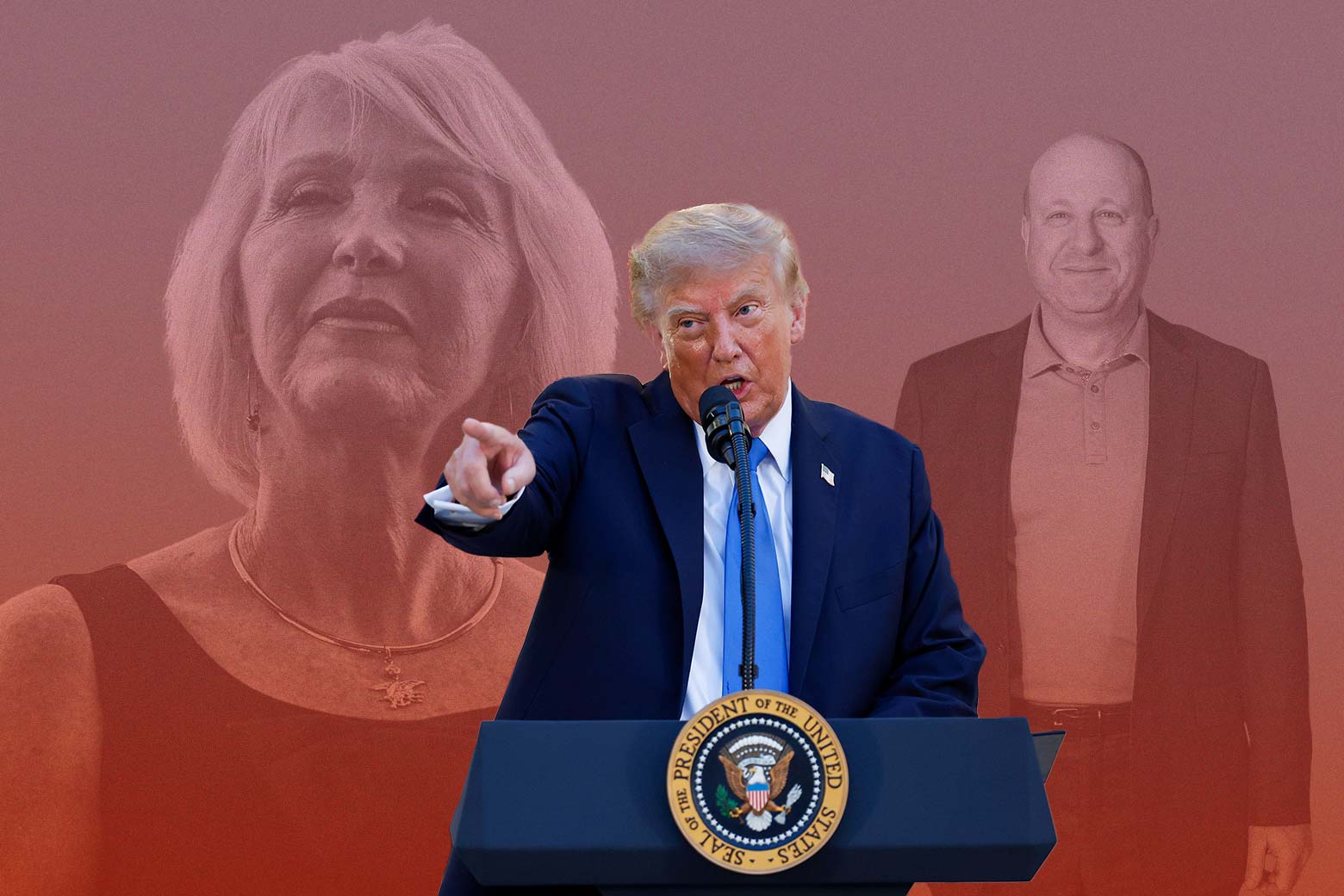
Jurisprudence Photo illustration by Slate. Photos by Marc Piscotty/Getty Images, Tom Cooper/Getty Images for SeriesFest, and Kevin Dietsch/Getty Images. This is the second in a series of articles, “Try, Try Again?,” drawn from my new book—Great and Dangerous Offences: The Case For (and Against) Impeaching Trump a Third Time—due out in early 2027. The Constitution created a federal republic consisting of states with equal legal status. Under the 10th Amendment, Congress and the executive branch have only limited authority to intrude on the sovereign prerogatives of the states. Individual residents of those states are guaranteed equal protection of the laws. These are pillars of the American constitutional order. To subvert any of them is to subvert the Constitution itself, a subversion that, as the Framers insisted, is impeachable. If a president engages in a pattern of conduct that subordinates the rights and interests of individual states to his personal or partisan political interests, that would be impeachable. Likewise, if a president engages in a pattern of conduct that denies equal protection of the laws of the United States to the citizens of individual states in order to promote his personal or partisan political interests, that, too, would be impeachable. In his second term as president, Donald Trump has continuously done both. To understand how Trump has abused his power against the states, it’s important to understand the power the federal government—and the president, specifically—does have. For example, the widely varying geographic, demographic, social, and economic circumstances of the states has meant that they need different things from the central government. Thus, the unruly interaction of democratic politics with national government accepts a good deal of horse trading over which states will get various types of federal largesse and regulation, along with a degree of more or less constant disagreement between state and federal authorities over policy and resource allocation. In extreme cases, the federal government may employ coercion against states that are sufficiently out of harmony with national law and policy. If a state government openly violates federal law despite clear orders from the federal judiciary—as was the case of some Southern states during the civil rights conflicts of the 20th century—the national government may use appropriate measures, including force, to compel compliance with the law. This is not the current circumstance. Critically, the federal government has to enforce such measures itself rather than commandeering the states to do so. Congress lacks “the power to issue orders directly to the States.” It cannot compel states to issue regulations. It cannot command state officers to participate in or enforce federal laws under what is known as the anti-commandeering doctrine. While Congress can condition a state’s receipt of federal funds on compliance with specified conditions, there are limitations to this power. Congress’ conditions to states must be clear and unambiguous and must have some relationship to the purposes of the federal grants in question. The conditions cannot be imposed without a state’s knowing and voluntary consent. This means that Congress may not set conditions on dispersal of federal funds that effectively offer the state no realistic choice except compliance. While Congress has some authority to induce states to participate in federal initiatives, the president acting on his own authority has no such power. To be sure, the president and the executive branch are charged with lawfully implementing congressional directives about the dispersal of appropriated funds. But the president cannot discriminate between states in dispersing federal funds by imposing his own rules, policy stipulations, or personal preferences, particularly if they contradict or are unrelated to congressional funding directives. Moreover, the post–Civil War 14th Amendment made explicit that the individual inhabitants of states are entitled to equal treatment under national law, which means that people living in different states cannot be treated differently simply because one lives in a state politically aligned with the president and another does not. Trump has flagrantly violated these principles on multiple occasions during his second term. The first violation began on his first day back in office when he issued an executive order commanding that “sanctuary jurisdictions,” meaning states, counties, or municipalities that did not order their law-enforcement authorities to cooperate fully with Trump’s immigration-enforcement actions, “do not receive access to Federal funds.” The initial executive order was followed by two others with the same thrust. These orders are not based on any congressional enactment conditioning federal funding on state or local cooperation with federal immigration efforts. Trump renewed the threat to all federal funding in a statement in January 2026. Following Trump’s executive orders, various elements of the executive branch began to withhold funding to state, regional, and local governments deemed insufficiently compliant with, or openly resistant to, Trump’s immigration program. A number of cities and states that suffered funding cuts sued. At least one court has ruled the cuts illegal. Multiple cases are pending. It is relevant to any article of impeachment premised wholly or in part on coercion of the states over immigration policy that Trump tried essentially the same tactic in his first administration and was blocked by the federal courts. In short, the courts previously ruled that Trump impinged on the sovereignty of the states and ignored Congress’ power of the purse, but he came right back and did it again. This sort of repeat-offender behavior elevates what might otherwise be considered a simple policy or legal dispute into an impeachable offense. As troublesome as Trump’s extortion of state cooperation with his immigration efforts may be, it is at least connected to an articulable policy objective, however controversial. Two other types of denial of federal funds, grants, or programs are even more concerning, and even more compelling as grounds for impeachment. First, the Trump administration has actively discriminated against “blue” states by systemically withholding federal funding, grants, and programmatic assistance. The discrimination is self-evident from the available data. A review of presidential disaster declarations entitling states and localities to federal aid revealed that in Trump’s first 14 months in office, he approved a mere 23 percent of applications from states with a Democratic governor and two Democratic senators, while approving 89 percent of requests from states with a Republican governor and two Republican senators. Moreover, approvals of disaster declarations in Democratic states took twice as long as those to Republican states (80 days vs. 40 days). No pattern remotely similar has ever been observed for past presidents. Moreover, one need not rely on inferences from data. In the fall of 2025, Russell Vought, head of the Office of Management and Budget, announced cancellation of “nearly $8 billion” in grants for clean-energy programs authorized by Congress during the Biden administration—what Vought called the “Green New Scam.” The first indication that these cancellations, in addition to being open violations of Congress’ power of the purse, were based primarily on politics rather than climate policy was that he listed the states in which grants were canceled—and they included no states dominated by Republicans and instead included 16 of the 19 states that had voted for Kamala Harris in the 2024 election. Multiple states, a coalition including energy and environmental organizations and the city of St. Paul, Minnesota, a group of University of California researchers, and others sued the Trump administration over the cancellations. In pleadings filed in the researchers’ case, the U.S. Department of Energy formally stipulated that none of the 284 grants terminated in October 2025 were terminated “based on any programmatic, statutory, cost-reduction or performance-based factor.” The stipulation admitted that, “with one exception, the 284 terminated grants had a recipient location and/or at least one place of performance in a state that awarded its electoral votes to Kamala Harris in the 2024 election and has two Democratic-caucusing senators.” The stipulation concluded by confessing: DOE accepts that the inclusion of grants in the October notice tranche was based solely on the political identity of the grant recipient’s state. …DOE accepts that the differential treatment resulting in the October 2025 termination of Blue State grants and the non-termination of non-Blue State grants was not based on a rational connection between the recipient’s location and/or place of performance and DOE’s past or current agency priorities. As reported by the New York Times, at the same time as the administration was cancelling grants to “blue states,” it “left untouched hundreds of additional energy grants in states that were represented by Republicans and had backed Trump in the last election.” In short, the Trump administration has admitted using payment or withholding of congressionally appropriated funds to punish or retaliate against states and their inhabitants because, and only because, those states support the president’s political opposition. Second, Trump has gone beyond generic discrimination against states controlled by Democrats and, in at least one case, organized a multipronged attack on a single state because its criminal justice system prosecuted, convicted, and refused to release a Trump backer and election denier. Following the 2020 election, Tina Peters, the clerk and recorder of Mesa County, Colorado, was convicted of multiple felonies for breaching the county election systems in a supposed effort to prove that the election had been rigged and lying about it thereafter. In October 2024, Peters was sentenced to nine years in prison. In the years since 2020, Peters had become a prominent figure in the election-denialist circles supporting Trump, persisting in unsubstantiated claims that somehow Trump had been cheated out of the election against Joe Biden. When Peters was sentenced, Trump declared himself outraged. In August 2025, he demanded that Colorado release Peters, threatening that if it did not, “I am going to take harsh measures.” On Dec. 11, 2025, Trump issued what he characterized as a pardon of Peters. The president’s pardon power does not extend to state crimes. At the same time Trump was issuing his counterfeit pardon, he was reportedly fuming behind the scenes. On Dec. 15, 2025, White House special assistant Emily Underwood sent an email to five federal agencies organizing an urgent “brainstorm call” in order to, in her words, “prioritize Colorado for the purposes of ensuring grants and federal support are in line with administration priorities.” The next day, the Departments of Transportation and Energy, which had been invited to the “brainstorm,” canceled hundreds of millions of dollars in federal grants for projects in Colorado. In addition to the cuts in transportation and energy projects, two days after the “brainstorm” call, the Trump administration ordered that Boulder’s National Center for Atmospheric Research, a world leader in climate and earth systems research, be dismantled, shuttering some programs and moving others out of state. In late December, Trump denied two Colorado disaster relief requests stemming from wildfires and a flood. Also in December, the Department of Agriculture attacked Colorado’s federally supported Supplemental Nutrition Assistance Program by imposing new requirements that would have been impossible to meet. On Dec. 30, 2025, Trump used his presidential veto to kill a congressionally authorized water project for the Eastern Plains region of Colorado. If there were any doubt about the connection between all these actions and Trump’s fury over the Peters prosecution, Trump removed them with a New Year’s Eve social media post in which he said, of Colorado Gov. Jared Polis and the Republican district attorney who prosecuted Peters: “I wish them only the worst,” and they should “rot in Hell.” Trump’s assault on Colorado was, if anything, more constitutionally egregious than his general attacks on other Democratic states. In his actions against other states, Trump and his minions were simply giving rein to general political animus or, in some cases, selectively applying his peculiar policy fixations, such as his hatred of clean energy. In Colorado, Trump employed the might of the federal government to coerce a state into granting undeserved personal relief to one properly convicted state felon. Worse, the felon in question was a figurehead in Trump’s ongoing effort to destroy confidence in the nation’s electoral system. Worst of all, the pressure worked: Polis granted Peters clemency in May and she was released in June, after having served less than a quarter of her original sentence. This was as blatant, and impeachable, an abuse of presidential power as can well be imagined. Multiple courts have entered orders blocking parts of Trump’s funding and program cancellations in states led by Democrats. In particular, in January 2026, a federal judge enjoined the assault on Colorado’s SNAP requirements. The move to dismantle NCAR was enjoined by the same federal court in June 2026; the court determined that the government’s action was procedurally “arbitrary and capricious” and that “retaliation played at least some role.” However, the question of whether presidential action is impeachable does not turn on the judgments of courts, particularly when the essential ground for an article of impeachment is the president’s active subversion of the basic constitutional design. It is absolutely plain that the president may not consciously discriminate against a state government or the residents of a state based purely on the partisan political alignment of the state’s residents or its government. Nor can a president enlist the power of the federal government to coerce a state’s justice system into granting special treatment to a personal favorite of the president, particularly if that favorite’s crime was committed in aid of the president’s own attack on the nation’s electoral system. Considered together, Trump’s partisan attacks on Democratic states and their residents amount to an abuse of presidential power sufficiently egregious and disruptive of constitutional order to merit impeachment. Congress Democrats Donald Trump Impeachment Jurisprudence Colorado Try, Try Again?
Trump Has Brutalized Blue States in His Second Term. There’s a Way for Democrats to Fight Back.
Full Article
Original Source
Read the full article at Slate →KhanList aggregates and links to publicly available news content. We do not host full articles from third-party sources. Always verify important information with original sources.