
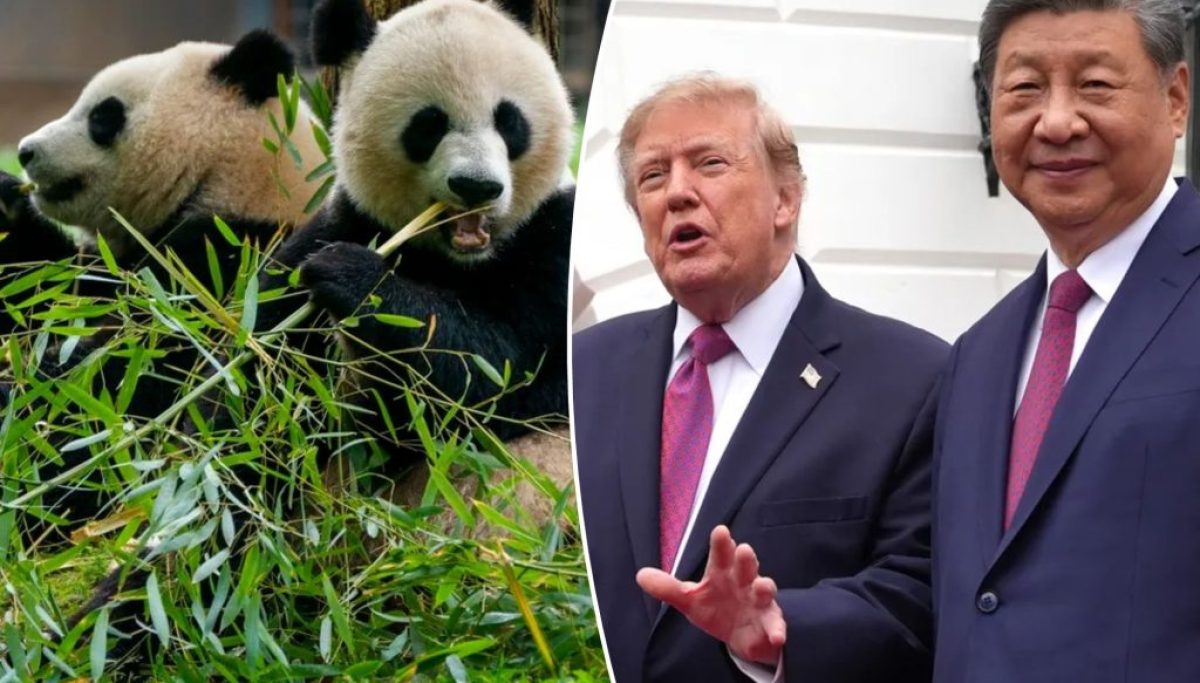
President Donald Trump put on a promiscuous display of fawning extravagance in welcoming the president of the People’s Republic of China, Xi Jinping, to the White House. The idea, one presumes, was to lavish the Chinese communist dictator with such a sheer volume of official state honor that he would be beguiled into returning the favor in the form of … oh, I don’t know, important trade concessions maybe? Critical minerals access and assurances that they won’t start World War III (Pacific Edition) by invading other countries? Committing to free an aging newspaper publisher from prison and to stop torturing and killing people for going to unauthorized churches?Assuming that was the goal of the spectacle, how did it work out? Welp, according to an official state communique from the CCP, the grandiose summit generated “eight deliverables.” The most concrete of which was the delivery by China of … two pandas to an Atlanta zoo.Seriously, that was about it. The rest of the “deliverables” were pure pablum. Trifle like noting cooperation on counter narcotics and precursor chemicals (wink-wink), agreeing that “Iran should honor its commitment to not developing nuclear weapons” (wink-wink, snicker), agreeing to build “a constructive China-U.S. relationship of strategic stability on the basis of respect, fairness, and reciprocity,” pinkie-promises to establish frameworks to set meetings to talk about this that and the other. … The type of workaday diplomatic drudgery a roomful of functionaries could hammer out in an afternoon over boxed lunches and tepid iced tea. We probably ought to have gotten the hint that Xi was not about to be moved to tears of humble gratitude when he showed up at the lavish state dinner in the White House donning a Mao suit, a revolutionary counter-punch to the black-tie uniform of the capitalist West; a sartorial middle-finger to the imperialist class enemy.One of the eight ridiculous “deliverables” stands out as a deliberate historical solecism — No. 4, which proclaims with unearned confidence that “The two heads of state recall that China and the U.S. were allies in World War II and fought side by side to win the war.”True enough. Just one thing: the country which Xi is the head of state, the People’s Republic of China, didn’t exist in WWII. Yes, Mao was around, doing Maoist things, which did include fighting the Japanese. But the country with whom we were allied in the war with Japan was the Republic of China, which is now — show of hands? That’s right, Taiwan.Granted, it’s something of a blessing that nothing major came of the summit, despite the grandiose show of official state flattery, inasmuch as “something major” would likely mean sacrificing Taiwan on the altar of a trade deal. Xi wanted, at minimum, some assurance from Trump that the United States was prepared to at least entertain just that, and, to Trump’s credit, he did not receive it. Which is not quite the same as bestowing on the Taiwanese the assurance that they are not being forsaken.Xi’s top strategic ambition is the absorption of Taiwan. Forget the historical embarrassment that Taiwan’s mere existence brings to the communist regime, or any twisted revisionist justification, or even the little capitalist island’s vaunted (and critical) semiconductor industry: physical occupation of the island of Taiwan is (Red) China’s key to the Pacific, the center block in the first island chain that serves to keep Beijing hemmed in.The official U.S. position of “strategic ambiguity” — interpreted for decades as a tacit, rather than explicit, guarantee to safeguard Taiwan’s sovereignty, even by the more dovish Democratic presidents — has worked to successfully maintain the status quo. But Trump has leaned heavily into the “ambiguity” part of late, ignoring the “strategic” part, and, in doing so, has brought Beijing closer than ever to its goal, potentially without even having to bother with a costly and bloody invasion or drawn-out blockade.Taiwanese politics is complicated, but generally dominated by two parties, the Democratic Progressive Party, which has traditionally advocated de jure, rather than merely de facto, independence; and the Kuomintang, inheritors of the Nationalist government of Chiang Kai-shek (that China with which we were allied against Japan) whose semi-official position still clings to the fantasy that the government in Taipei is the legitimate government of all of China — an eventuality about as likely as the Romanov’s return to power in Moscow.Excesses within both parties can, same as here, lead to bouts of reciprocal silliness that can turn dangerous. The DPP, in its eagerness to divorce Taiwan entirely from its Chinese heritage, has at times pursued something of a “cancel culture,” seen by some as an abandonment of the ROC’s historic duty as custodian of ancient Chinese culture, nearly obliterated by the communists during the Cultural Revolution, and salvaged by the Nationalists on their retreat to Taiwan in 1949. This has, at times, led to episodes of reactionary stupidity by some in the KMT; such as their chair, Cheng Li-wun, visiting Beijing last April, rivaling Trump in effusive homage to Xi, and reading from a CCP-approved script. That sound you may have heard was Chiang Kai-shek rolling over in his grave.CHINA IS EYEING AMERICA’S DEADLIEST CARIBBEAN BLIND SPOT. TRUMP CAN CLOSE IT TODAYBut even cooler heads in Taipei are starting to worry as they look to the U.S., their erstwhile protector, and see the first wisps of the clouds of abandonment starting to darken the horizon. More residents of the island than ever see themselves as “Taiwanese” rather than “Chinese,” and few, if any, would willingly trade their free, prosperous and humane lives for existence under Communist China’s yoke; but if their only option in the face of American abandonment is between bombardment and starvation on one hand and capitulation on the other, it is not unreasonable to expect a few here and there to decide that discretion is the better part of valor and to try and seek the best deal they can in turning their island over to Beijing. It’s an ominous weak point Xi is all too happy to exploit.We are in no position, obviously, to offer Taiwan any lessons in political hygiene. But a little tacit assurance from the president that the U.S. still knows who the good guys are and will be there — in the service of American self-interest — to help a valiant ally in time of need could go a long way to calming brewing fears in Taipei and spare us the anguish of waking up one morning to find we have lost the Pacific without firing a shot.Kelly Sloan (@KVSloan25) is a Denver-based public affairs consultant and columnist.
Trump got two pandas, Xi got the Pacific: How America got fleeced at the White House
Full Article
Original Source
Read the full article at Washingtonexaminer →KhanList aggregates and links to publicly available news content. We do not host full articles from third-party sources. Always verify important information with original sources.