
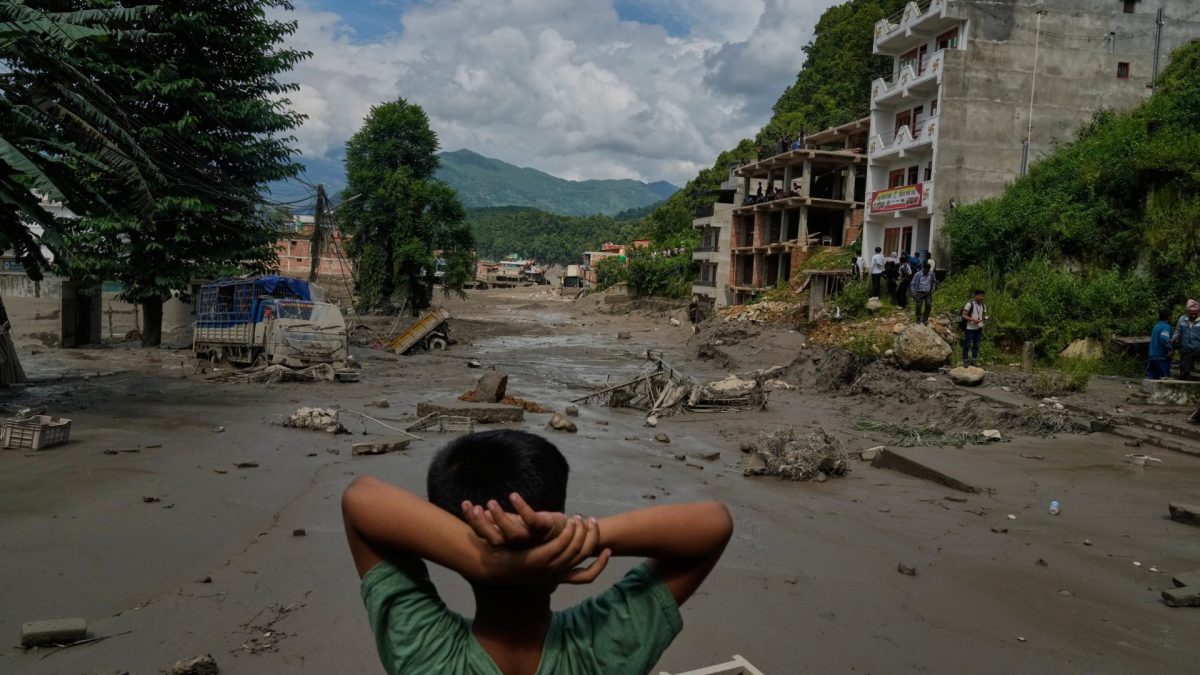
It’s hard to believe that a mountain range as mighty as the Himalayas can actually be fragile and increasingly unstable, but the avalanches, landslides and floods that have always shaped and scoured the valleys are now in overdrive as temperatures rise twice as fast in Nepal as the global average. Hotter conditions mean that the ice that acts as a glue to bind the rocks is now melting. Giant glaciers are being diminished and weakened, and frozen soil, known as permafrost, is thawing. Shorts The result is that a region home to important shrines for Hindu and Buddhist pilgrims and popular destinations for climbers and trekkers is becoming more volatile. Inevitably, this raises questions about whether it’s possible for the Nepalese to live safely in a landscape that’s sacred but unpredictable – and how to advise visitors about when, or even whether, they should go. Although the sequence of events isn’t established, the basics are clear. A massive chunk of ice and rock crashed into the valley below with enough force to set off earthquake alarms. That created a tsunami of water, mud and debris, which surged down a string of valleys known as the Bhoti Koshi-Trishuli corridor, tearing bridges and buildings from their foundations. The heart-stopping videos capture the terrifying scale of the onslaught with unimaginably large waves towering over defenceless communities in which the death toll is tragically bound to rise. One clip that I find especially moving shows a street where people are starting to flee as they hear or see the flood advancing, while others delay – maybe because they’re confused or disbelieving. Women salvage belongings from their wrecked homes in Nepal’s Nuwakot district after the catastrophic floods (Photo: Arun Sankar / AFP via Getty Images) The horror, as a viewer, is that few of those in this scene would have had the time to do the only thing that might conceivably have kept them alive: to rapidly climb as high as possible. That’s how the quick-thinking head of a secondary school managed to save more than 1,600 pupils. But in at least one village, the flood reached more than 100m above the valley floor. For anyone who failed to run away, survival was simply down to luck. The nightmare is not only the appalling loss of life. The country gets almost all its power from hydro-electric schemes capturing energy from mountain rivers, but at least a dozen have been destroyed or damaged, shutting off one-tenth of the national supply. The gauges measuring river levels had mainly been fitted to bridges that have now been swept away. A crucial indicator of danger has just vanished. The challenge is that much of Nepal’s recent development has been in the very areas that are most at risk. As a student backpacker in the 1970s, I saw for myself how the capital Kathmandu was expanding rapidly with long ribbons of new construction pushing up into the valleys above the city. I didn’t realise it at the time, but a clue about the dangers to come was visible in the rivers beside these new buildings: giant boulders, forced downhill by past floods, were evidence of the destructive potential of instability upstream. Over the past four decades, Nepal’s population has doubled, with nearly one million more people moving into the valleys hit by the disaster. Improved roads linking Nepal with China have boosted trade and acted as a magnet for tourism and development. But roads themselves and the recently expanded border crossing point at Gyirong are in ruins. An obvious solution is to improve forecasting, but this isn’t just a matter of accurately predicting the weather – it’s about developing monitoring systems and sophisticated maps of the geology and glaciers to calculate the likely pathways for any collapse of rock or ice. The Swiss have done this with networks of instruments and 3D computer models to keep watch on 1,400 glaciers in the Alps. It led to the evacuation of 300 people from the village of Blatten last year just before it was buried by an avalanche. Right now, another glacier, Weisshorn East, is judged to be unstable, but officials are confident enough in their forecasts to play down the risks to the village of Randa nearby. By contrast, no one in Nepal has anything like this. There are some monitoring instruments but not nearly enough of them. Trump’s slashing of the US aid budget last year didn’t help. A major programme called SERVIR-Hindu Kush Himalaya was trying to improve safety in the mountains with help from Nasa, but was cut. All that remains is its website. The tragedy is that the technologies exist to improve early warning and to save lives; it’s the funding that doesn’t. This matters more than ever now as the mountain landscape becomes more dynamic. Every collapse of ice or rock changes the geography, altering channels, destabilising slopes, and leaving behind great fields of loose sediment poised to be dislodged by the next storm. New weaknesses and dangers are created with each disaster. And that raises a fundamental question about reconstruction. Is it sensible to rebuild exactly as before? Roads, homes and power plants can be made more resilient, but not invulnerable. A new climate requires radically different thinking, together with finance that’s far more generous than Nepal is getting now. David Shukman is former BBC News Science Editor and author of The Response: A Story of Fire and Flood in Britain’s New World of Extremes
Trump cut aid to Nepal – a year later, disaster struck
Full Article
Original Source
Read the full article at Inews →KhanList aggregates and links to publicly available news content. We do not host full articles from third-party sources. Always verify important information with original sources.