
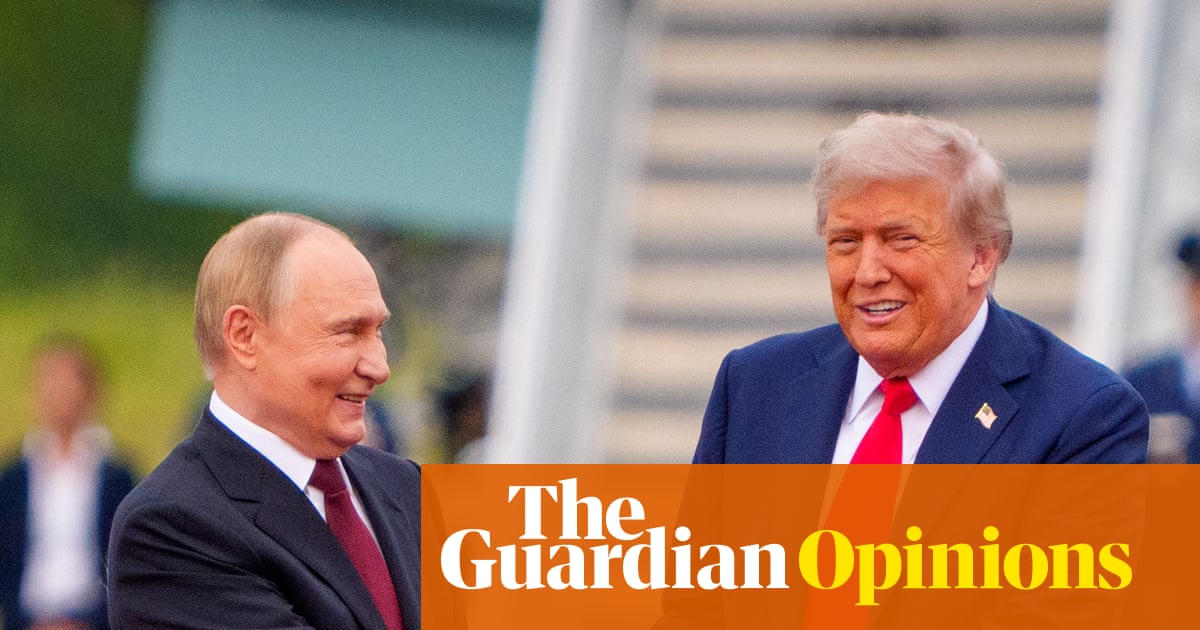
Donald Trump has lost substantial power over domestic policy after last week’s devastating midterm losses, but his ability to cement his legacy by upending US foreign policy remains largely intact.There is every reason to fear a ”great betrayal” of Ukraine in the coming weeks, one that would reward Vladimir Putin for Russia’s war of aggression against Kyiv, and also do lasting damage to the European security order. Yet lilliputian European leaders are too busy squabbling over who should represent them in future peace talks to focus on how to prevent a sellout. Despite fundamental European interests being at stake in this week’s three-way US-Russia-Ukraine negotiations in Abu Dhabi, Europe is relegated to a side room, represented by a posse of officials from the UK, France, Germany, the EU and Nato.Trump has said he is working with Moscow on a “big, beautiful deal” that is “going to involve more than Ukraine, and I could even say it might involve all of Europe”. His seemingly Kremlin-friendly negotiator and son-in-law, Jared Kushner, says Trump has discussed with several European leaders the need for “a broader European security architecture that can help establish conditions for lasting peace”.Strip away the rhetoric and both appear to be talking about cutting a deal with Putin behind the backs of Volodymyr Zelenskyy and other European leaders to carve up eastern Europe. Such a deal might hand Moscow permanent control of occupied Ukrainian territory – possibly more than it currently holds – and relief from western economic sanctions. It could also deny the countries of eastern Europe the right to choose their own security arrangements, by ruling out any further enlargement of Nato and possibly rolling back some of Nato’s eastern front deployments. In return, Trump’s family and business cronies would surely secure lucrative energy, commodity and perhaps real estate deals with Russia.Such a carve-up may be only a few weeks away, since Trump has accepted the principle of a meeting with Putin, and a possible big-power threesome with the Chinese president, Xi Jinping, on the sidelines of an Asia-Pacific summit in Shenzhen on 18-19 November. Even if a deal is not oven-ready by then, the opportunity to shape the future of European security in the absence of either Ukrainian or other European leaders must look inviting to the US leader after his electoral drubbing. Trump will want to make advances before the new Democratic-controlled Congress takes office in January.To force Kyiv to accept a humiliating partition, Trump has already shown he is willing to effectively blind Ukraine by withholding crucial satellite intelligence and missile interceptors. Meanwhile, Elon Musk is hobbling its drone defence by imposing crippling speed limits on his Starshield satellite network, preventing Ukrainian drones from shooting down Russia’s jet-powered kamikaze drones. Trump could also try to bludgeon European allies into acquiescing to a deal by threatening US troop withdrawals and base closures, under a Pentagon review that is nearing completion.If this all sounds like a paranoid fantasy, remember that Trump and Musk have already used most of these tactics recently, albeit in short, deniable bursts, as an apparent warning to Zelenskyy. The Ukrainian leader has made clear he will not surrender to such coercion, but Putin’s relentless destruction of Ukraine’s energy and transport infrastructure is clearly a drive to put Kyiv in the weakest possible position before diplomatic talks proceed.Faced with this possibly imminent betrayal, Europe is not without cards of its own, to coin a Trumpian phrase. The Europeans control hundreds of billions of dollars in frozen Russian assets and have the power to refuse any lifting of economic and financial sanctions against Moscow. Indeed, the EU could tighten the screws if they were to transfer impounded Russian central bank funds from the Belgian clearing house, Euroclear, to an EU-controlled entity, and leverage those holdings to raise a massive reparations loan for Ukraine.As a group of sovereign-debt experts has argued, that would not only keep Ukraine in the fight by meeting Kyiv’s financing needs for at least two years – removing the need for increasingly fraught EU funding negotiations every few months – but it would ensure that Russia is held to account financially for its destruction of Ukraine, and made to contribute to the reconstruction.Yet beggar-thy-neighbour European politics is preventing the EU from strengthening Zelenskyy’s hand here too. The Belgian prime minister, Bart de Wever, has refused to allow the impounded Russian funds to be used to support Ukraine, winning domestic popularity for supposedly standing up to Europe. As a result, the EU is likely to have to provide Kyiv with another loan to help it through next year. The risk is that elections in France and beyond could bring to power Eurosceptic nationalists who argue that their countries cannot afford to go on funding Ukraine while imposing spending cuts on their own citizens.skip past newsletter promotionafter newsletter promotionIt is not too late for Europe in the broadest sense – including the UK, Norway, Canada and Turkey – to act to counter a great betrayal by Trump. Apart from leveraging the frozen assets, European countries can tighten sanctions on the Kremlin’s shadow fleet, choking its exports by interdicting unsafe and uninsured tankers transporting Russian oil. They could transfer more of their own stocks of Patriot missile interceptors to Ukraine, which is now by any definition Europe’s frontline of defence. And they could make much clearer by joint diplomacy towards Trump that they will reject any deal reached without their participation and assent.The Europeans have managed to head off Trump once before: after his summit with Putin in Alaska last year, they accompanied Zelenskyy to the White House as “bodyguards”, and clearly spelled out their red lines. This time, the weakened US president is more desperate for a “deal”, and the Europeans are more divided and distracted by their own electoral politics. But there can be no greater priority for the future of European security than to prevent a sellout of Ukraine.
Trump could be about to sell out Ukraine. Europe must get its act together, fast | Paul Taylor
Full Article
Original Source
Read the full article at Theguardian →KhanList aggregates and links to publicly available news content. We do not host full articles from third-party sources. Always verify important information with original sources.