
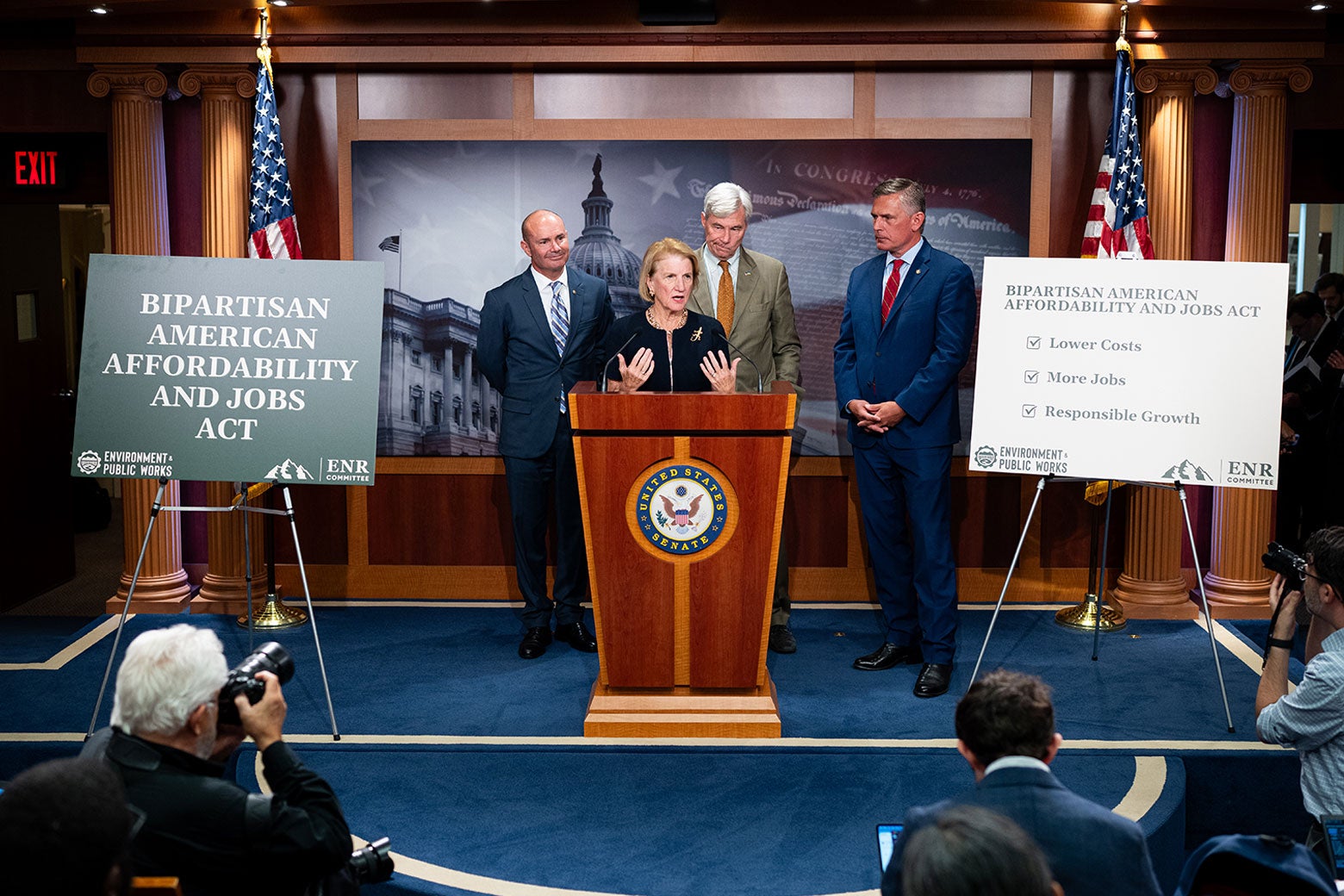
The Industry There’s a Reason Trump Loves This Bipartisan Energy Deal BAAJA promises to speed up renewables—but critics warn it will do a lot more harm to the environment than good. By Enter your email to receive alerts for this author. Sign in or create an account to better manage your email preferences. Unsubscribe from email alerts Are you sure you want to unsubscribe from email alerts for Nitish Pahwa? Nov 18, 20262:39 PM Bill Clark/CQ Roll Call/Sipa USA via Reuters Connect Sign up for the Slatest to get the most insightful analysis, criticism, and advice out there, delivered to your inbox daily. President Donald Trump devoted one of his premium Truth Social posts to singing this bill’s praises. Stephen Miller also considers it an urgent legislative priority. The American Petroleum Institute wants so desperately to pass the act that it handed out free tacos on Capitol Hill in a promotional spree. You wouldn’t think a piece of legislation with these kinds of friends would be of high priority for congressional Democrats. Yet their support is indeed robust, as evidenced by the act’s name: The Bipartisan American Affordability and Jobs Act of 2026, co-sponsored by self-identified progressives (Sheldon Whitehouse, Martin Heinrich) and MAGA loyalists (Mike Lee, Shelley Moore Capito). The bill has been moving along in the Senate, behind closed doors, and will soon head to the House of Representatives. It’s a framework for “permitting reform” that purports to speed up the approval and installation of fossil fuel and clean energy projects—along with power lines to transmit said energy. The package is so urgent for both parties that the upper chamber even convened on Veterans Day (typically a holiday for the Senate) to bicker over whether to speedily pass the bill as is, or to spend more time amending the legislation in order to address the myriad concerns from energy experts, legal observers, Indigenous tribes, the NAACP, myriad Democratic state attorneys general, and John Podesta. The issue is that if BAAJA is passed as is, the Trump administration will use its lame-duck leverage to keep easing pipeline expansions from already thriving fossil fuel and mining companies while indiscriminately suppressing renewable projects. (Trump all but copped to this in a now-infamous press conference.) Worse, the act would shield dozens of major fossil fuel projects from legal or financial accountability around their environmental damages, leaving them off the hook as they wreck essential biodiversity, run roughshod over beloved public lands and historic sites, and lock in greenhouse gas emissions. Further, the bill as currently written will, in the long haul, gut key provisions of historic laws like the National Environmental Policy Act, the Clean Water Act, the Endangered Species Act, the National Historic Preservation Act, and the Clean Air Act—most of which have already been weakened throughout the past decade, under Presidents Trump and Joe Biden. (A former federal judge appointed by President Bill Clinton points out that BAAJA would even kneecap the ability of protesters to successfully sue the Trump administration and stop boondoggles like the forest-ravaging East Potomac golf course.) All for a bill that wouldn’t even bring down energy costs that much, according to think tank projections, or even site as many transmission lines as we need. But some powerful, influential Democrats, like climate hawk Sheldon Whitehouse, are still dedicated to BAAJA in spite of these flaws. From their vantage point, the importance of permitting reform for the future of American energy—and for the fight against climate change—is worth the other risks, especially if those concessions can earn them buy-in from their Republican colleagues. The permitting-reform concept, which became something of a wonk buzzword during Biden’s presidency, addresses a very real issue holding up the otherwise-booming clean energy revolution: We are not able to build enough interstate power lines, at a fast enough rate, in order to connect new solar and wind and geothermal energy with the grid and ensure people everywhere can realize their benefits. By truncating environmental and preservation review timelines, and limiting the ability of concerned citizens to register any opposition, energy developers could potentially build even more plants at a wider scale—and ensure they get connected to the broader grid. BAAJA’s most fervent liberal advocates believe this is a rare bipartisan opportunity to work with climate deniers on behalf of renewables development. Not only does the pileup of clean energy projects stuck in federal compliance review make this worthwhile, but it also allows Dems to build on their successful midterm election focus on affordability with a bill that at least gestures toward a path to cheaper energy. Liberal “abundance” advocates like Ezra Klein also believe pro-development bills like BAAJA disproportionately benefit greener energy, while providing a check on the ability of NIMBYs to sue project developers on environmental grounds. The liberal case in favor of BAAJA, which is not an unreasonable one on its face, essentially purports that Dems can address the cost of living by making it easier for all energy developers to supersede government bureaucracy and trust the free market. There are strong cases to be made in favor of streamlining energy permits so we can hasten our existential energy transition. But BAAJA’s advocates tend to rely on market-based reasoning at a moment when the playing field is catastrophically skewed in favor of fossil fuels, thanks to an administration that’s all but gone to war with the renewables sector on behalf of Big Oil and encouraged the ongoing gas-powered data center boom. The bill’s most aggressive provisions have been striking enough to give even permitting-reform proponents some pause. Bill McKibben, who favors large-scale solar buildouts, notes that the act rolls backs decades’ worth of environmental protections—and undermines historic sovereignty afforded to tribal nations—while failing to guarantee any substantive emissions reductions down the line. David Bookbinder, former counsel for the centrist Niskanen Center, wrote in a letter that the act presents “a serious threat to American democracy,” noting that one portion of it effectively “limits the enforcement of all federal laws against any project with any federal permit.” Even Sens. Whitehouse and Heinrich were displeased with the initial permitting proposal—before letting it roll on through the Senate, thinking this is the best they’re gonna get. (Other consistent pro voters, like Michigan’s Elissa Slotkin, have nodded to “concerns” around the bill, while Nevada’s Catherine Cortez Masto has withdrawn her initial support because of state tribe objections.) “I don’t disagree that permitting reform is needed, but this bill was developed behind closed doors, and no one asked us what was going wrong with the NHPA and what didn’t work,” Sarah Lowry, director of geophysics at New South Associates, told me. The Georgia-based business works to identify cultural and historic sites, like cemeteries, via reviews mandated by Section 106 of the National Historic Preservation Act—the very provision BAAJA is attempting to override. “If you don’t identify those cemeteries before groundbreaking, you can’t protect them, and if a cemetery is discovered by a bulldozer, they have to stop their work. Ironically, it would actually be more costly and add more delays than just going through the process where you identify it and then attempt to avoid it.” Lowry, who notes that Trump is particularly fixated on nullifying Section 106, told me that if BAAJA rolls back compliance standards with Section 106, “It would decimate cultural resource management in this country—not just my company, even though about 70 percent of our business relates to that work.” The more everyday people actually learn about everything on offer in this legislation, the more they oppose it—yet the process for its passage has been notoriously obscure, allowing pretty much no one real insight into what’s going on here. One thing is certain, however: BAAJA is more utopian than it is concrete, simply asking millions of Americans to gamble their faith in a Congress they already do not trust in the wake of an election in which voters often signaled an embrace for environmental progress. During these midterms, Colorado voters refuted a ballot measure that would have enshrined natural gas production as a “constitutional right.” In the heart of Texas’ oil country, a clean-air activist beat out a former fossil fuel executive in a key congressional race. The first Montana Democrat to be elected to the House of Representatives in three decades is a former smokejumper who’s already been challenging the Trump administration’s sell-offs of public lands. And throughout the country, Americans approved more funding for car-free public transit. It’s likely because of those victories that pro-BAAJA Dems want to get it passed right now; they realize the tradeoffs are as intolerable to other lawmakers and constituents as both Whitehouse and Heinrich initially believed them to be. And yet, they’re ready to rubber-stamp a Trumpian agenda that could make the next two years even more destructive for public monuments and our heating atmosphere. We can and should do better than this, for the planet and the future of our civilization. But to some Democrats, this insufficient arrangement might just be good enough, purely because it’s bipartisan. Climate Change Democrats Donald Trump Energy Environment Oil Industry Republicans
Trump and Democrats Finally Agree on Something. Unfortunately, It’s Bad News for Us All.
Full Article
Original Source
Read the full article at Slate →KhanList aggregates and links to publicly available news content. We do not host full articles from third-party sources. Always verify important information with original sources.