
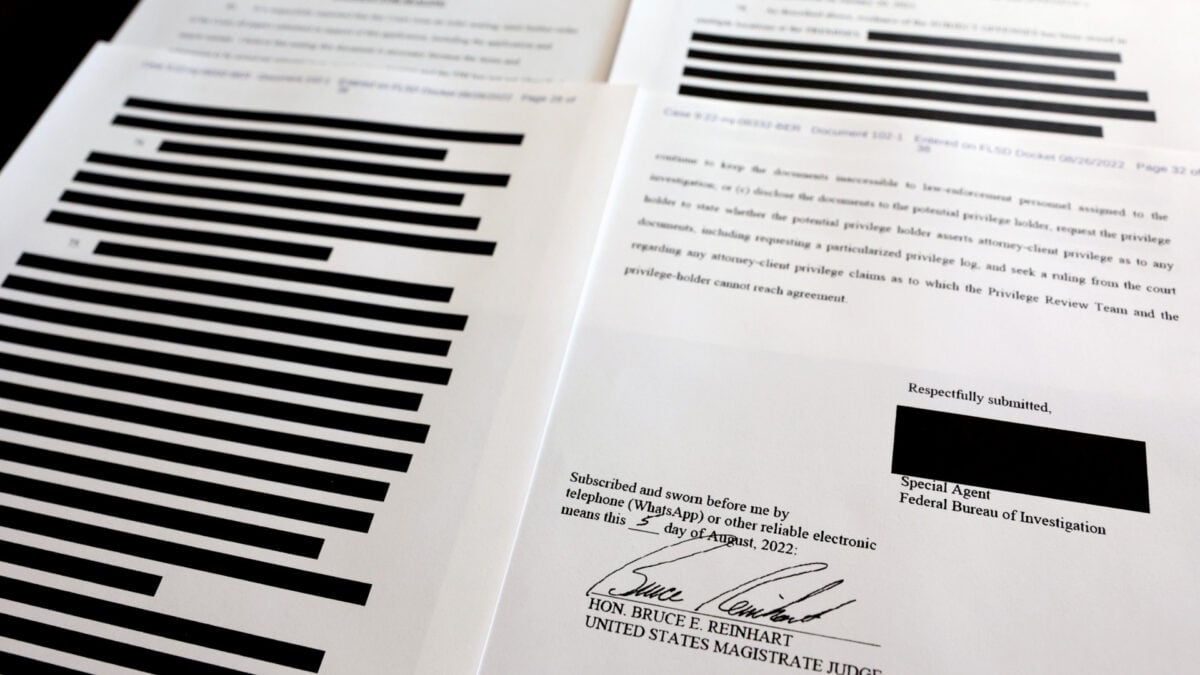
The U.S. government will ramp up its use of AI tools to automate redactions in Freedom of Information Act (FOIA) requests, according to an investigation by The Washington Post. FOIA requests allow members of the public to obtain records directly from the federal government. They are frequently used by lawmakers, activists, and journalists seeking to scrutinize government agencies and hold them accountable. Agencies are generally required to disclose requested records, though they may withhold or redact information covered by exemptions, including material related to national security or personal privacy. According to the Post, the Department of Homeland Security’s Customs and Border Protection is acquiring a Google AI tool, while the Interior Department is using tools from Microsoft, and the Department of Justice is using tools developed by an AI company called Veritone. The Department of Health and Human Services is also reportedly developing its own AI tool, called FRED, with an unnamed contractor. AI use will gradually increase across FOIA operations, even though employees still review any recommendations the AI makes, according to the report. The AI initiative will be used to “significantly reduce” processing times, according to the federal government. Indeed, the FOIA process is tiresome and time-consuming. Requesters hoping to get their hands on documents can sometimes wait months to hear back, even though the law requires a response in 20 days. But the time delays are only one issue plaguing the FOIA process. Often, requesters lament the “tons of completely unnecessary redactions,” in the words of Rep. Jamie Raskin’s characterization of the redactions in the Epstein files, which also included inappropriate redactions that outed information about the victims. Any faulty undercorrections driven by AI are likely to become a headache for the agencies, while any AI-driven overcorrections risk making the FOIA process even tougher and more opaque for the requesters. AI’s introduction to records redactions could give the federal government “a very powerful tool for secrecy,” according to David Cullier, a FOIA expert at the University of Florida, who spoke to the Post. The government’s increased push to embed AI in the FOIA redactions process unfolds in parallel with the introduction of AI into pretty much every facet of the U.S. government. Last year, the U.S. General Services Administration rolled out a generative AI evaluation suite called USAi that’s meant to speed up federal agencies’ adoption of AI tools. Meanwhile, congressional officers are reportedly relying on AI to draft legislation, often riddled with mistakes. Federal contractors working for the Nuclear Regulatory Commission began using AI to speed up the workload related to rule changes at the agency, per Politico, similar to previous use cases by the Centers for Disease Control and Prevention and the Department of Transportation. And earlier this month, the Federal Aviation Administration launched an AI initiative to automate some parts of air traffic management to “slash those frustrating delays, reduce stress on air traffic controllers, and lower travel prices,” according to Transportation Secretary Sean Duffy. But despite the scale at which this federal AI-ification has been unfolding, the process continues to be riddled with mistakes, some at times with fatal consequences. In one particularly tragic example, a recent Bloomberg investigation found that an American strike on an elementary school in Iran—which killed more than 150 people, mostly children, back in March—had been due to a series of preventable mistakes, including an overreliance on a Palantir-developed AI system among officials at the U.S. Central Command. There have also reportedly been potentially catastrophic near-misses tied to the army’s experimentation with AI. According to a CNN report from last week, an AI chatbot falsely told a special operations command analyst that a Chinese ship in the Middle East was transporting nuclear weapons materials, nearly triggering a U.S. operation on the vessel and risking all-out war with China. This type of overreliance is one of the biggest dangers of implementing AI tools in sensitive systems. The technology is not perfect, and it does make mistakes, often called hallucinations. These hallucinations can be missed by human auditors because humans tend to suffer from something called automation bias, aka the inclination to trust an automated system blindly and even over our own judgement, thinking it has access to more information than we do. That, combined with the fact that AI systems are black boxes, so we can’t easily pinpoint how the system arrives at a certain conclusion, means that any AI hallucination could have serious real-world impacts.
Trump Admin Is Reportedly Giving FOIA Requests an AI Makeover
Full Article
Original Source
Read the full article at Gizmodo →KhanList aggregates and links to publicly available news content. We do not host full articles from third-party sources. Always verify important information with original sources.