
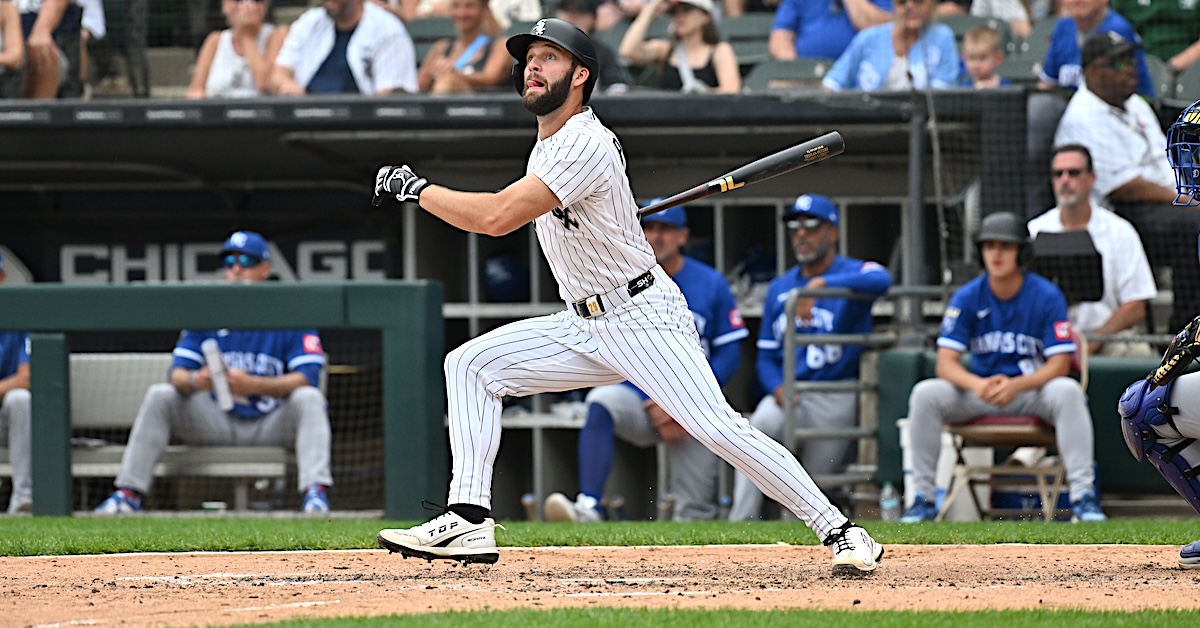
Patrick Gorski-Imagn Images Tristan Peters was hardly on anyone’s radar entering the season. A lefty-swinging 26-year-old center fielder playing for his fourth organization since being drafted in 2021, he didn’t land on any preseason top prospects list or even project to see much time in the majors, where in his brief career he’d gone 0-for-12. Yet Peters — whose résumé includes a stint with the Savannah Bananas in 2021, when they were a competitive collegiate summer league team instead of a barnstorming sensation — has become one of the season’s biggest and most pleasant surprises. While helping the AL Central-leading White Sox pull off an already-unprecedented turnaround, he landed on the All-Star team and ranks high on the rookie WAR leaderboard. Last week, he even earned a spot in the record books by homering in five consecutive games. Peters began his binge — which took place entirely at Guaranteed Rate Field against the Mets and Rangers — on August 22 with a solo home run off New York’s Christian Scott, then followed it up the next day with a wall-scraping walk-off solo shot off Kodai Senga, breaking a 1-1 tie. Peters hit both blasts while using a yellow bat — a nod to his time with the Bananas. The streak continued with a two-run tater off Texas right-hander Kumar Rocker on August 24 (Chicago’s only runs in an 11-2 drubbing), then a solo homer off Peyton Gray the next night, and finally a two-run dinger off Robby Ahlstrom on August 26. That 406-foot homer off Senga was Peters’ only one during this stretch with an estimated distance of at least 400 feet, and just his second to travel at least that far this season; he had a 410-footer off A’s righty Justin Sterner on July 10, the day he hit for the cycle. On that note, Peters finished a triple shy of the cycle on both August 25 and 26; the first of those efforts included a two-run double off Jacob deGrom. All told, he went 10-for-18 with three walks, three strikeouts, nine RBI, and a 1.500 slugging percentage during that five-game run, not too shabby for a guy whose last prospect report, under the Rays’ 2025 unranked “Depth Starters and Outfielders” section, referred to him as one of the team’s “smaller, contact-oriented corner outfielders at the upper levels without meaningful power.” Peters became the eighth White Sox player to homer in five consecutive games, a list that includes Hall of Famer Frank Thomas (twice in 1994) and rookies Ron Kittle (1983) and Munetaka Murakami (earlier this season). According to Elias Sports, Peters tied the rookie record for homers in consecutive games, joining 13 other players, and made the White Sox the first team with two such players in the same season. The complete list: Rookies with Home Runs in Five Consecutive Games Source: Baseball Reference Kittle, Cordova, and Acuña earned Rookie of the Year honors in those seasons. Peters has to be considered a long shot to join them, but he’s nonetheless been one of this season’s most productive rookie position players — and the most unheralded among those near the top of the leaderboard: You Aren't a FanGraphs Member It looks like you aren't yet a FanGraphs Member (or aren't logged in). We aren't mad, just disappointed. We get it. You want to read this article. But before we let you get back to it, we'd like to point out a few of the good reasons why you should become a Member. 1. Ad Free viewing! We won't bug you with this ad, or any other. 2. Unlimited articles! Non-Members only get to read 10 free articles a month. Members never get cut off. 3. Dark mode and Classic mode! 4. Custom player page dashboards! Choose the player cards you want, in the order you want them. 5. One-click data exports! Export our projections and leaderboards for your personal projects. 6. Remove the photos on the home page! (Honestly, this doesn't sound so great to us, but some people wanted it, and we like to give our Members what they want.) 7. Even more Steamer projections! We have handedness, percentile, and context neutral projections available for Members only. 8. Get FanGraphs Walk-Off, a customized year end review! Find out exactly how you used FanGraphs this year, and how that compares to other Members. Don't be a victim of FOMO. 9. A weekly mailbag column, exclusively for Members. 10. Help support FanGraphs and our entire staff! Our Members provide us with critical resources to improve the site and deliver new features! We hope you'll consider a Membership today, for yourself or as a gift! And we realize this has been an awfully long sales pitch, so we've also removed all the other ads in this article. We didn't want to overdo it. Rookie Position Player WAR Leadersand Preseason Prospect Grades/Rankings Player Team Top 100 Rk Grade PA HR AVG OBP SLG wRC+ WAR Kevin McGonigle DET 5 60 594 14 .276 .377 .418 127 4.6 JJ Wetherholt STL 12 55 586 17 .242 .343 .370 104 4.4 Tristan Peters CHW — — 411 12 .280 .344 .467 128 3.8 Carson Benge NYM 21 55 541 16 .277 .336 .422 112 3.1 Chase DeLauter CLE 26 55 480 13 .293 .365 .454 132 2.9 Sal Stewart CIN 34 50 595 31 .266 .338 .489 122 2.7 Munetaka Murakami CHW Int’l 3* 50 442 29 .218 .357 .497 137 2.7 Kazuma Okamoto TOR Int’l 2* 50 543 28 .230 .306 .447 111 2.4 Carter Jensen KCR 32 50 512 19 .221 .309 .409 98 2.1 Joe Mack MIA 56 50 269 12 .233 .287 .412 91 2.1 Not only is Peters the only player from among the top 10 who did not crack either our preseason Top 100 Prospects list or our separate ranking of international prospects, he didn’t even make the White Sox Top Prospects list or secure a secondary mention. This isn’t just a case of his not catching the eyes of our prospect team, however. He’s never been on a Baseball America Top 30 Prospects list for any organization he’s passed through, nor has he been in a Baseball Prospectus annual. The only time I could find any major outlet ranking him was in 2023, when he was 21st on the Rays’ list at MLB Pipeline, as a 45-FV prospect. Peters has taken quite a journey to this point. A native of Winkler, Manitoba — a town of less than 14,000 people — he didn’t catch the attention of any scouts in high school; he never appeared in Perfect Game’s database and wasn’t recruited by any Division I schools. He spent two years playing junior college ball at Chandler-Gilbert Community College in Arizona before moving on for a year at Southern Illinois University. Prior to the 2021 amateur draft — where he was chosen by the Brewers in the seventh round — Baseball America called him a “decent all-around player, [who] is limited physically and in projectability. He definitely knows how to find the barrel and did just that at Southern Illinois, slashing .355/.463/.548… and impressed with his patience at the plate.” At the time, Peters was listed at 5-foot-11, 180 pounds; he’s since grown an inch. Before being drafted, Peters played 17 games for the Bananas, who were then part of the Coastal Plain League, a 15-team wood bat collegiate summer league. While they were still playing competitive baseball by conventional rules — and dominating the league, whose championship they would win in both 2021 and ’22 — the team was already doing the kind of social media stunts that garnered them wider attention. Here’s Peters, wearing uniform no. 6 along with a black-and-yellow kilt for a choreographed dance routine: To be fair, this is what the Savannah Bananas looked like by the time Tristan Peters left. I’m not sure this qualifies as regular baseball behavior. pic.twitter.com/xr4zBy1ozR https://t.co/n24XgAj0hx — All Things Chicago Sports (@things_sox) August 29, 2026 “You’ve got to be a high-level player, but you also have to be open to, ‘Hey, we’re here to have fun,’” Bananas founder Jesse Cole told the Wall Street Journal’s Jared Diamond for a July 18 story on Peters. “Everyone had to know that’s what we’re about, and Tristan was all-in.” “I knew what I was getting into… I honestly thought it sounded fun,” Peters told Diamond. As for the Bananas’ evolution into barnstorming sensations, he added, “I didn’t know it was to get this big… I love what it’s turned into.” After debuting in the Arizona Complex League in August 2021, Peters didn’t even last a full season in the Brewers’ organization; on August 2, 2022, he was the return in a trade that sent reliever Trevor Rosenthal from the Giants to the Brewers. Rosenthal hadn’t pitched at all in 2021 or the first half of ’22 while recovering from surgeries to correct for thoracic outlet syndrome and a torn hip labrum. Two weeks after signing with Giants, he was traded, and he made just three Triple-A rehab appearances before suffering what proved to be a season-ending hamstring strain. Peters played just 34 games in the Giants’ organization, for Double-A Richmond, before being traded again in November 2022, this time to the Rays for infielder Brett Wisely. He spent 2023 with Double-A Montgomery, and ’24 and ’25 with Triple-A Durham, hitting .266/.355/.430 with 15 homers and 11 steals in the last of those seasons. Last August, when Jonny DeLuca and Taylor Walls landed on the injured list, Peters was called up and then optioned twice within a week; during that span, he played four games for the Rays, going hitless while striking out seven times in 12 plate appearances. In December, the Rays designated Peters for assignment, then traded him to the White Sox for cash considerations. Peters wasn’t sure if he’d get another opportunity, but he came around. As he recently told David Laurila, “When I got the news that I had been DFA’d, it was kind of, ‘Wow. OK.’ I didn’t have much of an opportunity there, so it was discouraging at first. But then after the process, when I got traded over here, it gave me confidence knowing another team wanted me.” With three straight seasons of at least 100 losses, including a record 121 in 2024 and then 102 last year, the White Sox might not have been anyone’s preferred destination. Even after they traded starting center fielder Luis Robert Jr. to the Mets in January, and right fielder Mike Tauchman departed as a free agent, Peters didn’t appear to be a likely candidate for regular duty. In our preseason Positional Power Rankings, he was sixth on a center field depth chart headed by Luisangel Acuña and Brooks Baldwin, projected for a token seven plate appearances in that capacity, and sixth on a right field depth chart headed by Austin Hays and Everson Pereira, with another 14 projected plate appearances; neither writer (including this scribe for the latter position) even mentioned Peters in passing. Yet with a strong spring, Peters earned not only a roster spot but also playing-time shares in both center (with Acuña) and right (with Pereira). Though he hit just .273/.324/.318 (84 wRC+) in March and April, Acuña was much worse, hitting .181/.250/.194 (29 wRC+). By the end of the first full month, the everyday center field job belonged to Peters, who was excellent in May (146 wRC+) and June (127 wRC+) before cooling off in July (77 wRC+) and then heating back up again in August (199 wRC+). Again, the big knock on Peters from a scouting standpoint has been his lack of power. MLB Pipeline graded his power at 40 in 2023, and in FanGraphs’ update later that season — the only grades of his we’ve published — he had values of 40 present and 45 future for raw power, and 30/40 for game power. His contact stats from Durham last year still suggested below-average power, but as he told Laurila, adjustments to his lower half have put him “in a better position to swing” and allowed him to be “more powerful.” Comparing last year’s limited batting stance data to this one, Peters has opened up his stance (from 1 degree closed to 5 degrees open), increased the distance between his feet by about six inches (from 24.8 to 30.5), and gradually moved deeper in the batter’s box (from 24.6 inches last August to 27.2 this month). Adjustments to his swing tilt, attack direction, and attack angle have bumped him from a 40.9% ideal attack angle (in last year’s very limited sample) to 55.9% this year. He’s gained bat speed, from an average of 67.9 mph to 69.8 mph, though that still places him in just the 18th percentile among qualifiers. Peters still doesn’t have a lot of thump, but he is hitting the ball harder than in 2025: Tristan Peters Statcast Profile Season Team BBE EV maxEV LA Brl% HH% AVG xBA SLG xSLG wOBA xwOBA 2024 TBR (AAA) 317 85.2 108.2 19.1 4.7% 23.3% .238 .205 .402 .323 .338 .291 2025 TBR (AAA) 384 86.5 106.8 16.9 4.9% 29.2% .266 .233 .429 .361 .353 .307 2025 TBR 5 86.8 101.3 26.8 0.0% 40.0% .000 .149 .000 .183 .000 .146 2026 CHW 300 87.4 108.5 17.6 5.7% 32.7% .280 .255 .467 .392 .353 .315 Peters has consistently outdone his Statcast expected slugging percentages by about 70 or 80 points since reaching Triple-A, in large part because he’s learned to pull the ball in the air. His minor league pull rates were consistently in the 45–49% range, but after running a 45.6% groundball rate in 2022, he lowered that to 41.2% in ’23, his first year in the Rays’ organization, and then to 34.7% in ’24 and 36.9% in ’25. After posting a 25.8% pulled air rate at Durham in 2024, and 21.8% last year, this year he’s up to 27.0%, placing him in the 89th percentile among qualified hitters. Meanwhile, his 76-point SLG-xSLG differential places him in the 94th percentile. The approach is working, and Peters has added further value by doing other things well. He’s 7-for-9 in stolen bases, and has accumulated 2.2 runs above average from his baserunning. He’s got 8 FRV and 6 DRS in 805 1/3 innings in center field, and 10 FRV and 7 DRS in 943 1/3 total innings, including his time in left and right. Both are areas he’s worked to improve. In May, he told the Chicago Sun-Times’ Jeff Agrest that last year at Durham, “We worked on our turns at second base a lot, leaning into it to get a tighter turn.” In center field, he maintains his focus by trying to call balls and strikes (“Just to keep me occupied and make sure I’m actually watching the pitch”) and keeps an eye on his Statcast jump times to add to what’s already 83rd-percentile speed. “I like to look at that stuff, especially my first step, or my jump, because I’m not the fastest player,” he told Agrest. Peters’ jump is 3.1 feet above average, which ranks fourth in the majors behind Pete Crow-Armstrong, Ceddanne Rafaela, and Wyatt Langford. More from his conversation with Agrest: “My pre-pitch is basically like an infielder’s little jump step,” Peters said of a move also used by Crow-Armstrong. “I wanna be in the air when [the batter] makes contact so that I can push off that. So slightly after contact, I wanna hit the ground. “I started doing that in Double-A [in 2023 with the Rays]. Then ever since, I’ve fine-tuned it, and it’s gotten a lot better. Last year [in Triple-A] is when it really started to work for me. I got my timing and everything.” Peters’ small steps forward in so many areas have added up to a very valuable performance. He’s second in WAR among White Sox position players, behind only Miguel Vargas, a welcome surprise on a team that itself has been one of the season’s biggest surprises. With their 71st win on Friday, the White Sox set a record for a team coming off three straight 100-loss seasons, with one month still to play. At 72-64, they’ve built a 3.5-game lead in the AL Central. Up against more heralded players such as McGonigle, Peters probably won’t win AL Rookie of the Year honors, but he’s been a crucial part of Chicago’s success.
Tristan Peters Has Gone Bananas
Full Article
Original Source
Read the full article at Blogs →KhanList aggregates and links to publicly available news content. We do not host full articles from third-party sources. Always verify important information with original sources.