
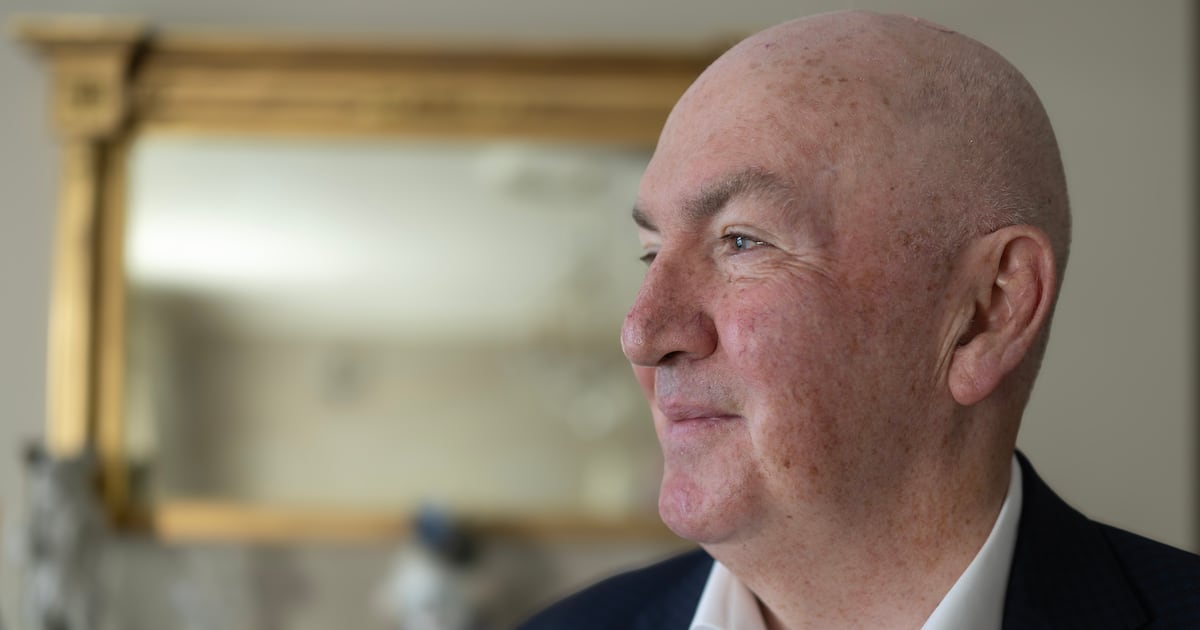
There is no greater gift than years of survival for people with a life-threatening cancer – or being spared that diagnosis altogether.This is what surgeon Prof John Reynolds has delivered for thousands of patients in Ireland, whether he operated directly on them for oesophageal/gastric cancer or they benefited from improvements he has driven within care systems and inspired among colleagues. He has been at the forefront of initiatives that have led to a doubling of overall survival for the 500-plus people diagnosed with oesophageal cancer in the Republic each year. That is the greatest increase in survival rate among seven high-income countries, according to a comparative study published in the Lancet in 2019.Patients have been able “to return to their families, to walk daughters down the aisle, to tend to their gardens, or to embark on a pilgrimage on the Camino”, says Noelle Ryan, a founder and current board member of the Oesophageal Cancer Fund (OCF). Those under his care “would speak of John with a reverence that went far beyond medical gratitude”.That is not to suggest for a moment that he radiates any sort of “god complex”.READ MOREIn fact, nothing could be further from the truth.There will undoubtedly be tributes to him at an academic symposium hosted by Trinity St James’s Cancer Institute, Trinity College and St James’s Hospital, Dublin, on October 16th to mark his retirement as professor of surgery, a role that combines teaching and research with clinical practice. But sitting down with The Irish Times, a day after his 69th birthday, to reflect on a career that spans a time of extraordinary medical advances since his graduation from University College Dublin medical school in 1981, the quietly spoken Reynolds is more comfortable focusing on patients, rather than the man behind the scrubs.A surgeon’s relationship with a cancer patient is paramount, he explains, right from the first consultation. “You’re trying to have their confidence, and you usually have ... they trust you.”The patient is struggling to cope with a very serious diagnosis that is “just pure bad luck”.“They’re naturally in a terrified state and so is their family.”He regards it as “an incredible responsibility” to guide them through the decision-making process and to prepare them for treatment. “But the real intensity of the relationship is from the time you take knife to skin, basically, and you operate on your patient. It could be a four-hour, eight-hour operation. The patient might be in for one week, two weeks or 10 weeks, depending on how they do.”Surgery for oesophageal cancer is typically complex, as it involves removing part, or sometimes all, of the affected food pipe and pulling up the stomach to rejoin what is left. No matter what way the surgery is done, whether with a hand-held scalpel, through a minimally invasive, keyhole operation or using robotic surgery, the consequences of having your stomach up in your chest, or near your neck, or no stomach at all if that is a cancer site, are going to be significant. “It’s really looking after that patient in the immediate aftermath of the surgery as best you can, to make sure that they get safely through that treatment. That requires seeing the patient a lot.”Former surgeon John Reynolds. Photograph: Chris Maddaloni/The Irish Times He admits he probably “freaked out” some patients by appearing at their bedside at 6am or midnight. “My natural bias was to overdo it,” he smiles. Other professors may like to travel the world attending conferences, “but I never did because I never wanted to leave the patients ... and the family, of course”. (No doubt his wife, Muriel, and their three now grown-up children are well used to him having vulnerable patients at the forefront of his mind.) “If I had done some major operation, I hated getting phone calls if I was away, ‘what do we do?’”In addition to the dedication to his own patients, “the very special thing about what John did,” says one of his proteges, consultant upper gastrointestinal surgeon Dr Jessie Elliott, was how he went far beyond that to create a system, and a team around that, both in clinical care and broader research.“He’s built a phenomenal multidisciplinary team at the national centre for oesophageal and gastric cancer here in James’s.”Between dietitians, speech and language therapists and specialist nurses, not to mention ward catering staff and healthcare assistants, as well as doctors, it’s like a 360-degree model of care for the patients, she says. The effectiveness is underscored by the outcomes from surgery. “It’s really not an exaggeration to say that the service that’s delivered here is on par with the best centres in the world for oesophageal and gastric cancer.”[ What to look out for: Symptoms of oesophageal cancerOpens in new window ]The centralisation of expertise for these types of cancer, along with the establishment of the Barrett’s registry, have had the greatest impact on survival rates in this country, she says. Reynolds was instrumental in both.The registry, funded by the OCF, is a system for monitoring people who have Barrett’s, a condition arising from severe or chronic acid reflux, which increases their risk of developing oesophageal cancer. A study published last year, analysing the outcomes of more than 9,400 patients on the registry, found only 1.6 per cent needed to have major surgery and nobody died from oesophageal cancer. That 100 per cent survival rate is “incredible”, she stresses, for a disease which, if it progresses, is very high risk. Elliott describes him as a “phenomenal mentor”, whose guiding principle is always, “what’s best for the patient?”“Everything else flows from that. People get distracted by other things but John doesn’t. He is always focused on quality and quality doesn’t just mean doing an adequate job, it means doing an excellent job.”That was never verbalised, she says, simply inherent in the way everything was done.He also always had an eye to how there might be a better way of doing things, she adds, pointing to his support for having four senior scientists involved in the department. They work predominantly on tumour biology. In the lab it is now possible to grow small representative tumours from any given patient, to test how different drug treatments might work best for them. Research and clinical practice go hand in hand for Reynolds, who talks about the need for clinicians to immerse themselves in trying to learn from every small detail, both through experience and study. Also “to know your own data” about patient outcomes.He spent two “fascinating” years in a tumour immunology lab while doing a master’s at the University of Pennsylvania in Philadelphia from 1986-1988. It was a time when the potential of immunology to treat cancer was becoming front-page news. Another formative US experience was a clinical fellowship at Memorial Sloan Kettering Cancer Centre in New York, where the chairman of surgery, Dr Murray Brennan, was “my greatest influence/role model”. Reynolds’ surgical specialisation dates from presenting himself as a clinical scientist at St James’s University Hospital in Leeds, England, in the early 1990s. “The whole area of cancer, but particularly, for me anyway, oesophageal and gastric, was rich in opportunity for improvement.” It was regarded as one of the “hopeless” cancers at the time. Seeds of this interest had been sown years previously, when he was a surgical senior registrar at St Vincent’s University Hospital, Dublin. He attended thoracic surgery weekly and was captivated by lung and oesophageal operations.[ Can exercise give cancer survivors a better quality of life and avoid a recurrence?Opens in new window ]Upper gastrointestinal surgeons are unique, he explains, in that they operate in three different compartments of the body – the neck, the chest cavity and the abdomen – and sometimes all three in the one operation.“Anatomically, for a surgeon, it’s a beautiful aesthetic,” he purrs, describing the three compartments as “stunningly beautiful”, particularly the chest cavity. “Excuse me for my bias, but that would be one of the things you’d be drawn to.”He returned to Dublin 30 years ago to take up a surgical post in St James’s. In 2001, he became professor of surgery, heading the department of clinical surgery at the hospital and Trinity College Dublin. On asking how that role breaks down between clinical and academic work, it becomes clear that it is best described as straddling two full-time jobs. But “it’s an absolute pleasure to teach medical students”, he says, and one of the privileges of being in a teaching hospital.If he were Minister for Health, what would he prioritise? “Definitely more capacity,” he replies without hesitation, “particularly in the teaching hospitals that look after so much extra and are under pressure and stress on a daily basis. “I don’t know how people can do their jobs sometimes, when they come in and there’s no beds available and so many people waiting in A&E to get in. Limerick is the clarion call for that, but there’s elements of that throughout the system.”There is no doubt about the excellence of oncology care in this country, he says, but he would like to see the infrastructure to support it. There should be some “meaningful, joined up connection” with “excellent private hospitals”.When cancer patients get priority within a challenging system, it is difficult for non-cancer patients needing surgery. He acknowledges the surgical hubs, already open at Mount Carmel, Swords and Cork, will improve matters, “but we’re still chasing our tails”.[ Oesophageal cancer: ‘I was fine, there was nothing wrong with me’Opens in new window ]He also mentions the plight of 100-plus people a year who experience gut failure and need to go on to total parenteral nutrition (TNP), administered through a central line into the chest. Unlike in the North, there is still no national centre of expertise in the Republic to care for “a group of patients who have no voice”. Without such a unit, it is estimated there are up to 12 avoidable deaths a year here. This is one systemic change he could not usher through, despite encouraging engagement, he says, by former health minister Simon Harris in 2019. Then Covid hit.What does “semi-retirement” look like for Reynolds after such a full-on career sketched above, not to mention 500-plus published papers and various leadership roles within Irish and European professional associations?“Like this,” he says, pointing to our immediate surroundings of an anonymous consulting room in the Beacon, where he spends a couple of days a week “seeing patients who want advice about their oesophagus and stomach”.But it does mean more time for walks with his beloved Fox terrier Kobe, who appears with “scrubs” and stethoscope as his owner’s profile photo on a messaging app. There is also the chance to play “incredibly bad golf” more often.Meanwhile, he and his wife have the wedding of “baby son” Jack to look forward to next month in the Cayman Islands, where he lives and works as an accountant. Their other two children are here: David is a vet in Ranelagh, Dublin, and Sophie is following in her father’s medical footsteps, not oesophageal surgery but is currently on hospital rotation in emergency medicine.[ Oesophageal cancer: ‘People definitely rally around when they think you are going to pop your clogs’Opens in new window ]After an interview close on two hours, Reynolds is still worried he might have forgotten to mention someone or something important. But the resulting article was always going to be full of omissions, the author’s not his.“My biggest reflection in reality is feeling beyond blessed in both my personal and professional life,” he adds in a follow-up text message. “Career wise, to have an ambition to be a surgeon investigator and to have ended up at St James’s and Trinity was a perfect match for me.”A match that has paid huge dividends for patients and fellow professionals too.
Treating oesophageal cancer: ‘The service delivered here is on par with the best in the world’
Full Article
Original Source
Read the full article at Irishtimes →KhanList aggregates and links to publicly available news content. We do not host full articles from third-party sources. Always verify important information with original sources.