
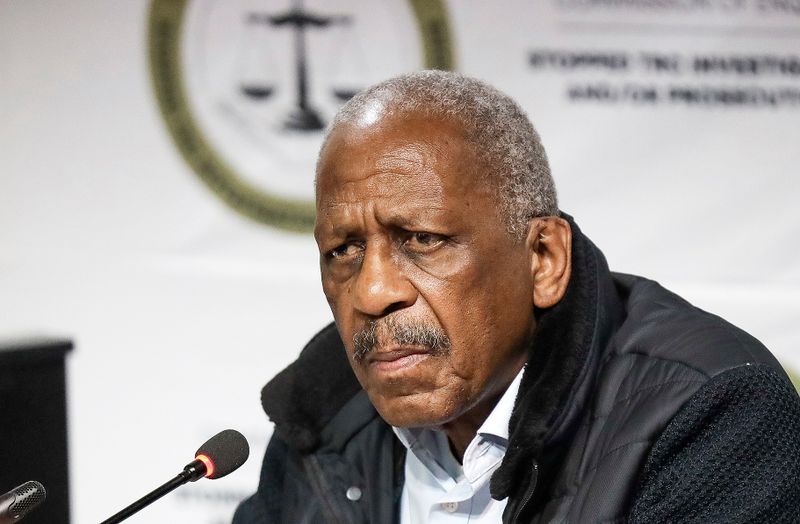
At the Khampepe Commission of Inquiry into delayed TRC prosecutions veteran ANC stalwart, Dr Mathews Phosa, said he had been “disappointed” to learn that former President Thabo Mbeki had attempted to delay testifying.Phosa, now 74, holds the earliest and most significant chunk of history about the earliest negotiations between the former apartheid state and the African National Congress (ANC) in the 1990s when issues of human rights abuses and amnesty were discussed. Phosa was there in the room when Vlakplaas commander Dirk Coetzee defected to the ANC, went into exile, dug up all the graves, gave up all the arms caches and let the dark secrets out of the cave. Phosa testified on day 95 of the Khampepe Commission on 2 October and brought with him deeper context of early negotiations between the liberation movement he served and the Nationalist government.The second inauguration of former South African president Thabo Mbeki, pictured with former president Nelson Mandela, on 27 April 2004. (Photo: Gallo Images / Christiaan Kotze) Subpoena MbekiAsked whether any secret agreement had been reached between the last white government led by FW de Klerk and his military and police leadership and the ANC leadership, Phosa told the inquiry he had no knowledge of this.A previously classified memo, offered as evidence to the commission of FW de Klerk’s last cabinet meeting 48 hours before the historic elections on 27 April 1994, suggests an agreement was reached.Phosa’s proximity to the national leadership of the time, including then president Nelson Mandela and his deputy Thabo Mbeki as well as other senior ANC leaders had not, however, brought with it this knowledge.Phosa has an extensive history, first as a practising attorney and later working in the ANC underground and military intelligence. Asked by Khampepe evidence leader Advocate Ishmael Semenya whether a secret agreement had been conceived, Phosa replied: “If you ask me, I think you had a president called Mandela, right? Let’s not avoid the issue. He was the president and he had a deputy president called Mbeki.“Mandela, may his soul rest in peace, our father. He can’t testify here. Mbeki is there. He must come here and testify.“I was actually disappointed when I thought there was an attempt not to do so. And I’m very happy that we can be open now. And I’ll be pleased. Let’s see if we can come here to explain these things.“I would be pleased if you could subpoena him,” Phosa told the panel.Former minister of law and order, Adriaan Vlok, with former police commissioner, Johann van der Merwe, and Security Branch officers Gert Otto, Hermanus van Staden and Christoffel Smith after their trial at the high court relating to the attempted murder of Frank Chikane, on 17 August 2007. (Photo: Johnny Onverwacht / City Press / Gallo Images) Threat to ‘unleash’ mayhemPhosa said that while much of the focus of evidence at the Khampepe Inquiry had been from 2003 onwards, in other words post-TRC, the origin story of forgiveness, reconciliation, pre-1994 negotiations and issues of amnesty remained alive.Phosa was the legal head of 15 negotiators, including Mandela, Ruth Mompati, Cheryl Carolus, Jacob Zuma, Penuell Maduna and others, who operated as a collective but each had specialisations in the ANC. His was a pivotal role in the transition to democracy, including the secret negotiations he entered into after his undercover return in 1990 to South Africa in pre-Codesa discussions. He told the inquiry, however, that on the eve of the announcement of the country’s new interim Constitution in 1993 a “turning point’ had been reached. This was when General Krappies Engelbrecht, head of the South African Police’s counter-intelligence unit, raised the issue of blanket amnesty for “his men”.The interim Constitution paved the way for the Promotion of National Unity and Reconciliation Act, establishing a negotiated compromise where amnesty was not granted automatically or in bulk, but conditionally through individual applications requiring full disclosure.Phosa said he had assumed the “men” Engelbrecht referred to were former “askaris” (captured and tortured members of liberation movements) and members of Vlakplaas, the notorious, murderous, undercover police Security Branch headquarters outside Pretoria. The assassination squad was lead by Dirk Coetzee and Eugene de Kock. Vlakplaas hitman Dirk Coetzee. (Photo: Gallo Images / Oryx Media Archive) In the roomPhosa was, in fact, part of a team who led a seven-day interrogation of Coetzee – who defected to the ANC and fled into exile in 1989 – regarding the covert structures of military intelligence, the police and Vlakplaas.He described Coetzee as “very generous” in confessing to the full extent of the torture and murders committed, including a detailed, step-by-step account of how civil rights lawyer Griffiths Mxenge was brutally assassinated.So when Krappies Engelbrecht argued that these individuals needed to be granted a blanket amnesty and that if the ANC did not accede to this he would “let loose his men”, Phosa understood the gravity of the threat.The deadlockIt was close to midnight, Phosa recalled for the commission, “and this man is threatening us when we do not agree about amnesty. He is telling us he is going to let his men loose.” Phosa said that Mandela was called on the hotline, who in turn called FW de Klerk. Both leaders had agreed that these matters were best left to be resolved by a Truth and Reconciliation Commission, which was set up in 1996.“I think you need to have that context, because if you lose that, you do not understand exactly what were the different positionings on this matter of amnesty. “I took a stand very strongly that there is no way you can give amnesty without knowing what you are doing. And he threatened me, and I said: you dare not, goodbye. I left. That is what happened there,” he said.The butchers of VlakplaasDuring his testimony Phosa described a car journey after his return from exile in Mozambique 1990 when members of the security police picked him up at the airport. He said he had been briefed by Thabo Mbeki on what the priorities would be on arrival and during the talks.Mbeki had in fact purchased Phosa’s ticket via Botswana. One of the key ANC demands had been that hangings should be stopped. On arrival at then Jan Smuts Airport, Phosa noted that “I looked at this country and I said to myself this country is worth fighting for. I do not regret having left. If they kill me now when I land, it is fine,” he recalled.The first encounter was not a kumbaya moment as he viewed the security police as enemies. The security police were aware he had interrogated Coetzee and knew perhaps more than they did. Jacob Zuma, too, had returned from exile.“They were very obsessed with the fact that I probably know a lot. So in the car they made a sick joke about like ‘we are taking you to Vlakplaas’. And I wondered why did they make such a sick joke?”He had replied “okay you win”, which amused them. His escorts then took him to join Jacob Zuma and Penuell Maduna, which was where the underground negotiations for some sort of settlement began, he told the inquiry.ANC camps in exileOne of Phosa’s tasks at some point had been to visit ANC camps in exile gathering information with regard to criminal activity and human rights abuses.He said that he discovered that many of those being held captive by the ANC were being punished for minor infractions such as smoking dagga. He recommended to the National Executive Committee (NEC) that petty offenders be released, earning himself the nickname “a judge in prison” among the detainees.He said he focused his investigation on “serious crimes and security threats, uncovering how apartheid agents had infiltrated camps to poison cadres using household chemicals”. In one instance, he said, a detainee had confessed to having personally killed 35 people in Port Elizabeth.Phosa said he had been one of the writers of the ANC’s submission to the TRC “emphasising that the ANC acknowledged its own wrongdoing and was never an angel”. The late Archbishop Desmond Tutu. (Photo: EPA / Georg Hochmuth) Moral equivalenceThe panel heard also how when Archbishop Desmond Tutu officially opened the TRC, he had claimed “everybody is equal” before the commission. Phosa, then heading the ANC’s legal department, publicly pushed back, arguing that liberation fighters and apartheid perpetrators could not be equated. He asked: “How can I be equated to someone who wanted to kill me?... The one is a criminal, the one is a murderer.”Phosa addressed for the inquiry allegations from court filings and publications (such as those by author/journalist Michael Schmidt and Ole Bubenzer) that secret high-level meetings had occurred between 1998 and 2004 to shield SADF generals and ANC figures from prosecution.Phosa firmly denying this stating that he had never made any attempt to suppress or stop investigations or prosecutions of TRC cases, had not attended secret meetings mediated by German politician Jürgen Kögel or held dinners with SADF generals to negotiate extended amnesty post TRC.He had never been, he added, an “ANC lobbyist” pushing for protection from prosecution, noting that during the period in question (1997–2002) he was the premier of Mpumalanga and detached from national discussions. DM
TRC Roulette : Subpoena Thabo Mbeki, ANC stalwart Mathews Phosa urges TRC inquiry
Full Article
Original Source
Read the full article at Dailymaverick →KhanList aggregates and links to publicly available news content. We do not host full articles from third-party sources. Always verify important information with original sources.