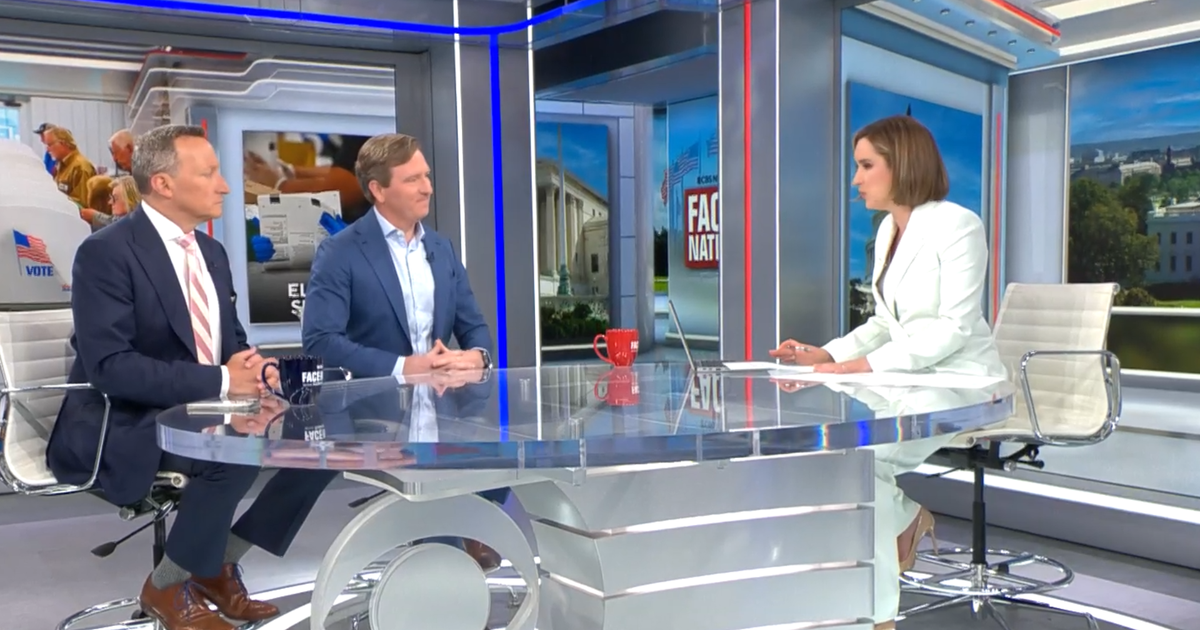
July 19, 2026 / 12:24 PM EDT / CBS News Add CBS News on Google The following is the transcript of an interview with CBS News contributors Chris Krebs and David Becker that aired on "Face the Nation with Margaret Brennan" on July 19, 2026.MARGARET BRENNAN: And for more on election security, we're joined now by CBS News contributors David Becker and Chris Krebs. Good to have you both here, because I want to download from both of you what we should be understanding about this past week. Chris, the President of the United States, Donald Trump, appointed you to run the Cybersecurity and Infrastructure Security Agency. That's CISA, that Senator Warner was just talking about to help states protect their election infrastructure during 2020. That was a secure election, you said the president fired you for saying that. This past Thursday, he again insisted it was not secure. Did you read- did you hear anything that changes your assessment?CBS NEWS CYBERSECURITY EXPERT AND ANALYST CHRIS KREBS: Not- not at all. In fact, I would say that it further bolsters my confidence in the security of the 2020 election between what has been released, disclosed last week, and all the information and the results of court challenges and other things in the intervening six years. Six years. But it's also, I think, a good opportunity to reflect on the good work that the millions of- hundreds of thousands, if not million or more, election workers that helped execute the 2020 election, the tens of thousands of federal government employees that worked to protect the 2020 election, that was not something that came together a couple weeks before 2020. That was years in the making, and that work was solid.MARGARET BRENNAN: Secretary Mullins said Friday he'll have a plan within 30 days. We are 100 days out from the midterms. KREBS: Yeah, and- and in 2020 we had our CISA election security plan out in February of 2020-- MARGARET BRENNAN: So just to- before we move on to the current day, just to put a fine point on this for you, Chris. So during his first few months in office, the president issued executive order against you, saying you promoted the censorship of election information, and he claimed you dismissed election malfeasance and serious vulnerabilities with voting machines. In intel-speak, what you saw, interference would be hacking, changing some of the language the president used in those on-camera remarks. What you saw- how would you describe the Chinese role in the 2020 election?KREBS: Well, I think there was an honest debate and discussion across the intelligence community about what China's intent were. But ultimately, when it came out in the intelligence community assessment that was released in the spring of 2021, it was that China had a preference, and that they were not in favor of President Trump, but their efforts were principally limited to influencing the American public, seeking to pay journalists, media. But it was an influence effort. MARGARET BRENNAN: I wouldn't [inaudible] journalists, if you're getting paid to tell a story, that's my own--KREBS: That's fair. But it was- it was an influence operation, and they have been doing that stuff since the mid aughts, the mid two- early 2000s This is not net new. They did turn up the heat, and they are still doing it today. We have a significant and serious counterintelligence and counterespionage problem with China, and that's what I really want to see us talking about. What are they doing today? We have to put more emphasis on that.MARGARET BRENNAN: Okay, here is exactly what President Trump said on Thursday about China.[START SOUND ON TAPE] PRESIDENT DONALD TRUMP: They did not disclose to me as president or to anyone else, and to the best of our knowledge, they did not inform Congress. In fact, all they kept saying is, "this is the most secure election in the history of our country" -- a standard, very pat line that was divvied out to say. [END SOUND ON TAPE]MARGARET BRENNAN: Was the president informed of what China was doing? You were in those rooms.KREBS: in January of 2020, there was a National Intelligence Committee- community memorandum about the 2020 election that talked about the vulnerabilities we saw on systems and the work we needed to do there, but it also talked about the intent of adversaries, and there were countless memos after that. So, you know, a lot of these products were in senior executive and policymakers' binders, their intelligence binders every single day. We use those to get out there and talk to the American people. I had an op-ed in September of 2020 to the general public that talked about various threat actors, including China. So, I have a hard time believing that it didn't get up into the Oval.MARGARET BRENNAN: Okay, as China was described as attempting to influence, it was Iran and Russia primary actors directly "undermining" the election in some of those 2020 statements. It sounds like you're saying he didn't read the memo.KREBS: Look, we could not have been more clear, is my view.MARGARET BRENNAN: Okay. CBS NEWS ELECTION LAW CONTRIBUTOR DAVID BECKER: Or search the web.MARGARET BRENNAN: Or search the web.KREBS: Right.MARGARET BRENNAN: We did report on it on this network. I know, I remember. David, I want to go to you because the president said a lot of things. One of the other elements this week was what the Justice Department put forward. Harmeet Dhillon there, sent a letter to states saying any election official who knowingly retains non-citizens on voter registration lists or facilitates non-citizens in casting ballots will be held criminally liable. And then DHS Secretary Mullin described here the consequence of refusing to participate in their program. Take a listen.[START SOUND ON TAPE]DHS SECRETARY MARKWAYNE MULLIN: If the election officials, once we gave them the information they need to secure their elections, and they chose not to, then those individuals can also be held accountable by fines, by penalties, and even, depending on how far it goes, prison time.[END SOUND ON TAPE] MARGARET BRENNAN: You speak to election officials. Are they concerned? That sounds like a threat.BECKER: Hardly a week goes by where someone in this administration doesn't threaten election officials with arrests. This- this week we had at least two prominent administration officials doing that. It's become almost a running joke. They've been into this administration 18 months now. The total number of election officials who've been arrested for wrongdoing is zero, and that's appropriate because not only have they committed no crime, they've actually acted heroically and patriotically to support and facilitate our democracy through a pandemic and after- in the aftermath with disinformation. What Secretary Mullin's talking about there, he's trying to pressure states to surrender sensitive voter data to the federal government, and the DOJ has filed over 30 lawsuits about that, and they are 0-16 in those lawsuits so far. He's threatening them with arrest for following the law, and so I think the election officials in the states feel very confident that they are following their state laws, they're following federal laws. They're doing everything they can to make sure this election is going to be safe, convenient, and secure.MARGARET BRENNAN: We are 107 or so days out from Nov. 3. What Secretary Mullin talked about as well is he said there's going to be a public plan in 30 days- stay tuned, but he wants them to use the Systematic Alien Verification for Entitlements program, the SAVE program, to screen for the citizenship of voters. How does- how does that work? For people at home who may say, 'sure, there's a law that says non-citizens cannot vote in federal elections,' they say, 'well, what's the problem with showing an ID?'BECKER: So the SAVE system is a federal system that takes data from federal sources. It's currently in legal limbo because there are some challenges over whether it's legal or not. And from the limited federal data that it has, it can then match it in some cases to data that states may choose to share with it. The problem is that DHS admits that data is incomplete. They don't have all of the data, so a lot of the individuals that they might flag are actually citizens. They just don't have the documentation in the federal database to back that up. The states actually have far better data. The states are doing a really good job with this, and the reason they have better data is because when you go into a motor vehicles agency and you get a license, particularly a real ID, you have to show proof of legal presence, and that data, what you've shown, what you've documentarily shown to a government official, is kept in that database. And so you see election officials in states like Georgia, which is, you know, run by Republicans, and states like Michigan, which are run by Democrats, and all across the country, able to do a better job of confirming that there are non-citizens on their voter lists than the federal government could ever do. And they've been in office for 18 months, and now they're talking about coming up with a plan in 30 days. MARGARET BRENNAN: Right.BECKER: And in that 18 months, they've only charged 39 people throughout the entire country with voting as non-citizens.MARGARET BRENNAN: Chris, we were checking for what election officials were saying after Thursday's revelations. Republican officials in West Virginia and in Utah say they have no outreach from the White House about direct election threats. They said, "You got them, bring them." Utah said they actually want the election security resources to be restored and to have the federal government stop filing frivolous, again, this is a quote, "lawsuits that consume our precious time and taxpayer resources." There are what, a thousand people who were cut from the agency you used to run? What should be happening to make sure that these officials have what they need? Because they said they do want some federal help. KREBS: Well, first off, exactly what Secretary Warner in West Virginia highlighted. If there is intelligence that needs to be shared with the states, get it to them. And typically, you share the intelligence with the affected parties prior to making a public announcement. So, if there was something net new in the Thursday night address that needed to get out to election officials, that should have gone out Wednesday or Thursday morning, and as of Friday, it had not, you know, trickled down to West Virginia. In 2020, we conducted 33 classified briefings with election officials, 2020, 33. As far as I can tell, there have been no classified briefings with election officials since the beginning of this administration. So, number one, we need to start the partnership and engagement with election officials, get them the intelligence they need. We need to recapitalize CISA, rehire CISA, stand up the election security initiative. We need FBI task forces. We need the DNI mission centers all around election security, and we need to give them the funding and the resources they need to modernize their security systems-- MARGARET BRENNAN: Yeah.KREBS: --and get the people there that conduct these safe, convenient, secure elections.MARGARET BRENNAN: And David, what are you hearing from the officials you speak with? It is the states that administer the elections, but what kind of federal help do they even want?BECKER: Well, remember, and Chris alluded to this. In the first few months of this administration, they dismantled all of the work that the first Trump administration under the leadership of Chris, had built, and the Biden administration continued. It took a long time to build trust and credibility and expertise, so that states would welcome federal assistance. That's not their normal sta- status, and they built that up admirably. And starting in February of 2025, almost on day one, they dismantled all of it. And so all of those things that- that Chris was talking about that are so essential to push back on foreign influence campaigns, they're gone. On the bright side, and this is a pretty limited bright side, the- that happened early in the administration. MARGARET BRENNAN: Yeah.BECKER: So the states have been able to prepare for that. They have been try- working and networking amongst themselves to fill that gap. And at the end of the day, they have paper ballots. They audit those paper ballots to make sure that they're counted properly. They've hardened their systems, their voter registration databases. It's going to be a secure election. MARGARET BRENNAN: Thank you, gentlemen. Both of you. We'll be right back. Stay with us.
Transcript: Chris Krebs and David Becker on "Face the Nation with Margaret Brennan," July 19, 2026
Full Article
📰 Original Source
Read full article at Cbsnews →KhanList aggregates and links to publicly available news content. We do not host full articles from third-party sources. Always verify important information with original sources.