
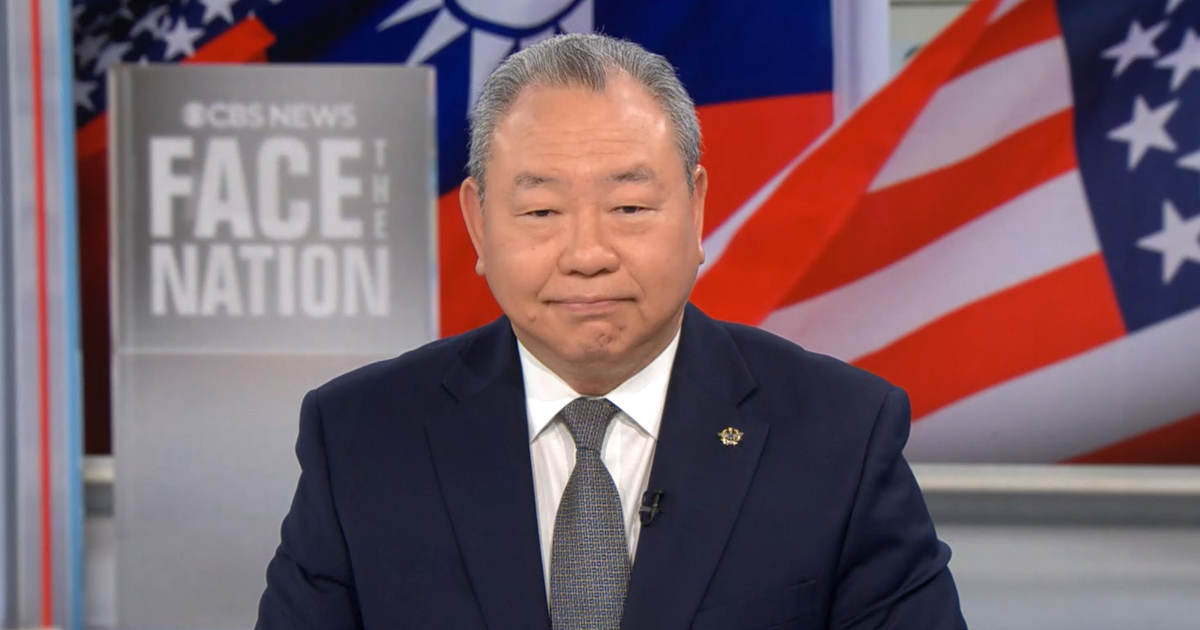
September 27, 2026 / 11:22 AM EDT / CBS News Add CBS News on Google The following is the transcript of the interview with Alexander Yui, Taiwan's representative to the U.S., that aired on "Face the Nation with Margaret Brennan" on Sept. 27, 2026.MARGARET BRENNAN: We're joined now by the Taiwan representative to the United States, Ambassador Alexander Yui. Good to have you back here. ALEXANDER YUI, TAIWAN REPRESENTATIVE TO THE UNITED STATES: Thank you. Nice to be back, Margaret.MARGARET BRENNAN: You were here in May after President Trump-- YUI: Yeah.MARGARET BRENNAN: --visited Beijing, and we discussed that the two leaders did, at length, discuss Taiwan-- YUI: Yes, they did. MARGARET BRENNAN: --according to President Trump at that time. When it came to this meeting, this past week, President Trump said Taiwan did come up with Xi, but, quote, "We didn't spend a lot of time talking about Taiwan." Do you have any sense what context there was? How Taiwan was discussed? Have you been given any readout?YUI: Well, I mean, you've heard many people comment, including President Trump, comment on the question of Taiwan. He made it clear himself that it was mentioned, but it was not the main topic of discussion. As a matter of fact, during the released statements by both sides on the deliverables or the achievements, Taiwan does not figure neither side of- of- of the- of the papers, so--MARGARET BRENNAN: China did say this issue was foundational.YUI: Well, it was foundational, but there was no reaction from the U.S. side. Which, I think, again during May, President or General Secretary Xi gave an earful of Taiwan to President Trump when he was in Beijing. But during this- this trip, the United States made it very clear that no change in position towards Taiwan, and I think they made it clear during and before and after the visit. Right before the visit, Secretary Rubio met with the foreign ministers of Japan and Korea in UNGA in New York, and they made it very clear that supported peace stability of the Taiwan Straits, no coercion, no status quo, and even supported Taiwan's meaningful participation in the- in the international organizations, as well as many other countries during UNGA, but so Taiwan is- there's no change in Taiwan's position for the United States. MARGARET BRENNAN: In May, President Trump said he wanted to speak with your president, President Lai. Did that call ever take place?YUI: Well, I'll say that the communications between the two sides, between Thai and the United States is open, is regular, and it's very, very close, at different levels, and I'll just leave it at that.MARGARET BRENNAN: But not at the presidential level-- YUI: Well, I--MARGARET BRENNAN: --which could be provocative to Xi Jinping.[CROSSTALK]YUI: Well, I'll just say that our communications are quite regular and quite open. MARGARET BRENNAN: I want to ask you about the state of play with Taiwan and the tension with Beijing. The unclassified U.S. intelligence community assessment says Chinese leaders do not currently plan to execute an invasion of Taiwan in 2027. But it also says Beijing will continue setting the conditions for eventual unification short of conflict. What do you need from the U.S. to deter Xi Jinping?YUI: Well, this comes back all the way to the- the mentions of United States President Xi- Donald Trump and the Secretary General of China Xi Jinping during their visits, during his visit, where both mentioned the- the historical factors between World War II or the war of Japanese invasion of China during the late '30s.MARGARET BRENNAN: Right.YUI: Which President Trump highlighted the historical actions, the heroic actions of United States flying tigers, but Secretary General Xi wanted to mention that it was- made a reference that it was the Chinese Communist Party that fought World War II or fought the Japanese--MARGARET BRENNAN: And that's not correct.YUI: That's not correct. Let me show you this. This is the Flying Tigers using our- our flag. This is our- our crest. This is the bloodshed by which every American pilot, when they flew on missions on the Flying Tigers, they wore on their- the back of their- of their jacket to show if they're down that- that people- Chinese people can help them.MARGARET BRENNAN: That's what that- those words say. YUI: Yeah, it says--MARGARET BRENNAN: If this pilot goes down--YUI: It says this–MARGARET BRENNAN: --he is an American.YUI: --foreigner is here to help us in the war effort, please help them.MARGARET BRENNAN: And the point you are making, as I understand it, is that the Chinese Communist Party was not running China during World War II. YUI: Well-- MARGARET BRENNAN: It was actually the very same party that--YUI: Exactly. MARGARET BRENNAN: --eventually left the mainland and set up a government in Taiwan. YUI: The communist regime did not exist until 1949. During the war, they were guerrillas, barely having any skirmishes against Japanese, if any. But, and then after they became a People's Republic in '49, a few years afterwards they were fighting and killing American soldiers in the Korean War. So let's- let's- let's put that into perspective. MARGARET BRENNAN: Was that offensive to people in Taiwan when they heard the president of the United States not correct--YUI: No, no--MARGARET BRENNAN: --Xi Jinping, but accept that claim? YUI: President Trump was correct in saying that the- the Chinese and the Americans fought valiantly in the war, but that was- in the context that it was the- the Republic of China-- MARGARET BRENNAN: Right.YUI: --government fighting alongside the--MARGARET BRENNAN: --not the government led by-- YUI: Not the- not Xi Jinping. But also the perspective that that now because of that is making reference that China United States has to fight the new militarism implying Japan and other countries for example the Philippines-- MARGARET BRENNAN: Right.YUI: --or even Taiwan being aggressive that therefore there's we should- that United States shouldn't sell arms to Taiwan or-- MARGARET BRENNAN: Except--YUI: --and that's- that's- that's- that's messing, you know, again twisting the facts because it is the People's Republic of China who is being the aggressor. They're the ones who are creating all these tensions in the region, the first talent chain in the Asia Pacific. And now Japan is after- currently they're not the aggressors.MARGARET BRENNAN: Right.YUI: And their the- and then P- PRC is trying to drive a wedge between United States and its partners--MARGARET BRENNAN: Yeah.YUI: --and allies, which is Japan and--MARGARET BRENNAN: But to bring you back-- YUI: --and Taiwan.MARGARET BRENNAN: --to where we started here. What does Taiwan need from the United States? Because one of the things that President Trump referred to as a bargaining chip was this $14 billion weapons package-- YUI: Exactly.MARGARET BRENNAN: --that still has not been delivered to your country-- YUI: Well--MARGARET BRENNAN: --despite initial indications it would be.YUI: Well, it's just not this purchase or this sale. Actually, it's peace through strength is- is the best way to avoid any conflict. The- the- the notion that China will not attack Taiwan is on the basis that Taiwan is strong-- MARGARET BRENNAN: Right. YUI: --is- is, you know, that we are- we're well prepared to fence any- fence off against any Chinese aggression.MARGARET BRENNAN: And there's more than a billion dollars in additional aid that we heard Republican senators-- YUI: Yes.MARGARET BRENNAN: --including Tillis, Murkowski, McConnell, and Cornyn, say they want to know why the Trump administration is not delivering it.YUI: Exactly. Therefore, we want to share our burden of defense, our- share our burden of doing better at being better defended ourselves, and therefore we need- and we're increasing our defense budget, and we need to procure arms as necessary. The United States has been our main supplier of selling weapons to Taiwan. We hope that we can get that weapons in- in- in as soon as possible.MARGARET BRENNAN: Taiwan is also a huge supplier of computer chips to the rest of the world, 90% of the highest level computer chips. And Mike Gallagher, the former congressman who helped set up the Select Committee on the Chinese Communist Party, wrote an op-ed in the journal arguing the biggest threat to humanity is not rogue AI, but rather AI controlled by China. He refers to Taiwan as the single point of failure in the most important technology the Communist Party wants to dominate. How do you shore up defense of those critical industries? YUI: Well, that's- that's why Taiwan matters to United States and to the world. It's not just on the security side, which is part of the first island chain in Asia Pacific, but also Taiwan has been the relevant partner in terms of technology, in terms of semiconductor, especially. And United States is creating this huge wave of artificial intelligence development, you know, now superintelligence, this huge wave, and Taiwan is the one making the surfboards, you know-- MARGARET BRENNAN: Yeah.YUI: --the semiconductors, the- the AI stacks, the servers that- that people will ride on this huge wave. So it's interdependency symbiotic relationship between United States-Taiwan, and that makes Taiwan very relevant, and why it should be protected.MARGARET BRENNAN: Ambassador, thank you for coming on and explaining the centrality of Taiwan to all of this. We'll be back in a moment.YUI: Thank you very much.
Transcript: Alexander Yui, Taiwan's representative to the U.S., on "Face the Nation with Margaret Brennan," Sept. 27, 2026
Full Article
Original Source
Read the full article at Cbsnews →KhanList aggregates and links to publicly available news content. We do not host full articles from third-party sources. Always verify important information with original sources.