
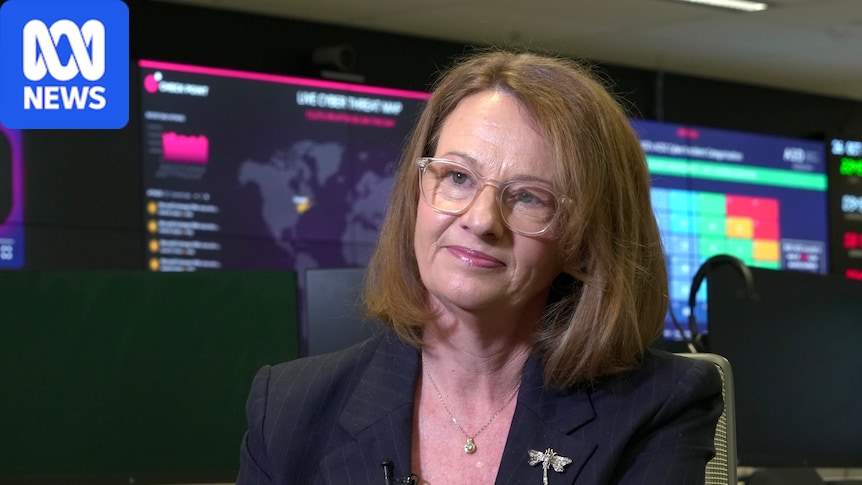
Australia's top cyber spy is warning the country to prepare for more frequent disruptions to everyday services amid a surge of AI-powered cyber attacks.Australian Signals Directorate (ASD) director-general Abigail Bradshaw says artificial intelligence frontier models have "redefined" the threat facing Australia."What is inevitable is that with each capability increase, we are likely to see more disruption," she said."Disruption can look like what we've seen over the last few weeks, with websites that require patching having to be taken down in order to be secured."Disruption could look like data breaches. Disruption could look like service disruption."Virtually any service that you rely on in your life today is enabled in some respect by a digital network."The warning comes just days after a number of government websites, including the ASD's, were brought partially offline after vulnerabilities were found.Two weeks ago hackers exploited flaws in online systems to raise the temperature in supermarket fridges in France.Today the ASD is publishing its annual cyber threat report, which details a 20 per cent jump in cyber security incidents the agency was required to respond to last financial year.But Ms Bradshaw said the defining event of the past year was the release of frontier models such as Anthropic's Mythos.Models like Mythos were touted as being too dangerous to release publicly due to their capability to find vulnerabilities in cyber defence systems.A swarm of AI agents was responsible for breaching Australian health data security, in what was described as the first autonomous hack of a government website.Ms Bradshaw said that incident had led to a reworking of the relationship between agencies such as the ASD and the massive American companies at the forefront of the technology.She said the ASD had worked "very quickly" to set up protocols to act as an "early warning system" with AI companies, including OpenAI."These protocols have been shared with all of the labs, and all of the Five Eyes [intelligence agencies]," she said."We now have an equal expectation about the sorts of things that agencies like ASD need to be engaged on ahead of model testing."Dismantling dark web operatorsResponding to cyber incidents makes up a large portion of the ASD's work, but the agency is also keen to talk up the success of its offensive operations.It revealed details of a recent effort to take down criminal groups selling and operating a piece of malware known as Amadey.Hidden inside free software, Amadey steals the personal data or login details of its victims and transmits it back to criminal groups, where it is then sold on the dark web.The ASD said in one case it was found hidden in a free, illegitimate version of Photoshop editing software.It also found evidence of the software being sold on the dark web for about $US500.ASD has found malicious software being sold on the dark web. (Supplied: Australian Signals Directorate)ASD operators were able to access the back end of Amadey's operation and found the criminal network had access to 180,000 computers across the globe, including in Australia."The next steps that we took were to disconnect that Amadey controller from all those victims," ASD acting deputy director-general of intelligence Tauri Gregory said."And so, effectively, that cyber criminal can no longer access those 180,000 computers and no longer steal data from all those people."If ASD had not acted here, you'd have 180,000 businesses or individuals whose data was being stolen and be either sold on the dark web or monetised in other ways, or used to inform follow-on crimes such as fraud and identity theft."Criminals used Amadey to access an enormous amount of data. (Supplied: Australian Signals Directorate)In another case the ASD was tipped off to the sale of 5 terabytes of data stolen from a business that was unaware it had been hacked.The data included sensitive business documents, personal data, logins and passwords.Mr Gregory said the agency was able to break in and destroy the data before it could be sold."To give some context, we think there are about 4.8 million files which were stolen from Australians, which we destroyed in that operation, as well as hundreds of thousands of files from other victims around the world," he said.Tauri Gregory says AI is a friend and a foe in the cybersecurity space. (ABC News: Mark Moore)Mr Gregory said AI was increasing the scope and scale of attacks, but it was also an enormous asset to those trying to defend against them."We are using AI to generate software capabilities much more quickly, and so we use it to support our software engineering and development of new tools and capabilities directly," he said.An accelerating threatThe agency has previously joined international partners in warning of Chinese-aligned actors building hidden networks of hijacked devices that can be used for espionage or offensive operations.It has also warned that some state actors want to maintain access to essential services and infrastructure that could be disrupted if conflict were to break out.Ms Bradshaw said strategic tensions in the region would increase that threat."The natural progression of this is, as the world becomes uncertain, of course nation states will try to reduce that uncertainty by obtaining more information," she said."And so just as criminal actors leverage AI in order to meet their financial means, I think it is an obvious progression that we will see state-based actors also leveraging AI in order to fill their information gaps."Ms Bradshaw said there was a huge amount of work to do in both corporate and government systems to better prepare for and defend against cyber threats, particularly in replacing vulnerable "legacy" systems.She said it also meant learning how to best use AI as a defensive tool."There is much more that we need to do and, in the current context, that is now a matter of urgency," Ms Bradshaw said.
Top cyber spy braces for more AI-powered hacking attacks
Full Article
Original Source
Read the full article at Abc →KhanList aggregates and links to publicly available news content. We do not host full articles from third-party sources. Always verify important information with original sources.